
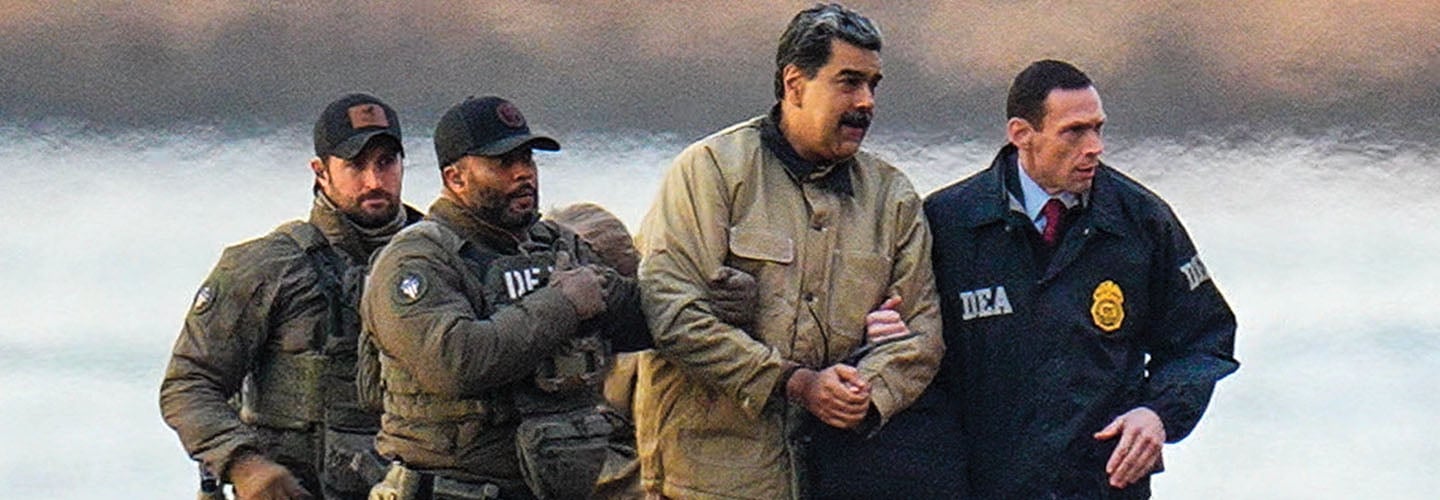

Federal agents escort Nicolás Maduro to court in New York. AFP via Getty Images

Standards

What’s Next for Venezuela?

In January, the United States military raided Venezuela and arrested its president. Here’s what you need to know.

The predawn mission stunned the world. On January 3, members of the United States Army’s elite Delta Force raided Venezuela’s capital, Caracas, and captured President Nicolás Maduro and his wife, Cilia Flores, from their compound. Soldiers whisked them to a U.S. warship stationed off the coast of Caracas before flying them to New York City, where they’re currently in jail facing drug trafficking and other charges.

Maduro’s seizure culminated a monthslong campaign by the Trump administration to oust the authoritarian socialist leader, whose repressive regime ruled Venezuela for 13 years. President Trump said in January that the U.S. would “run” Venezuela—a nation of 31 million people—indefinitely, “until such time that we can do a safe, proper, and judicious transition.”

The operation has raised many questions, including about the future of Venezuela’s government and the scale of American involvement in that nation’s affairs.

Here’s what you need to know to understand the situation.

The predawn mission shocked the world. On January 3, members of the United States Army’s elite Delta Force raided Venezuela’s capital, Caracas. They captured President Nicolás Maduro and his wife, Cilia Flores, from their compound. Soldiers quickly took them to a U.S. warship stationed off the coast of Caracas. Then they were flown to New York City and taken to jail. They are facing drug trafficking and other charges.

Maduro’s seizure concluded a monthslong campaign by the Trump administration to remove the authoritarian socialist leader. His repressive regime ruled Venezuela for 13 years. President Trump said in January that the U.S. would “run” Venezuela—a nation of 31 million people—indefinitely, “until such time that we can do a safe, proper, and judicious transition.”

The operation has raised many questions, including about the future of Venezuela’s government and the level of American involvement in that nation’s affairs.

Here’s what you need to know to understand the situation.

AFP via Getty Images

A military complex burns in Caracas

Why did President Trump order the capture of Venezuela’s president?

President Trump has said his goals were to protect Americans from illegal drugs coming from Venezuela and to reclaim U.S. oil interests there that were nationalized by the Venezuelan government in 2007.

The mission in Venezuela sits at the heart of two of Trump’s stated priorities: ushering in an era of U.S. “energy dominance” to cut costs for Americans and asserting U.S. influence over the Western Hemisphere.

Since returning to office last year, the Trump administration has attacked what it says were drug-smuggling boats off the coasts of  South America and Central America, imposed economic sanctions on the president of Colombia and a judge in Brazil, and attempted to influence elections in the region. Many observers have compared President Trump’s focus on establishing U.S. authority in Latin America to the Monroe Doctrine—a 19th-century foreign policy philosophy pushed by President James Monroe. Monroe sought to drive out European powers from the Western Hemisphere and shore up American dominance there. Today the main competitor is China, which has built up enormous political and economic power in the region and invested heavily in Venezuelan oil production.

President Trump has said his goals were to protect Americans from illegal drugs coming from Venezuela. He also wanted to reclaim U.S. oil interests there that were nationalized by the Venezuelan government in 2007.

The mission in Venezuela focuses on two of President Trump’s goals: helping the U.S. control energy to reduce prices and increasing American influence in the region.

Since returning to office last year, the Trump administration has attacked what it says were drug-smuggling boats off the coasts of South America and Central America. Economic sanctions have been imposed on the president of Colombia and a judge in Brazil. There have also been attempts to influence elections in the region.

Many observers have compared President Trump’s focus on establishing U.S. authority in Latin America to the Monroe Doctrine—a 19th-century foreign policy philosophy pushed by President James Monroe. Monroe sought to drive out European powers from the Western Hemisphere and strengthen American dominance there. Today the main competitor is China. The Chinese have built up enormous political and economic power in the region and invested heavily in Venezuelan oil production.

Jim McMahon

Trump believes “you can’t be the pre-eminent global power if you’re not the pre-eminent regional power,” says White House adviser Mauricio Claver-Carone.

Trump wants American oil companies, which helped develop Venezuela’s oil industry, to be able to extract and sell Venezuelan oil. He says such an arrangement will enrich both Americans and Venezuelans, who faced an economic crisis under Maduro’s rule.

Many energy analysts say that large-scale increases in Venezuela’s oil production could take many years and billions of dollars of investment.

Trump believes “you can’t be the pre-eminent global power if you’re not the pre-eminent regional power,” says White House adviser Mauricio Claver-Carone.

American oil companies helped develop Venezuela’s oil industry. Trump wants to be able to extract and sell Venezuelan oil. He says such an arrangement will benefit both Americans and Venezuelans, who faced an economic crisis under Maduro’s rule.

Many energy analysts say that large-scale increases in Venezuela’s oil production could take many years and billions of dollars of investment.

Jim Watson/AFP via Getty Images

President Trump, at a news conference after Maduro’s capture,  said the U.S. will “run” Venezuela for the foreseeable future.

Does the president have the authority to take those actions?

According to the U.S. Constitution, the president is commander in chief of the military, while only Congress has the power to declare war. The War Powers Resolution, passed by Congress in 1973, requires the president to notify Congress within 48 hours of military action and to end the deployment of armed forces within 60 days, unless Congress authorizes it.

President Trump says he didn’t alert Congress before the attack out of concern that the plans would leak to the public. Secretary of State Marco Rubio has described the mission as a “law enforcement operation,” which doesn’t require congressional oversight. In past decades, presidents from both parties—including George H.W. Bush, Barack Obama, and Joe Biden—have conducted military actions without prior congressional approval.

Views of the Venezuela mission have largely divided along ideological lines. Critics blasted it as unconstitutional, while recognizing that Maduro’s rule had harmed Venezuelans.

“The president of the United States does not have the right to unilaterally take this country to war,” says Independent Senator Bernie Sanders of Vermont, “even against a corrupt and brutal dictator like Maduro.”

But many Republicans have celebrated the mission and defended its legality.

“We are not at war,” says Republican House Speaker Mike Johnson of Louisiana. “We do not have U.S. armed forces in Venezuela, and we are not occupying that country.”

According to the U.S. Constitution, the president is commander in chief of the military. But only Congress has the power to declare war. The War Powers Resolution, passed by Congress in 1973, requires the president to notify Congress within 48 hours of military action. The deployment of armed forces has to end within 60 days, unless Congress authorizes it.

President Trump says he didn’t alert Congress before the attack out of concern that the plans would leak to the public. Secretary of State Marco Rubio has described the mission as a “law enforcement operation,” which doesn’t require congressional oversight. In past decades, presidents from both parties—including George H.W. Bush, Barack Obama, and Joe Biden—have conducted military actions without prior congressional approval.

Views of the Venezuela mission have largely divided along ideological lines. Critics view it as unconstitutional, while recognizing that Maduro’s rule had harmed Venezuelans.

“The president of the United States does not have the right to unilaterally take this country to war,” says Independent Senator Bernie Sanders of Vermont, “even against a corrupt and brutal dictator like Maduro.”

But many Republicans have celebrated the mission and defended its legality.

“We are not at war,” says Republican House Speaker Mike Johnson of Louisiana. “We do not have U.S. armed forces in Venezuela, and we are not occupying that country.”

Leonardo Fernandez Viloria/Reuters

Delcy Rodríguez, Maduro’s former vice president, is serving as Venezuela’s interim leader. As of press time, she was cooperating with the U.S. while also condemning its military action.

How have Venezuelans reacted?

Maduro’s removal has led to deep uncertainty among Venezuelans. While a majority voted against him in the 2024 election—which the U.S. and many other nations said Maduro illegally stole—many now worry about the country’s ability to achieve political and economic stability.

“It’s bittersweet,” says José, a Venezuelan entrepreneur based in Mexico who hopes to return to his home country. He withheld his last name, fearing retaliation from the Venezuelan government. “The first thing on my mind isn’t, ‘We are free and I’m so happy,’” he says. “It is, ‘What will happen tomorrow?’”

Despite Maduro’s capture, his government largely remains intact, with his vice president, Delcy Rodríguez, serving as interim leader. As of press time, she had cooperated with the U.S., while also condemning the mission.

“The government of Venezuela runs our country,” Rodríguez said in a January speech. “No one else.”

Reactions among Venezuelans in the U.S. too have ranged from jubilation to fear of what will happen to them and their country. Eight million Venezuelans have fled their nation amid the social and economic turmoil of Maduro’s regime. As of June 2025, about 1.1 million had sought refuge in the U.S. They worry about what recent developments could mean for their immigration status. Soon after taking office, Trump ended protected status for Venezuelan immigrants like Rose Ramírez, who is seeking asylum.*

“If I had to . . . describe this moment, I would say it’s one of great joy and hope that we will have a more prosperous country,” she says. But she expects her immigration situation to remain in limbo.

Maduro’s removal has led to deep uncertainty among Venezuelans. A majority voted against him in the 2024 election. (The U.S. and many other nations said Maduro illegally stole the election.) Many now worry about the country’s ability to achieve political and economic stability.

“It’s bittersweet,” says José, a Venezuelan entrepreneur based in Mexico who hopes to return to his home country. He withheld his last name, fearing retaliation from the Venezuelan government. “The first thing on my mind isn’t, ‘We are free and I’m so happy,’” he says. “It is, ‘What will happen tomorrow?’”

Despite Maduro’s capture, his government largely remains intact. The vice president, Delcy Rodríguez, is serving as interim leader. As of press time, she had cooperated with the U.S., while also condemning the mission.

“The government of Venezuela runs our country,” Rodríguez said in a January speech. “No one else.”

Venezuelans living in the U.S. have had mixed reactions, ranging from happiness to fear of what will happen to them and their country. Eight million people have left Venezuela because of economic and social problems under Maduro. By June 2025, 1.1 million Venezuelans had come to the U.S. Many now worry about their immigration status, especially after Trump ended protected status for some Venezuelan immigrants, including people seeking asylum* like Rose Ramírez.

“If I had to . . . describe this moment, I would say it’s one of great joy and hope that we will have a more prosperous country,” she says. But she expects her immigration situation to remain in limbo.

AFP via Getty Images

Maduro supporters rally in Caracas

What happens next?

President Trump has said that the U.S. will oversee Venezuela for the foreseeable future, including the sale of its vast oil reserves, which are the largest in the world.

“We’re going to rebuild the oil infrastructure,” Trump said in the hours after Maduro’s capture. “We’re going to run it properly and make sure the people of Venezuela are taken care of.”

The White House said that a team of officials including Secretary of State Rubio and Vice President JD Vance was determining Venezuelan policy. But many foreign policy experts are skeptical that the U.S. will be able to rebuild the oil sector or that life for Venezuelans will meaningfully improve without a democratic government in place there.

“What you have is the Maduro regime without Maduro,” says Roxanna Vigil,
a fellow at the Council on Foreign Relations. “A good scenario would be if we hear the Trump administration talk about a policy that prioritizes a transition to democracy.”

President Trump has said that the U.S. will oversee Venezuela for the foreseeable future, including the sale of the largest oil reserves in the world.

“We’re going to rebuild the oil infrastructure,” Trump said in the hours after Maduro’s capture. “We’re going to run it properly and make sure the people of Venezuela are taken care of.”

The White House said that a team of officials including Secretary of State Rubio and Vice President JD Vance was determining Venezuelan policy. But many foreign policy experts doubt that the U.S. will be able to rebuild the oil sector or that life for Venezuelans will improve without a democratic government in place there.

“What you have is the Maduro regime without Maduro,” says Roxanna Vigil, a fellow at the Council on Foreign Relations. “A good scenario would be if we hear the Trump administration talk about a policy that prioritizes a transition to democracy.”

Despite Maduro’s capture, his government remains largely intact.

Meanwhile, Maduro is being held in a Brooklyn jail. Among other things, his indictment states that Maduro and his allies, including his wife, worked for decades with major drug trafficking groups to move large quantities of cocaine to the U.S.

“I am innocent,” Maduro told a judge at his arraignment in January. “I am a decent man, the constitutional president of my country.” He has pleaded not guilty. His next hearing is scheduled for March.

Meanwhile, Maduro is being held in a Brooklyn, New York, jail. His indictment includes that Maduro and his allies, including his wife, worked for decades with major drug trafficking groups to move large quantities of cocaine to the U.S.

“I am innocent,” Maduro told a judge at his arraignment in January. “I am a decent man, the constitutional president of my country.” He has pleaded not guilty. His next hearing is scheduled for March.

Nicole Combeau/Bloomberg via Getty Images (Doral); Jacek Boczarski/Anadolu via Getty Images (Chicago)

Venezuelans in Doral, Florida, celebrate Maduro’s capture (left); in Chicago, protesters criticize the U.S. raid (right).

What does the U.S. action mean for the rest of the world?

Since Maduro’s capture, many around the globe have wondered what the U.S. action signals to Russia and China. Both nations now risk losing ground in Venezuela, after years of heavy investment and support of the Maduro government.

Officially, Russia and China have joined some American allies, including France and Mexico, in condemning the U.S. move as a violation of international law.

Still, some experts see the Venezuelan mission as a potent deterrent to authoritarian regimes around the world.

“The president has committed to a doctrine of peace through strength,” Richard Goldberg, a senior advisor at the Foundation for Defense of Democracies told The Boston Globe. “He’s trying to restore deterrence against our greatest adversaries . . .to ensure there’s no great war this century.”

Others worry that the mission could ultimately help Russia and China justify their aggressive approaches to claiming Ukraine and Taiwan as their own.

The assault on Caracas “does further erode the norms against great power use of force that have steadily weakened in the last two decades, which works just fine for Beijing,” says Rush Doshi, a China expert at Georgetown University. “More important, if it distracts the United States by tying us up in Venezuela, all the better for Beijing too.”

Since Maduro’s capture, many around the globe have wondered what the U.S. action signals to Russia and China. Both nations have invested heavily there and supported the Maduro government.

Officially, Russia and China have joined some American allies, including France and Mexico, in condemning the U.S. move as a violation of international law.

Still, some experts see the Venezuelan mission as a way to discourage authoritarian regimes around the world.

“The president has committed to a doctrine of peace through strength,” Richard Goldberg, a senior advisor at the Foundation for Defense of Democracies told The Boston Globe. “He’s trying to restore deterrence against our greatest adversaries . . . to ensure there’s no great war this century.”

Others worry that the mission could ultimately help Russia and China justify their aggressive approaches to claiming Ukraine and Taiwan as their own.

The assault on Caracas “does further erode the norms against great power use of force that have steadily weakened in the last two decades, which works just fine for Beijing,” says Rush Doshi, a China expert at Georgetown University. “More important, if it distracts the United States by tying us up in Venezuela, all the better for Beijing too.”

The War Powers Resolution
The legislation was passed by Congress in 1973 to limit a president’s ability to unilaterally decide to deploy troops.

*Protection granted by a nation to someone who fears persecution or harm in their home country

*Protection granted by a nation to someone who fears persecution or harm in their home country

With reporting by Jack Nicas, Rebecca F. Elliott, Maria Abi-Habib, Jazmine Ulloa, David Pierson, and Edward Wong of The New York Times.

With reporting by Jack Nicas, Rebecca F. Elliott, Maria Abi-Habib, Jazmine Ulloa, David Pierson, and Edward Wong of The New York Times.

AT A GLANCE

Venezuela

Population

31 million 

(U.S.: 342 million)

Per Capita GDP

$7,700

(U.S.: $74,600)

Unemployment Rate

5.5%

(U.S.: 4.2%)

Source: The World Facebook (C.I.A.)

Source: The World Facebook (C.I.A.)

videos (1)
Skills Sheets (3)
Skills Sheets (3)
Skills Sheets (3)
Leveled Articles (1)
Text-to-Speech