

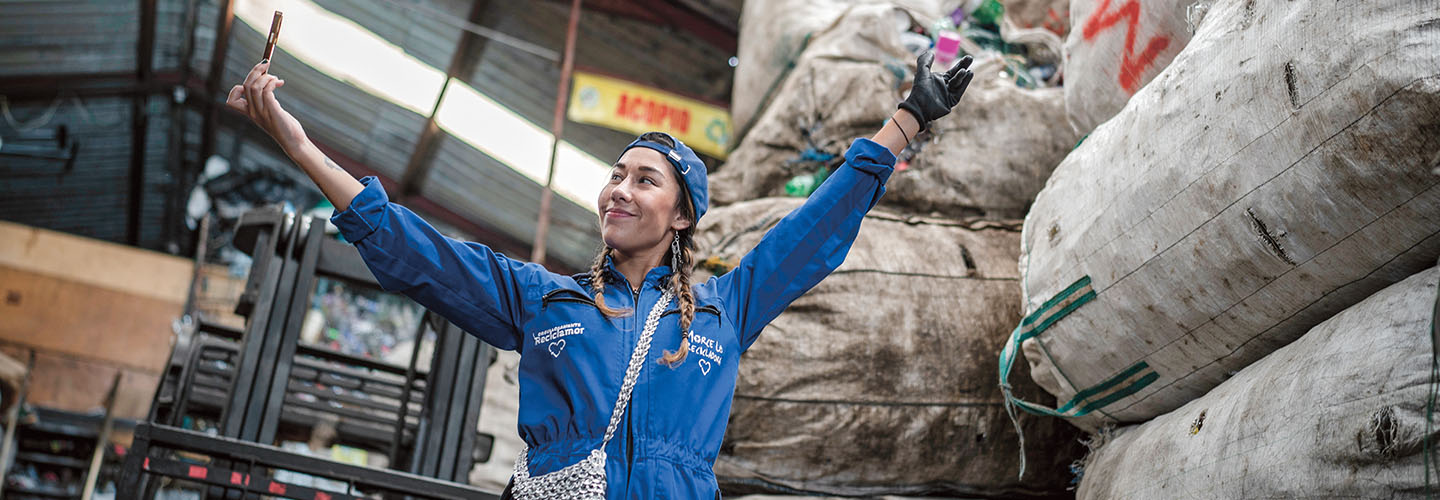

A woman in blue work uniform raises her arms in celebration beside large recycling bags

Sara Samaniego, in character as Marce the Recycler, records a video for social media. Nathalia Angarita/The New York Times

Standards

The Adventures of Marce the Recycler

How one Colombian influencer made recycling cool

Sara Samaniego stands in a warehouse filled with plastic, glass, and newspapers, lip-synching to a rap song while wearing her trademark blue jumpsuit and braids.

Samaniego is filming a video for the hundreds of thousands of followers she has amassed across Instagram, TikTok, and YouTube. She has won international awards, collaborated with celebrities, and regularly gets stopped on the street for photographs.

The topic that has earned her so much popularity? Recycling.

With her colorful aesthetic and peppy persona, Samaniego, 33, brands herself as Latin America’s first recycling influencer, attracting a passionate fan base in Colombia’s capital, Bogotá. She educates followers on how to clean and sort their garbage through her character, Marce the Recycler.

Sara Samaniego stands in a warehouse filled with plastic, glass, and newspapers. She is lip-synching to a rap song while wearing her trademark blue jumpsuit and braids.

Samaniego is filming a video for the hundreds of thousands of followers she has across Instagram, TikTok, and YouTube. She has won international awards and collaborated with celebrities. Fans regularly stop her on the street for photographs.

What topic has made her so popular? Recycling.

With her colorful and peppy personality, Samaniego, 33, brands herself as Latin America’s first recycling influencer. She has attracted a passionate fan base in Colombia’s capital, Bogotá. Samaniego created a character called Marce the Recycler. She educates followers on how to clean and sort their garbage.

Hundreds of thousands of followers watch Samaniego’s videos.

Her work has also drawn attention to the often overlooked community of informal recyclers who eke out a living redeeming recyclables. Bogotá, like many cities in the developing world, has no government service for collecting items on a set schedule. Instead, it relies on about 26,000 informal recyclers, according to Consuelo Ordóñez, director of the city’s public utilities authority.

Families traverse streets digging through garbage left outside homes and businesses, searching for glass, cardboard, and plastic. They load recyclables onto huge wheeled carts that they drag to recycling organizations or private warehouses where they redeem their haul (see “Informal Recyclers,” below). The waste is eventually converted back into raw materials and made into new products. Collecting recyclables is grueling, backbreaking work that earns about $35 a week—half the country’s minimum wage.

Samaniego’s widely seen videos have helped recyclers by encouraging viewers to clean items properly so that more can be redeemed.

“The majority with whom I have spoken, they are mothers, heads of families, fathers,” Samaniego says. “They make an effort every day and work really hard.”

Her work has also drawn attention to the often overlooked community of informal recyclers who make a small living redeeming recyclables. Bogotá, like many cities in the developing world, has no government service for collecting items on a set schedule. Instead, it relies on about 26,000 informal recyclers, according to Consuelo Ordóñez, director of the city’s public utilities authority.

Families walk streets digging through garbage left outside homes and businesses. They search for glass, cardboard, and plastic. They load the recyclables onto huge, wheeled carts that they pull to recycling organizations or private warehouses. The recyclers are given money for their haul (see “Informal Recyclers,” below). The waste is eventually converted back into raw materials and made into new products. Collecting recyclables is hard, backbreaking work that earns about $35 a week—half the country’s minimum wage.

Samaniego’s popular videos have helped recyclers by encouraging viewers to clean items properly so that more can be redeemed.

“The majority with whom I have spoken, they are mothers, heads of families, fathers,” Samaniego says. “They make an effort every day and work really hard.”

Shutterstock.com (phone); via Instagram (post)

‘A YouTuber Recycler’

Many of Samaniego’s videos seek to humanize a class of workers that’s largely invisible or looked upon with disdain. One video, for example, features recyclers talking about common assumptions people make about them, including that they use drugs or want to rob people.

She has also tried to use her renown to provide financial aid. During the Covid-19 pandemic, Samaniego raised funds to donate food to informal recyclers, an experience that led her to create a nonprofit that helps provide health care and other services.

Milena Cantor, 47, has been a recycler since she was 8 and is proud of work she believes helps the environment, despite the financial hurdles. When her son suffered an injury that caused him to have seizures, Cantor says Samaniego released a video to raise funds for his medications.

“Marce is a very special girl,” she says.

Samaniego’s interest in recycling started as a child. Her family vacationed in the countryside, which had no garbage collection, so they’d burn their trash—a common practice in developing nations. The black smoke wafting up into the air shocked her.

Years later, after college, Samaniego started a digital marketing agency and would often chat with recyclers outside her office, asking how she should wash and sort materials.

Then one day, she was watching a viral video on YouTube when she happened to look out her window and see a recycler rifling through the trash. It was her eureka moment.

“The two ideas came together,” she says. “We need a YouTuber recycler!”

Many of Samaniego’s videos seek to humanize a class of workers that’s largely invisible or looked down upon. One video features recyclers talking about common mistakes people make about them, including that they use drugs or want to rob people.

She has also tried to use her fame to provide financial aid. During the Covid-19 pandemic, Samaniego raised funds to donate food to informal recyclers. The experience led her to create a nonprofit that helps provide health care and other services.

Milena Cantor, 47, has been a recycler since she was 8 and is proud of her work, despite the financial hurdles. She believes that it helps the environment. Her son suffered an injury that caused him to have seizures.  Cantor says Samaniego released a video to help raise funds for his medications.

“Marce is a very special girl,” she says.

Samaniego’s interest in recycling started as a child. Her family vacationed in the countryside that had no garbage collection. They had to burn their trash—a common practice in developing nations. The black smoke blowing up into the air shocked her.

After college, Samaniego started a digital marketing agency. She would often chat with recyclers outside her office, asking how she should wash and sort materials.

Then one day, she was watching a viral video on YouTube when she happened to look out her window. She saw a recycler looking through the trash. It was her eureka moment.

“The two ideas came together,” she says. “We need a YouTuber recycler!”

The Problem With Plastics
How single-use plastics affect the lives of both animals and people

Creating a Character

Samaniego dedicated herself to researching her new role. For three months, she accompanied recyclers, peppering them with questions.

That’s how she created the character of Marcela, or Marce for short, complete with a backstory modeled on the people she had spent time with: Marce has been a recycler since she was a little girl, just like her parents. She lives with her boyfriend, Hernando. She’s friendly, family-oriented, and hardworking.

In May 2019, Samaniego uploaded her first video, teaching viewers which items to put in white trash bags (recyclables) and which to put in black ones (nonrecyclables). Her YouTube channel quickly took off, and soon she was fielding calls from local media.

Blanca Usa, who has sorted recyclables at a warehouse for nine years, says items arrive much cleaner than they once did, an improvement she attributes to Samaniego.

And Gina Villabon, a teacher who uses the videos, credits Marce with helping younger generations become interested in caring for the planet.

“She was our inspiration,” Villabon says. “The children know the color code very well, and at home, they are making an effort to separate the garbage. And we have learned that from Marce.”

Samaniego dedicated herself to researching her new role. For three months, she accompanied recyclers, asking them questions.

That’s how she created the character of Marcela, or Marce for short. She created a backstory modeled on the people she had met. Marce has been a recycler since she was a little girl, just like her parents. She lives with her boyfriend, Hernando. She’s friendly, family-oriented, and hardworking.

In May 2019, Samaniego uploaded her first video. She taught viewers which items to put in white trash bags (recyclables) and which to put in black ones (nonrecyclables). Her YouTube channel quickly took off. Soon she was answering calls from local media.

Blanca Usa, who has sorted recyclables at a warehouse for nine years, says items arrive much cleaner than they once did, an improvement she attributes to Samaniego.

And Gina Villabon, a teacher who uses the videos, credits Marce with helping young people become interested in caring for the planet.

“She was our inspiration,” Villabon says. “The children know the color code very well, and at home, they are making an effort to separate the garbage. And we have learned that from Marce.”

Genevieve Glatsky covers Latin America for The New York Times.

Genevieve Glatsky covers Latin America for The New York Times.

Nathalia Angarita/The New York Times

Redeeming recyclables for cash at a warehouse in Bogotá, Colombia

Informal Recyclers

These workers play a key role in waste management

Cities all over the world rely on informal recyclers to collect plastic, glass, and other materials from the trash and bring them to recycling centers for cash. These workers help clean up streets and parks while keeping recyclable items from ending up in landfills. There are an estimated 24 million informal waste collectors around the globe, according to Cities Alliance, an organization which fights urban poverty worldwide. Although this line of work is especially common in developing countries, informal recyclers are also found in other nations, including the U.S. In New York City, for example, experts estimate that more than 10,000 people collect billions of recyclable items each year. For their efforts, they receive 5 cents per bottle or can.

—Chrisanne Grisé

Cities all over the world rely on informal recyclers to collect plastic, glass, and other materials from the trash and bring them to recycling centers for cash. These workers help clean up streets and parks while keeping recyclable items from ending up in landfills. There are an estimated 24 million informal waste collectors around the globe, according to Cities Alliance, an organization which fights urban poverty worldwide. Although this line of work is especially common in developing countries, informal recyclers are also found in other nations, including the U.S. In New York City, for example, experts estimate that more than 10,000 people collect billions of recyclable items each year. For their efforts, they receive 5 cents per bottle or can.

—Chrisanne Grisé

videos (1)
Skills Sheets (3)
Skills Sheets (3)
Skills Sheets (3)
Leveled Articles (1)
Text-to-Speech