

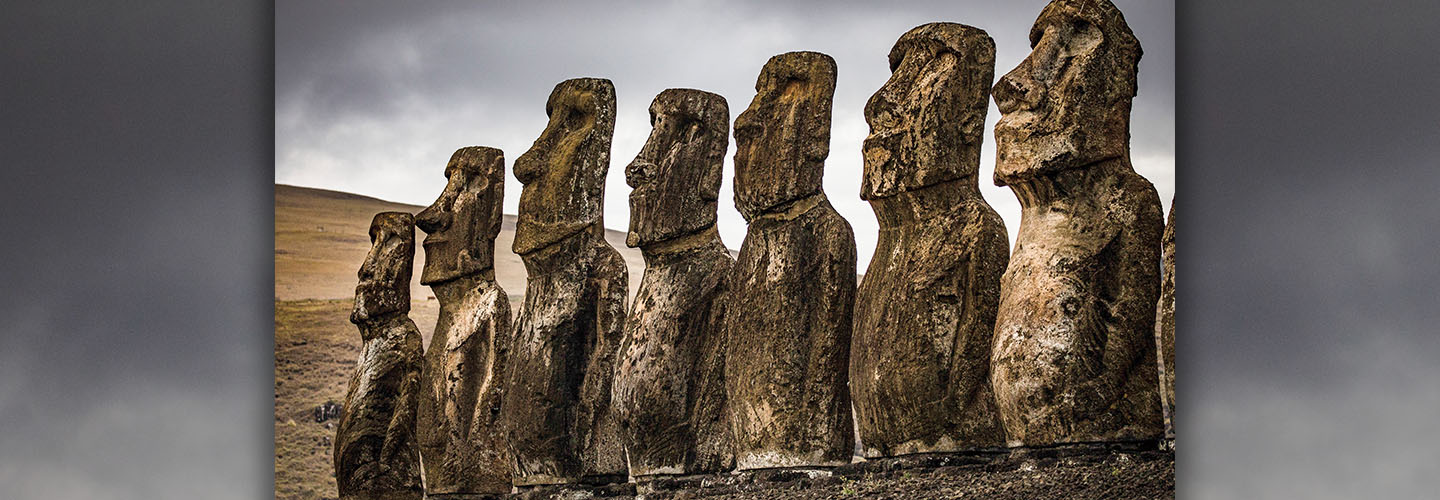
Easter Island—also known as Rapa Nui—is famous for its moai (MOH-eye), massive stone figures that are believed to represent worshipped ancestors. Roughly 950 moai have been discovered on the remote island, located in the South Pacific Ocean. Scientists believe that between 1200 a.d. and 1700 a.d., the stone statues were chiseled inside an extinct volcano and then transported as far as 11 miles across rugged terrain. But how? Scholars have a variety of theories, including that the people of Rapa Nui could have placed the moai—which weighed as much as 86 tons—on wooden sleds. But a recent study by Binghamton University and the University of Arizona offers another theory: They attached ropes to the heads of the moai and by tugging on them were able to shimmy the statues from side to side, gradually advancing them forward as if they were walking. However the statues made the journey, it was a monumental engineering feat, according to study co-author Carl Lipo. “It shows that the Rapa Nui people were incredibly smart,” he says. The research, he adds, “gives honor to those people, saying, look at what they were able to achieve, and we have a lot to learn from them in these principles.”
Back to Teacher View
Student View
Josh Haner/The New York Times

The Mysteries of Easter Island
Jim McMahon (globe); Carl Lipo (replica)
A crew of researchers attached ropes to a moai replica and were able to shimmy it across 328 feet in 40 minutes.
Text-to-Speech