
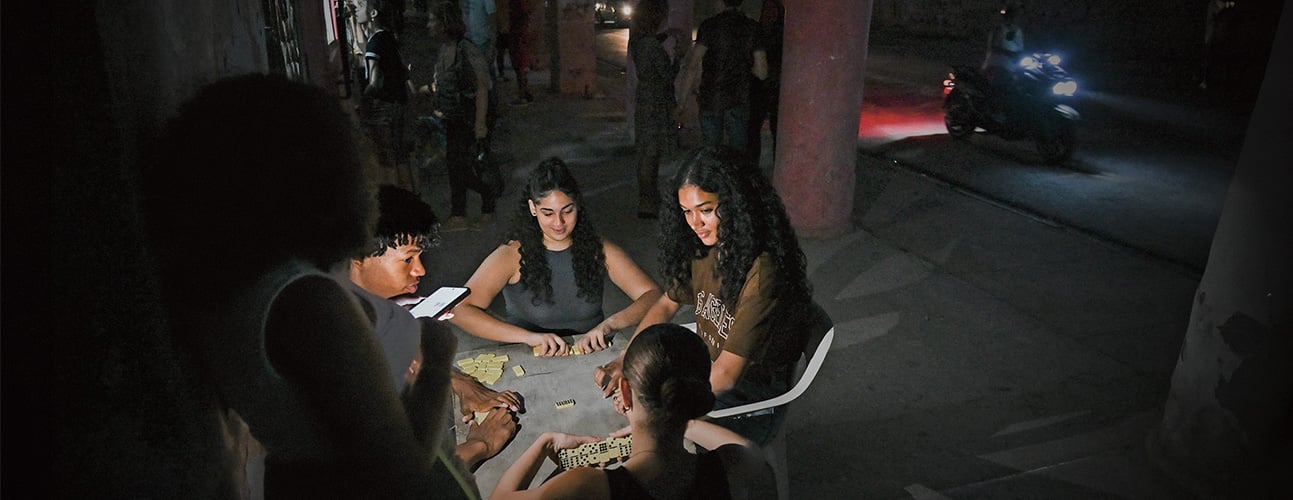

Four young people play dominoes around a table on a dark street at night while a motorcycle passes

Young people play dominoes during a blackout in Havana in February. Yamil Lage/AFP via Getty Images

Standards

Cuba Goes Dark

Cuba’s economy and school system were already in decline. Now a U.S. energy blockade is pushing the country to the brink of collapse.

Jim McMahon

Raúl Cabrera Oliva, 18, was trying to finish his final year at a high school in Artemisa, Cuba. But in February, with a nationwide fuel shortage leaving students stranded, the school shut its doors.

“No transportation, no school,” Oliva says.

Soon after, with Cuba’s government imposing blackouts to save energy, every school in the country closed. In May, the government decided to end the school year two weeks early and scrapped college entrance exams for high school seniors. Officials finally recognized that sleepless nights without electricity and a lack of school meals were exhausting students and teachers alike.

The energy shortage stems from an oil blockade the United States imposed in January. President Donald Trump signed an executive order threatening new tariffs on any nation that tried to deliver oil to Cuba, and the U.S. military has intercepted oil tankers bound for the island. The move was intended to pressure Cuba’s Communist government into making political and economic changes.

Raúl Cabrera Oliva, 18, was trying to finish his final year at a high school in Artemisa, Cuba. But in February, with a nationwide fuel shortage leaving students stranded, the school shut its doors.

“No transportation, no school,” Oliva says.

Soon after, the Cuban government starting imposing blackouts to save energy.  Every school in the country closed. In May, the government decided to end the school year two weeks early. It also scrapped college entrance exams for high school seniors. Officials finally recognized that sleepless nights without electricity and a lack of school meals were exhausting students and teachers alike.

The energy shortage stems from an oil blockade the United States imposed in January. President Donald Trump signed an executive order threatening new tariffs on any nation that tried to deliver oil to Cuba. The U.S. military has also intercepted oil tankers bound for the island. The move was intended to pressure Cuba’s Communist government into making political and economic changes.

Ramon Espinosa/AP Images

Getting by: Carrying a portable generator in Havana during a blackout

©Moe Zoyari/ZUMA Press Wire

Castro’s legacy: A classroom in Havana under the gaze of Fidel Castro

Since then, continuous blackouts and a lack of transportation have forced families out of work and plunged the country into its worst humanitarian crisis since the Cuban revolution nearly seven decades ago, which paved the way for Communist rule (see timeline slideshow, below).

The U.S. blockade has also exacerbated ongoing problems in Cuba’s educational system. Schools were already reeling from Hurricane Melissa in October 2025, which damaged hundreds of buildings. Textbooks, uniforms, and even pencils and paper have been in short supply. So have teachers: Over the past decade, some 26,000 of them have left the profession, many citing poor wages.

The current crisis coincides with growing social unrest. For years, the government has crushed political dissent as it has struggled to provide enough power, food, and basic services for its people. Those who can work barely survive on their income.

“It torments me,” says Adrián Silva Guerra, an electronics repairman in Santiago de Cuba. “When there’s no power, my mind starts to wander. I think about what I can sell to buy a packet of spaghetti.”

Since then, continuous blackouts and a lack of transportation have forced families out of work. The country is experiencing its worst humanitarian crisis since the Cuban revolution nearly seven decades ago, which paved the way for Communist rule (see timeline slideshow, below).

The U.S. blockade has also exacerbated ongoing problems in Cuba’s educational system. Schools were already reeling from Hurricane Melissa in October 2025. The storm destroyed hundreds of buildings. Textbooks, uniforms, and even pencils and paper have been in short supply. So have teachers: Over the past decade, some 26,000 of them have left the profession. Many cited poor wages as their reason for leaving.

The current crisis coincides with growing social unrest. For years, the government has crushed political dissent as it has struggled to provide enough power, food, and basic services for its people. Those who can work barely survive on their income.

“It torments me,” says Adrián Silva Guerra, an electronics repairman in Santiago de Cuba. “When there’s no power, my mind starts to wander. I think about what I can sell to buy a packet of spaghetti.”


Yamil LageAFP via Getty Images

Out of gas: Stalled cars have become a familiar sight in Cuba.

Renewed Tensions

The oil blockade is a return to the kinds of punitive measures the U.S. imposed on Cuba at the height of the Cold War (1947-91), when it opposed the regime of Fidel Castro. In the mid-1950s, Castro led a successful guerrilla war against Cuban dictator Fulgencio Batista. After seizing power in 1959, Castro solidified his own dictatorship and began transforming Cuba into the first Communist state in the Western Hemisphere.

Castro’s government took over private industry, including American-owned businesses, and became an ally of the Soviet Union. This led the U.S., in 1960, to levy the first of a series of trade embargoes, trying to starve Cuba of cash and spark popular resistance to Castro. Those embargoes stood for more than half a century.

Then in 2015, President Barack Obama took steps to normalize relations with the Cuban government under Raúl Castro, Fidel’s brother, who had taken over in 2008. Obama concluded that the policy of isolating Cuba had failed to advance U.S. interests, promote democratic reform, or improve the lives of the Cuban people. He loosened travel restrictions between the countries and restored trade. For a couple of years, waves of tourists and business investment flowed into the island.

The oil blockade is a return to the kinds of punitive measures the U.S. imposed on Cuba at the height of the Cold War (1947-91), when it opposed the regime of Fidel Castro. In the mid-1950s, Castro led a successful guerrilla war against Cuban dictator Fulgencio Batista. After seizing power in 1959, Castro solidified his own dictatorship. He began transforming Cuba into the first Communist state in the Western Hemisphere.

Castro’s government took over private industry, including American-owned businesses. Cuba became an ally of the Soviet Union. In 1960 the U.S. levied the first of a series of trade embargoes. The intention was to starve Cuba of cash and spark popular resistance to Castro. Those embargoes stood for more than half a century.

Then in 2015, President Barack Obama took steps to normalize relations with the Cuban government. Raúl Castro, Fidel’s brother, was Cuba’s president. He had taken over in 2008. Obama concluded that the policy of isolating Cuba had failed to advance U.S. interests, promote democratic reform, or improve the lives of the Cuban people. He loosened travel restrictions between the countries. He also restored trade. For a couple of years, waves of tourists and business investment flowed into the island.

The U.S. says it isn’t to blame for Cuba’s energy crunch.

But after winning his first term, President Trump reimposed sanctions in 2017, saying that the engagement policy had empowered Cuba’s Communist government. President Joe Biden once again eased restrictions in 2022, then Trump reimposed them when he regained the White House in 2025.

Tourism, once the lifeblood of Cuba’s economy, dried up. Prolonged power outages and empty supermarket shelves returned. More than a million people fled the country, just as millions had fled hardship and political repression under Fidel Castro.

The Trump administration argues that the U.S. isn’t to blame for Cuba’s current energy crunch. Instead, it faults Cuban officials for not investing enough in infrastructure, including the country’s power grid.

“The real reason you don’t have electricity, fuel, or food,” Secretary of State Marco Rubio told the Cuban people over social media in May, “is because those who control your country have plundered billions of dollars, but nothing has been used to help the people.”

But after winning his first term, President Trump reimposed sanctions in 2017. He said the engagement policy had empowered Cuba’s Communist government. President Joe Biden once again eased restrictions in 2022. Then in 2025, Trump reimposed them when he regained the White House.

Tourism, once the lifeblood of Cuba’s economy, dried up. Prolonged power outages and empty supermarket shelves returned. More than a million people fled the country, just as millions had fled hardship and political repression under Fidel Castro.

The Trump administration argues that the U.S. isn’t to blame for Cuba’s current energy crunch. Instead, it faults Cuban officials for not investing enough in infrastructure, including the country’s power grid.

“The real reason you don’t have electricity, fuel, or food,” Secretary of State Marco Rubio told the Cuban people over social media in May, “is because those who control your country have plundered billions of dollars, but nothing has been used to help the people.”

Gabbro/Alamy Stock Photo

Students at the University of Havana before classes went online

Altered Lives

Cuba’s public education system was once a signature triumph of the country’s Communist revolution. Castro made education a priority in the 1960s, mobilizing 250,000 students and teachers to teach people to read, particularly in the countryside. Illiteracy was all but eradicated, and over the decades, a free university system steadily expanded, churning out doctors and engineers.

But in Cuba, the government controls most of the industries and pays workers’ salaries, which have been minuscule for decades. Many Cubans now see little incentive to study or teach. And since the fall of the country’s main benefactor, the Soviet Union, in 1991, budget shortfalls have led to the further decay of the educational system.

Cuba’s public education system was once a signature triumph of the country’s Communist revolution. Castro made education a priority in the 1960s. He mobilized 250,000 students and teachers to teach people to read, particularly in the countryside. Illiteracy was all but eradicated. Over the decades, a free university system steadily expanded, churning out doctors and engineers.

But in Cuba, the government controls most of the industries. It pays workers’ salaries, which have been minuscule for decades. Many Cubans now see little incentive to study or teach. When Cuba’s main benefactor, the Soviet Union, fell in 1991, budget shortfalls led to the further decay of the educational system.

‘I was studying and studying for nothing.’

Remote learning for college students, one of the austerity measures the government adopted this year before closing schools entirely, proved all but impossible. Blackouts stretched over 20 hours a day, and most students and teachers couldn’t pay for enough data on their phones to support remote classes. Instead, professors sent lessons using WhatsApp voice messages.

Alejandro Paradero Almenarios had enrolled at the University of Guantánamo, hoping to become a biology teacher. But he dropped out in January, five months into his freshman year. The effort wasn’t worth it, he decided, given the paltry wages he would earn teaching high school, about $7 a month.

“I was studying and studying for nothing,” he says.

He now works full-time making charcoal, which people rely on to prepare meals because cooking gas is unavailable.

Remote learning for college students was one of the austerity measures the government adopted this year before closing schools entirely. It proved all but impossible. Blackouts stretched over 20 hours a day. Most students and teachers couldn’t pay for enough data on their phones to support remote classes. Instead, professors sent lessons using WhatsApp voice messages.

Alejandro Paradero Almenarios had enrolled at the University of Guantánamo, hoping to become a biology teacher. But he dropped out in January, five months into his freshman year. The effort wasn’t worth it, he decided. He would earn only about $7 a month teaching high school.

“I was studying and studying for nothing,” he says.

He now works full-time making charcoal, which people rely on to prepare meals because cooking gas is unavailable.

Lisette Poole González/The New York Times

Workday: Alejandro Paradero Almenarios at his job making charcoal after quitting college

Seven decades of U.S. pressure have taught Cubans how to improvise to survive. The country is now powering its electric grid solely with domestic oil and gas and relying on a growing network of solar parks, where Chinese-made solar panels convert sunlight into electricity. The government rations energy by turning on the lights for just a few hours a day. Many Cubans get around on battery-powered motorcycles and rickshaws.

The Cuban government says it wants a deal with the U.S.

“Cuba is not an enemy of the United States,” says Carlos Fernández de Cossio, the deputy foreign minister. “What we would like is a constructive and respectful relationship.”

Exhausted Cubans say they’re angry at both their government and the U.S. But few have protested publicly. Cubans know the limits of what their leaders will tolerate.

“You go out to express your opinion on the street, and they throw you in jail or fine you,” says David Hechavarría Gamboa, 24, standing with his wife on a darkened street in Havana. “I can’t put my family at risk.” 

Seven decades of U.S. pressure have taught Cubans how to improvise to survive. The country is now powering its electric grid solely with domestic oil and gas. It relies on a growing network of solar parks, where Chinese-made solar panels convert sunlight into electricity. The government rations energy by turning on the lights for just a few hours a day. Many Cubans get around on battery-powered motorcycles and rickshaws.

The Cuban government says it wants a deal with the U.S.

“Cuba is not an enemy of the United States,” says Carlos Fernández de Cossio, the deputy foreign minister. “What we would like is a constructive and respectful relationship.”

Exhausted Cubans say they’re angry at both their government and the U.S. But few have protested publicly. Cubans know the limits of what their leaders will tolerate.

“You go out to express your opinion on the street, and they throw you in jail or fine you,” says David Hechavarría Gamboa, 24, standing with his wife on a darkened street in Havana. “I can’t put my family at risk.”

With reporting by Frances Robles of The New York Times and Ed Augustin.

With reporting by Frances Robles of The New York Times and Ed Augustin.

How Cubans Are Surviving a Fuel Crisis
People are finding creative ways to adapt to the energy crisis in Cuba.
Cuba & the U.S.
A brief history of the relationship between the two nations
videos (2)
videos (2)
Skills Sheets (4)
Skills Sheets (4)
Skills Sheets (4)
Skills Sheets (4)
Lesson Plan (1)
Leveled Articles (1)
Text-to-Speech