

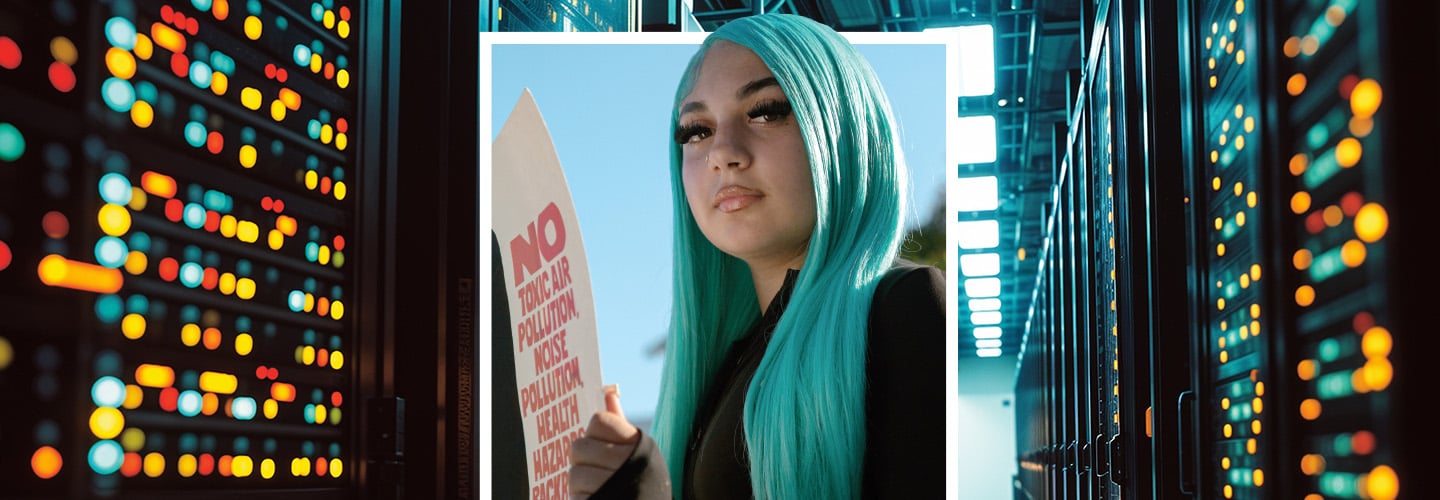

Composite image of a woman with turquoise hair holding a No Toxic Air Pollution sign by server racks

Sadie Cisneros, 17, at a recent protest in Pittsburg, California. Shutterstock.com (Data Center); Aubrey Trinnaman/The New York Times (Sadie Cisneros)

Standards

The Teens Taking On Data Centers

Young people are forming after-school clubs, speaking at community meetings—and wrestling with their own dependence on A.I.

When Sadie Cisneros first heard about ChatGPT a couple of years ago, she figured it was harmless. Like many other high school students, Sadie, 17, began using the A.I. chatbot regularly as a search engine and study aid.

Then she saw something on a friend’s Instagram story that alarmed her. A 300,000-square-foot data center—one of the huge facilities with thousands of computers and other electronic equipment that power artificial intelligence—was slated to be built near her neighborhood in Pittsburg, California.

A couple of years ago, Sadie Cisneros first heard about ChatGPT. The 17-year-old thought it was harmless. Like many other high school students, Sadie began using the A.I. chatbot regularly as a search engine and study aid.

Then she saw something on a friend’s Instagram story that alarmed her.

A data center was planned to be built near her neighborhood in Pittsburg, California. The 300,000-square-foot facility holds thousands of computers and other electronic equipment that power artificial intelligence.

Some teens worry A.I. is advancing too quickly.

As she read more about the project, she grew concerned. How much water would the facility’s giant cooling systems consume to keep the computers from overheating? Would the data center’s enormous demands on the electric power grid worsen the area’s air pollution? Would the incessant noise coming from the site disrupt students at the middle school less than half a mile away?

She wrote down her objections and read them aloud in a three-minute speech during a Pittsburg City Council meeting in July—her first real brush with civic engagement.

“I came in there with pink hair, I came in there dressed like a teenager,” she says. “I don’t think they expected me to actually bring up real stuff that’s going on.”

Sadie read more about the project, and she grew concerned. How much water would the facility’s giant cooling systems use to keep the computers from overheating? Would the data center’s enormous power demands worsen the area’s air pollution? Would the constant noise coming from the site disrupt students at the middle school less than half a mile away?

She wrote down her objections. Then she presented a three-minute speech at a Pittsburg City Council meeting in July. It was her first real experience with civic engagement.

“I came in there with pink hair, I came in there dressed like a teenager,” she says. “I don’t think they expected me to actually bring up real stuff that’s going on.”

Benjamin Rasmussen/The New York Times

Kyle McGuffey, 14, conducted research and took notes (inset) about a data center project approved for construction near his home in Colorado.

A New Target

Close to a decade ago, young people walked out of school to demand action on climate change and marched to protest gun violence. Some of today’s high school activists have chosen to take on a new foe: the rapid growth of A.I. data centers (see “A Data Center Boom,” below). These young people argue that data centers pose health and environmental threats that are being ignored as companies race to keep up with the nation’s surging demand for computing power.

Students are joining a wave of local opposition to data centers that stretches from coast to coast and includes Americans from vastly different backgrounds and political beliefs. Young adults tend to have more negative views of data centers than their elders do, according to data from the Pew Research Center.

But many are also struggling with how much they rely on the chatbots that require so much computing power. More than half of American Gen Z-ers (born from 1997 to 2012) use A.I. regularly, according to a survey by Gallup and the Walton Family Foundation. For some, getting involved in the fight against data centers has raised a thorny question: Can you protest the physical footprint of A.I. while still taking advantage of the technology?

Close to a decade ago, young people walked out of school to demand action on climate change. They marched to protest gun violence. Today some high school activists have chosen to take on a new foe: the rapid growth of A.I. data centers (see “A Data Center Boom,” below). These young people argue that data centers pose health and environmental threats. They are concerned companies are ignoring potential harm as they race to keep up with the nation’s surging demand for computing power.

Students are not alone in their concern. Americans from vastly different backgrounds and political beliefs oppose data centers from coast to coast. Young adults tend to have more negative views of data centers than their elders do, according to data from the Pew Research Center.

But many young adults are also struggling with how much they rely on the chatbots that require so much computing power. More than half of American Gen Z-ers (born from 1997 to 2012) use A.I. regularly, according to a survey by Gallup and the Walton Family Foundation. For some, getting involved in the fight against data centers has raised a difficult question: Can you protest the physical footprint of A.I. while still using the technology?

Courtesy of Mihir Nimkar

In Virginia: Joshua Weber (left) and Mihir Nimkar formed a group to oppose power lines planned for a nearby data center.

10 Million Views

Sadie is now a regular at community meetings and rallies against the planned data center in Pittsburg, which was approved in 2024. She posts videos on social media urging other young people to get involved. One of her TikToks demonstrating how to speak at a City Council meeting has gotten more than 10 million views.

Her activism has led Sadie to try to cut back on her use of A.I. She downloaded a browser that doesn’t use A.I. summaries and has stopped plugging offhand questions into ChatGPT.

“I didn’t even need A.I. for half the stuff that I was using A.I. for,” she says.

A representative for Avaio Digital, the developer of the Pittsburg project, said in a statement that many of the objections to the center were a result of misunderstandings. The center’s closed-loop cooling system will continuously recirculate water, and Avaio is making efforts to limit noise pollution, the statement said.

Sadie is now a regular at community meetings and rallies against the planned data center in Pittsburg. The data center was approved in 2024. She posts videos on social media urging other young people to get involved. One of her TikToks demonstrating how to speak at a City Council meeting has gotten more than 10 million views.

Her activism has led Sadie to try to cut back on her use of A.I. She downloaded a browser that doesn’t use A.I. summaries. She also stopped putting offhand questions into ChatGPT.

“I didn’t even need A.I. for half the stuff that I was using A.I. for,” she says.

A representative for Avaio Digital, the developer of the Pittsburg project, said in a statement that many of the objections to the center were a result of misunderstandings. The center’s closed-loop cooling system will continuously recirculate water. Avaio is making efforts to limit noise pollution, the statement said.

Ted Shaffrey/AP Images

Data centers in Loudon County, Virginia. The county has the world’s largest concentration of data centers.

Digging for Answers

Kyle McGuffey, a 14-year-old in Colorado Springs, Colorado, says he’s well aware that anyone who has a smartphone is already relying on A.I. in countless ways, not all of them obvious. In iPhoto, for example, the technology is used to identify landmarks and plants.

“A.I. is already a part of our lives and something we can’t reverse,” Kyle says. “My concern is that it’s advancing way too quickly and without public oversight.”

Kyle spent most of his summer break between middle school and high school submitting public records requests related to Project Taurus, an A.I. data center project that was approved for construction about three miles from his home. He wanted to know what plans there were to mitigate the noise or evaluate the effects on local wildlife. He also wanted to know what would happen in the case of a water leak.

Kyle McGuffey, a 14-year-old in Colorado Springs, Colorado, says he’s well aware that anyone who has a smartphone is already relying on A.I. in many ways. It is not always obvious. For example, iPhoto uses A.I. technology to identify landmarks and plants.

“A.I. is already a part of our lives and something we can’t reverse,” Kyle says. “My concern is that it’s advancing way too quickly and without public oversight.”

Kyle spent most of his summer break between middle school and high school submitting public records requests related to Project Taurus. The A.I. data center project was approved for construction about three miles from his home.

Kyle wanted to know what plans there were to lessen the noise or evaluate the effects on local wildlife. He also wanted to know what would happen in the case of a water leak.

‘I didn’t even need A.I. for half the stuff that I was using A.I. for.’

In May, he received two dozen pages of planning documents and email communications related to the project that he had requested through the Colorado Open Records Act, a law that lets anyone request government documents. They included an early report suggesting that the site could require far more power than had been publicly advertised—300 megawatts as opposed to 50, which would make it a far bigger drain on the local power grid. (One megawatt is roughly enough power to supply electricity to 750 to 1,000 homes.) Kyle shared the records with two opposition groups. At least one of them ended up using his research in an appeal filed against the data center’s approval.

Jason Green, the co-founder and president of Raeden, the company responsible for Project Taurus, says the document Kyle found was from before the company had completed its formal review of the site. The company went to great lengths to address the community’s concerns, including redesigning the data center’s walls to mitigate noise as much as possible, he says. The final development plan approved by the city allows for only 50 megawatts.

In May, he received two dozen pages of planning documents and email communications related to the project that he had requested. (The Colorado Open Records Act lets anyone request government documents.) They included an early report suggesting that the site could require far more power than had been publicly advertised—300 megawatts as opposed to 50. (One megawatt is roughly enough power to supply electricity to 750 to 1,000 homes.) Kyle shared the records with two opposition groups. His research was used in an appeal filed against the data center’s approval.

Jason Green, the co-founder and president of Raeden, the company responsible for Project Taurus, says the document Kyle found was from before the company had completed its formal review of the site. He says the company went to great lengths to address the community’s concerns. That includes redesigning the data center’s walls to mitigate noise as much as possible, he says. The final development plan approved by the city allows for only 50 megawatts.

Erik Isakson/Getty Images

Rows of servers in a data center

“I applaud the interest, even if it’s critical of what we’re doing,” he says.

Rachel Janfaza, founder of the Up and Up, a research and media firm focused on Gen Z, says she has been hearing lively debates about data centers in focus groups since January. Many young people feel as if their age group was already a guinea pig for Big Tech once with the advent of social media; they don’t want to repeat history with A.I.

“People sleep on Gen Z’s appetite for, and interest in, local politics,” she says. “For them, the creation of data centers in their communities is something that they’re not only deeply aware of, but also understand that they are going to be the ones who are affected by it.”

Backers of A.I. say the technology could be a game changer in a positive way in areas including medicine, transportation, and the environment (see “Some Pros and Cons of A.I.,” below). But many young people appear anxious about how artificial intelligence will affect their lives in the long term. At graduation ceremonies around the country last spring, college students booed commencement speakers who shared optimism about A.I. Fewer than 20 percent of Gen Z respondents in the Gallup survey said they felt hopeful about the technology.

“I applaud the interest, even if it’s critical of what we’re doing,” he says.

Rachel Janfaza is the founder of the Up and Up, a research and media firm focused on Gen Z. She has been hearing lively debates about data centers in focus groups since January. Many young people feel as if their age group was already a guinea pig for Big Tech with social media use. They don’t want to repeat that with A.I.

“People sleep on Gen Z’s appetite for, and interest in, local politics,” she says. “For them, the creation of data centers in their communities is something that they’re not only deeply aware of but also understand that they are going to be the ones who are affected by it.”

Supporters of A.I. say the technology could be a positive game changer in many areas including medicine, transportation, and the environment (see “Some Pros and Cons of A.I.,” below). But many young people appear anxious about the long-term effect of artificial intelligence. At graduation ceremonies around the country last spring, college students booed commencement speakers who shared optimism about A.I. Fewer than 20 percent of Gen Z respondents in the Gallup survey said they felt hopeful about the technology.

Wild Horizons/Universal Images Group via Getty Images

In Tuscon, Arizona: opponents of a proposed data center at a community meeting in 2025

A Common Concern

A Data Center Boom

The number of data centers in the U.S. is expected to grow sharply after 2026, increasing the demand for electricity and other resources.

Top map: Current / Bottom map: Planned after 2026

Jim McMahon (maps) | Sources: The New York Times, Cleanview

Note: Only the contiguous U.S. is shown. Alaska has no data centers in use and 1 planned. Hawaii has no data centers in use and none planned. Map data as of August 2026.

Data centers are also a common concern for a generation that’s otherwise often politically divided. In July, Marco Sanchez, a 15-year-old in El Paso, Texas, started the El Paso Youth Alliance to organize teenagers in opposition to the multibillion-dollar data center being built there by Meta.

Close to 100 high school students in the area have joined so far, he says—and people with different political views are welcome to participate.

“I don’t care if someone disagrees with me on who should be the next president if we both agree that the data center is bad,” Marco says.

When he first heard that a data center was coming to El Paso, he hoped that it would be the start of a meaningful investment in the city and its residents. His feelings shifted when he learned of the 80 percent break on property taxes that Meta received for building there, meaning the company will pay only a fraction of the taxes other property owners pay. He now worries that the project will drive up energy costs and increase pollution while Meta reaps the benefits.

Amid growing concern about pollution linked to the rapid growth of A.I. data centers, a spokesman for Meta says the company is “committed to offsetting 100 percent of our electricity use in El Paso with clean and renewable energy,” and that Meta “will not pass those costs on to Texans.”

Data centers are also a common concern for a generation that’s otherwise often politically divided.

In July, Marco Sanchez, a 15-year-old in El Paso, Texas, started the El Paso Youth Alliance. The group helps organize teenagers to fight a massive data center that Meta is building there.

Close to 100 high school students in the area have joined so far, he says. And people with different political views are welcome to join.

“I don’t care if someone disagrees with me on who should be the next president if we both agree that the data center is bad,” Marco says.

When he first heard that a data center was coming to El Paso, Marco was hopeful. He thought it might be the start of an important investment in the city and its residents. His feelings changed when he learned of the property tax break that Meta received for building there.  The company will pay only 20 percent of the taxes other property owners pay. He now worries that the project will drive up energy costs and increase pollution while Meta benefits from it.

In response to the growing concern about pollution linked to A.I. data centers, a spokesman for Meta says the company is “committed to offsetting 100 percent of our electricity use in El Paso with clean and renewable energy,” and that Meta “will not pass those costs on to Texans.”

Mario Tama/Getty Images

A data center under construction in Vernon, California

Living With A.I.

Some teens have been learning about the costs and benefits of data centers for practically their entire lives. Mihir Nimkar, 17, grew up in Loudoun County in Virginia, home to a region known as Data Center Alley for its large concentration of facilities that power internet traffic and cloud computing. Data centers are necessary for pretty much everything we like about digital life, he says. But Mihir has been frustrated by what he sees as the poor planning of a recent data center construction project that has been fueled by the rapid growth of A.I. Last year, a local utility proposed a route for new high-voltage power lines that runs directly across the property of his high school.

In response, he and a friend, Joshua Weber, 17, formed a club called Students Against High-Voltage Expansion. It encouraged teenagers to pass out flyers and pack school board meetings. (The data center project, which has faced fierce local resistance, is headed to the Virginia Supreme Court, because of legal challenges over the power-line route.)

Mihir still uses A.I. for feedback on his writing and to quiz himself before tests at school. No matter what happens with the power lines, he thinks the fight has challenged the assumption that A.I. is some kind of magic blinking cursor that spits out answers and doesn’t come with any costs.

“I’ve definitely become more cognizant of what it is that happens when I use A.I.,” Mihir says. “There are so many consequences that you don’t see.”

Some teens have been learning about the costs and benefits of data centers for almost their entire lives.

Mihir Nimkar, 17, grew up in Loudoun County in Virginia. The region is known as Data Center Alley because it has a large concentration of facilities that power internet traffic and cloud computing. Data centers are necessary for pretty much everything we like about digital life, he says. But Mihir has been frustrated. The rapid growth of A.I. has created a rush to build more data centers with a lack of proper planning. Last year, a local utility proposed a route for new high-voltage power lines that runs directly across the property of his high school.

In response, he and a friend, Joshua Weber, 17, formed a club called Students Against High-Voltage Expansion. It encouraged teenagers to pass out flyers and pack school board meetings. (The data center project has faced strong local resistance. It is now headed to the Virginia Supreme Court, because of legal challenges over the route of the power lines.)

Mihir still uses A.I. for feedback on his writing and to quiz himself before tests at school. No matter what happens with the power lines, he thinks this fight changed how people look at A.I. It is not just a magic blinking cursor that spits out answers. It comes with costs.

“I’ve definitely become more cognizant of what it is that happens when I use A.I.,” Mihir says. “There are so many consequences that you don’t see.”

Inside the Data Center Capital of the World
A New York Times reporter investigates how the boom is affecting Loudoun County, Virginia.

Callie Holtermann is a reporter for The New York Times. With reporting by Lucia De Stefani.

Callie Holtermann is a reporter for The New York Times. With reporting by Lucia De Stefani.

Some Pros and Cons of A.I.

Artificial intelligence brings both opportunities and risks across society, from health and science to jobs, privacy, and the environment

PROS

Jakub Porzycki/NurPhoto via Getty Images (Car); Cui Jun/Beijing Youth Daily/VCG via Getty Images (Health Care); Shutterstock.com (servers)

SCIENCE & RESEARCH
A.I. can analyze enormous amounts of data quickly, helping scientists make predictions and discoveries in fields including genetics, climate science, and space exploration.

JOBS & THE ECONOMY
Companies can use A.I. to automate repetitive tasks, allowing people to spend more time on creative, complex, or human-centered work. The growth of A.I. can also create new job opportunities and businesses.

ENERGY & THE ENVIRONMENT
A.I. can help make power grids more efficient, predict energy demand, improve renewable-energy systems, monitor pollution, and track changes in ecosystems.

HEALTH & MEDICINE
Doctors can use A.I. to spot early signs of diseases such as cancer in medical scans. It can also help researchers develop new drugs and treatments.

TRANSPORTATION & SAFETY
A.I. can help vehicles navigate, improve traffic systems, and identify potential dangers. It can also predict equipment failures and assist emergency responders during disasters.

CONS

gualtiero boffi/Alamy Stock Photo (servers); Shutterstock.com (All Other Images)

JOBS & THE ECONOMY
Companies could use A.I. to automate jobs and reduce demand for human workers, putting many people out of work and disrupting parts of the economy.

PRIVACY & SURVEILLANCE
A.I. can process enormous amounts of personal information, making it easier for governments and companies to track, identify, and profile people.

MISINFORMATION
A.I. can generate convincing fake audio, photos, and videos, making it harder to know what is real. Algorithms powered by A.I. help spread misinformation to a vast audience.

ENERGY & THE ENVIRONMENT
Huge amounts of electricity and water are needed to operate data centers that power A.I. This can increase emissions, put pressure on power grids, and possibly lead to water shortages.

NATIONAL SECURITY & WARFARE
A.I. can be used to develop weapons, cyberattacks, surveillance systems, and autonomous military technology for use against people.

videos (1)
Skills Sheets (4)
Skills Sheets (4)
Skills Sheets (4)
Skills Sheets (4)
Lesson Plan (1)
Leveled Articles (1)
Text-to-Speech