


Jim McMahon

Standards

Where We Come From

Waves of migration have long brought people to our shores and continue to influence the nation

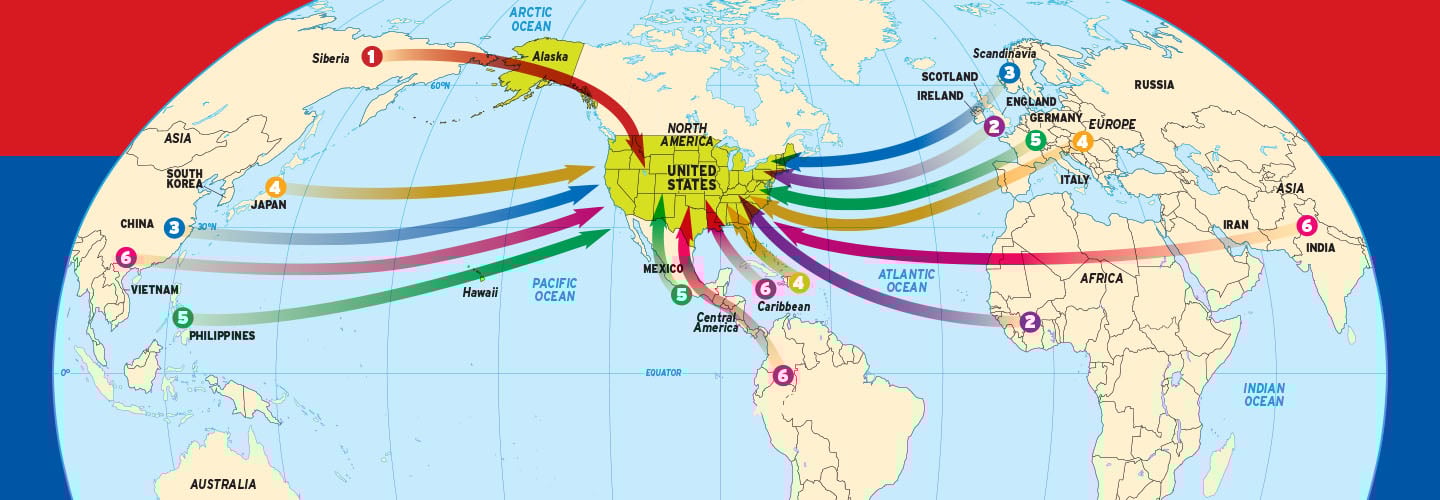
America’s story is a story of migration. People have long been coming to this land—mostly in waves. On the world map below, we’ve divided these migratory waves into six periods, from the first groups that crossed the Bering Land Bridge during the Ice Age to the tens of millions who have arrived since the colonial period and continue to come today.

The colored arrows show roughly where people came from and when. First, the earliest peoples traveled from Siberia into what is now Alaska, then spread across the continent. The next wave, during the 17th to 19th centuries, brought colonists from Europe and enslaved Africans forced out of their homelands. The 19th and early 20th centuries saw millions of immigrants arriving from Europe, Asia, and other regions. The most recent wave, still ongoing, comprises migrants from Latin America, Asia, Africa, and elsewhere, including highly skilled immigrants and refugees from various conflicts.

Study the map and the timeline below—doing further research on key events—and answer the questions.

MAP KEY: New Arrivals to America

1. Pre-Columbian Migration (Ice Age: 15,000-20,000+ years ago)

Arriving: Peoples from Northeast Asia
Place of Origin: Asia

2. Colonial Period/Post-Colonial Period (1600s–1820)
Arriving: English, Dutch, Germans, French, Spanish, Scotch-Irish, Africans (enslaved)
Places of Origin: Europe, Africa

3. Mid-19th Century (1820s–80s)
Arriving: Irish, Germans, Scandinavians, Chinese
Places of Origin: Northern/Western Europe, Asia

4. Turn of the 20th Century (1880s–1920s)
Arriving: Italians, Poles, Russians, Jews, Japanese, West Indians
Places of Origin: Southern/Eastern Europe, Asia, Caribbean

5. Mid-20th Century (1920-60)
Arriving: Latin Americans, Filipinos, Germans, British, Irish
Places of Origin: North America, South America, Asia, Northern/Western Europe

6. Post-1965
Arriving: Latin Americans, Vietnamese, Indians, Chinese, Iranians, Africans
Places of Origin: North America, South America, Asia, Caribbean, Middle East, Africa

Key Dates

Fine Art Images/Heritage Images via Getty Images

Two million people leave Ireland as a result of the potato crop failure.

1845-52

Irish Potato Famine

1848-69

Fine Art Images/Heritage Images via Getty Images

Prospectors from the U.S. and China search for gold in California, 1852.

California Gold Rush and Transcontinental Railroad draw people west to search for gold and later to connect the country by rail.

1882

Chinese Exclusion Act bans Chinese laborers from immigrating to the U.S.

1924

National Origins Act sets restrictive immigration quotas, prioritizing people from Northern and Western Europe.

Rolls Press/Popperfoto via Getty Images

Fidel Castro assumes power in Cuba. In the following decades, more than a million Cubans flee to escape political repression.

1959

Cuban Revolution

1965

Immigration and Nationality Act abolishes immigration quotas from 1924.

Bettmann Archive/Getty Images 

Vietnamese and Western civilians evacuate during Saigon’s fall, 1975.

1975

End of the Vietnam War

1980

Refugee Act strengthens the U.S. commitment to accepting refugees.

The Immigration and Nationality Act
The 1965 legislation reversed earlier policies rooted in isolationism.

Questions

1. What changes do you notice over time in where immigrants to America came from?

2. Look at the timeline. How might major world events—such as wars, famines, or revolutions—have influenced these immigration waves?

3. How does the arrival of enslaved Africans in the colonial period differ from other immigration waves? Why is this distinction important?

4. Why do you think U.S. immigration laws or policies might have changed after 1965?

5. Based on where Americans have come from, what influence do you see on American culture from all these points of origin?

6. Choose a world region to study and write a short essay on why people from there migrated to the United States.

videos (1)
Skills Sheets (2)
Skills Sheets (2)
Text-to-Speech