
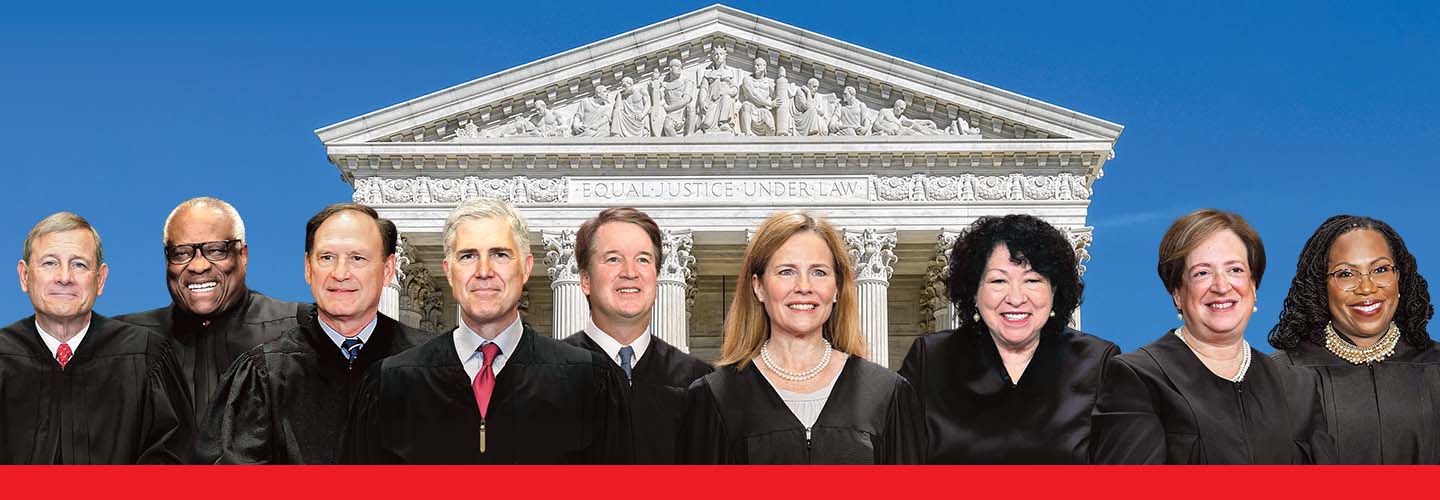

Nine Supreme Court justices in black robes standing in front of the Supreme Court building

Supreme Court Justices, from left: Chief Justice John G. Roberts Jr.; Clarence Thomas; Samuel A. Alito Jr.; Neil M. Gorsuch; Brett Kavanaugh; Amy Coney Barrett; Sonia Sotomayor; Elena Kagan; Ketanji Brown Jackson  Erin Schaff/POOL/AFP via Getty Images (Roberts, Thomas, Gorsuch); Andel Ngan/AFP/Getty Images (Alito); Eric Lee/Bloomberg via Getty Images (Kavanaugh, Barrett, Kagan); Alex Wong/Getty Images (Sotomayor); Jabin Botsford/The Washington Post via Getty Images (Jackson); Shutterstock.com (Supreme Court building)

Standards

How Will the Justices Rule?

The Supreme Court is considering important cases this term on a variety of hot-button issues

Erin Schaff/POOL/AFP via Getty Images (Roberts, Thomas, Gorsuch); Andel Ngan/AFP/Getty Images (Alito); Eric Lee/Bloomberg via Getty Images (Kavanaugh, Barrett, Kagan); Alex Wong/Getty Images (Sotomayor); Jabin Botsford/The Washington Post via Getty Images (Jackson)

1. Chief Justice John G. Roberts Jr., Leans conservative, Appointed by George W. Bush in 2005

2. Clarence Thomas, Leans conservative, Appointed by George H.W. Bush in 1991

3. Samuel A. Alito Jr., Leans conservative, Appointed by George W. Bush in 2005

4. Neil M. Gorsuch, Leans conservative, Appointed by Donald Trump in 2017

5. Brett Kavanaugh, Leans conservative, Appointed by Donald Trump in 2018

6. Amy Coney Barrett, Leans conservative, Appointed by  Donald Trump in 2020

7. Sonia Sotomayor, Leans liberal, Appointed by Barack Obama in 2009

8. Elena Kagan, Leans liberal, Appointed by Barack Obama in 2010

9. Ketanji Brown Jackson, Leans liberal, Appointed by Joe Biden in 2022

Before its current term ends this summer,  the Supreme Court will have the potential to reshape U.S. law—and American life—on a host of hot-button issues.

This term, the Court will address questions such as whether the police should be able to access location data from cellphones near a crime scene and whether transgender girls should be allowed to participate on girls sports teams at school. It will also decide whether gun owners need permission to carry guns on private property that’s open to the public and whether states can continue to consider race when creating voting districts.

In addition, the Court will issue several rulings on President Trump’s expansive use of executive power, including an executive order seeking to end birthright citizenship and his wide-ranging use of tariffs (See “All About Tariffs” in the November 24, 2025, issue of Upfront).

The Supreme Court will hear several cases that have the potential to reshape U.S. law and American life before the current term ends this summer.

This term, the Court will address several important questions. Should the police be able to access location data from cellphones near a crime scene?  Should transgender girls be allowed to participate on girls sports teams at school?  It will also decide whether gun owners need permission to carry guns on private property that’s open to the public and whether states can continue to consider race when creating voting districts.

In addition, the Court will issue several rulings on President Trump’s expansive use of executive power. This includes the executive order seeking to end birthright citizenship and his wide-ranging use of tariffs. (See “All About Tariffs,” in the November 24, 2025, issue of Upfront.)

The Supreme Court has the potential to reshape U.S. law.

Six of the Court’s nine justices are conservative-leaning, and three were appointed by Trump during his first term. Yet it can be difficult to predict how some of the justices will vote in any particular case.

Because the Court has the power to review whether the government’s actions are constitutional, the justices’ decisions are essentially “the law of the land,” says Lee Epstein, a law professor at Washington University in St. Louis. This term, she says, “they’re going to make some important decisions regarding what our Constitution means.”

Here’s a look at five key issues the Court is considering.

Six of the Court’s nine justices are conservative-leaning, and three were appointed by Trump during his first term. Yet it can be difficult to predict how some of the justices will vote in any particular case.

The Court has the power to review whether the government’s actions are constitutional. The justices’ decisions are essentially “the law of the land,” says Lee Epstein, a law professor at Washington University in St. Louis. This term, she says, “they’re going to make some important decisions regarding what our Constitution means.”

Here’s a look at five key issues the Court is considering.

Shutterstock.com

Can police use your phone’s location data to help solve crimes?

Chatrie v. United States

You may not give it much thought, but your cellphone is likely tracking you everywhere you go—and that location data could be used by law enforcement. When police in Richmond, Virginia, were trying to solve a 2019 robbery at a credit union,* they obtained phone location data from Google that told them who was in the area around the time of the crime. Using that data, they charged a man named Okello Chatrie, who eventually pleaded guilty and is now serving prison time.

Chatrie later appealed his conviction, claiming the police’s use of his phone data was a violation of the Constitution’s Fourth Amendment, which protects against “unreasonable searches and seizures.” A federal appeals court ruled against Chatrie, and he appealed to the Supreme Court.

In their investigation, police used what’s called a geofence warrant. That allows law enforcement to collect cellphone data stored by companies like Google from a specific location and time period.

The key question in the case is whether a search occurred at all. Government lawyers argue that since Chatrie voluntarily shared his location data with Google, he forfeited any expectation of privacy.

Geofence warrants have become increasingly common in recent years. The case will test the constitutional boundaries for the way criminal investigators use new technologies, experts say.

“Law enforcement is increasingly using digital information to get suspect lists and help solve crimes,” says Brent Skorup, a Constitutional law expert at the Cato Institute. “Do we own our digital records that contain our sensitive information? . . . The law is uncertain about this.”

You may not give it much thought, but your cellphone is likely tracking you everywhere you go. Law enforcement could use that location data. When police in Richmond, Virginia, were trying to solve a 2019 robbery at a credit union,* they obtained phone location data from Google. They used that data to determine who was in the area around the time of the crime. Based on that data, they charged a man named Okello Chatrie. He eventually pleaded guilty and is now serving prison time.

Chatrie later appealed his conviction. He claimed the police’s use of his phone data was a violation of the Constitution’s Fourth Amendment, which protects against “unreasonable searches and seizures.” A federal appeals court ruled against Chatrie, and he appealed to the Supreme Court.

Police used what’s called a geofence warrant. That allows law enforcement to collect cellphone data stored by companies like Google from a specific location and time period.

The key question in the case is whether a search occurred at all. Government lawyers argue that since Chatrie voluntarily shared his location data with Google, he gave up his expectation of privacy.

Geofence warrants have become increasingly common in recent years. The case will test the constitutional boundaries for the way criminal investigators use new technologies, experts say.

“Law enforcement is increasingly using digital information to get suspect lists and help solve crimes,” says Brent Skorup, a Constitutional law expert at the Cato Institute. “Do we own our digital records that contain our sensitive information? . . . The law is uncertain about this.”

Can states bar transgender girls from girls sports teams?

West Virginia v. B.P.J. and Little v. Hecox

Caroline Gutman/The New York Times

Becky Pepper-Jackson is challenging a West Virginia law that bans her from joining her school’s track team.

Becky Pepper-Jackson was 11 when she sued the state of West Virginia over a law that barred transgender girls like her from joining girls sports teams. A judge issued an order that blocked the law and allowed her to compete on the school track team while the legal process continued. But the judge eventually ruled in the state’s favor. After Becky appealed the ruling and won, the state asked the Supreme Court to review that case. Now 15, Becky is awaiting the Court’s decision about whether she can compete for her final two years of high school.

As the justices consider Becky’s case, West Virginia v. B.P.J., they’re also reviewing a challenge to a similar law in Idaho brought by college student Lindsay Hecox, now 24 and a senior, after she was barred from joining the women’s track and cross-country teams at Boise State University her freshman year.

The students argue that these state laws—which require that participation on sports teams for girls be based on biological sex rather than gender identity—violate the Fourteenth Amendment and its guarantee of “equal protection of the laws” to all Americans. The students also say the bans violate Title IX, a federal civil rights law that prohibits sex discrimination in educational programs and activities that receive federal funding.

Becky Pepper-Jackson was 11 when she sued the state of West Virginia over a law that barred transgender girls like her from joining girls sports teams. A judge issued an order that blocked the law. She was allowed to compete on the school track team while the legal process continued. But the judge eventually ruled in the state’s favor. Becky appealed the ruling and won. The state asked the Supreme Court to review that case. Now 15, Becky is awaiting the Court’s decision. The outcome will determine if she can compete for her final two years of high school.

As the justices consider Becky’s case, West Virginia v. B.P.J., they’re also reviewing a challenge to a similar law in Idaho brought by college student Lindsay Hecox. She was barred from joining the women’s track and cross-country teams at Boise State University her freshman year. (Hecox is now 24 and a senior.)

The students argue that these state laws—which require that participation on sports teams for girls be based on biological sex rather than gender identity—violate the Fourteenth Amendment. The amendment guarantees “equal protection of the laws” to all Americans. The students also say the bans violate Title IX, a federal civil rights law. Title IX prohibits sex discrimination in educational programs and activities that receive federal funding.

The Court’s ruling could affect laws in 25 other states.

Lawyers for West Virginia and Idaho and the Trump administration say the sports laws are needed, arguing that transgender girls and women have a competitive edge. Allowing them to compete on girls teams, they say, takes away opportunities for female athletes and reverses five decades of progress for women in sports since the passage of Title IX in 1972.

However the Supreme Court rules, it could affect similar laws passed by 25 other states that ban transgender women and girls from participating on school sports teams that don’t align with their sex at birth.

“On the trans girls’ side, [the argument is] whether they should be effectively denied any opportunity to participate in sports because they are trans,” says David D. Cole, a professor at the Georgetown University Law Center. “And on the state side, it’s whether the state should be permitted to prohibit trans girls across the board, out of a concern for fair competition.”

Lawyers for the states and the Trump administration say the sports laws are needed.  According to the lawyers, transgender girls and women have a competitive edge. Allowing them to compete on girls teams, they say, takes away opportunities for female athletes. They claim it also reverses five decades of progress for women in sports since the passage of Title IX in 1972.

However the Supreme Court rules, it could affect similar laws passed by 25 other states.

“On the trans girls’ side, [the argument is] whether they should be effectively denied any opportunity to participate in sports because they are trans,” says David D. Cole, a professor at the Georgetown University Law Center. “And on the state side, it’s whether the state should be permitted to prohibit trans girls across the board, out of a concern for fair competition.”

Can states ban concealed guns on private property?

Wolford v. Lopez

In 2023, Hawaii passed a law that bans concealed firearms on private property open to the public, including restaurants and grocery stores, unless the property owners post signs allowing guns or otherwise give explicit permission. Three Hawaii gun owners and a Hawaii gun rights group sued the state, arguing that the law violates their Second Amendment right to bear arms and their ability to protect themselves. A federal district court initially blocked the law’s enforcement, but an appeals court reversed that decision, allowing the law to take effect. The gun owners have asked the Supreme Court to review that ruling.

“Hawaii is basically saying, ‘We’re just giving business owners . . . the right to exclude people with firearms,’” says Hayley Lawrence, executive director of the Duke Center for Firearms Law. “[Gun owners] have said, ‘This is infringing upon our right to carry in public.’”

At the heart of the case is a 2022 landmark Supreme Court decision, New York State Rifle & Pistol Association v. Bruen. In that case, the justices ruled that the Second Amendment gives Americans the right to bear arms in public places. It also established a new test for the constitutionality of other gun laws, which requires courts to analyze whether the laws align with states’ and the nation’s history and tradition of gun ownership.

Hawaii’s lawyers argue that the law is consistent with its history of having some of the country’s most restrictive gun laws. The Court’s decision, experts say, could help clarify how the history test is supposed to work. And as the justices consider whether the rights of gun owners or private property owners take precedence in this case, their ruling could determine how far other states can go in restricting gun rights.

Ultimately, Lawrence says, the outcome of the case will dictate whether states can pass laws that, by default, ban concealed weapons in “shopping malls, or restaurants, gas stations­—any number of places we go on a daily basis.”

In 2023, Hawaii passed a law that bans concealed firearms on private property open to the public unless the property owners post signs allowing guns or otherwise give explicit permission. The ban includes restaurants and grocery stores. Three Hawaii gun owners and a Hawaii gun rights group sued the state. They argue that the law violates their Second Amendment right to bear arms and their ability to protect themselves. A federal district court initially blocked the law’s enforcement, but an appeals court reversed that decision. The law went into effect. The gun owners have asked the Supreme Court to review that ruling.

“Hawaii is basically saying, ‘We’re just giving business owners . . .  the right to exclude people with firearms,’” says Hayley Lawrence, executive director of the Duke Center for Firearms Law. “[Gun owners] have said, ‘This is infringing upon our right to carry in public.’”

The case centers on a 2022 landmark Supreme Court decision, New York State Rifle & Pistol Association v. Bruen. In that case, the justices ruled that the Second Amendment gives Americans the right to bear arms in public places. It also established a new test for the constitutionality of other gun laws. The courts must analyze whether the laws align with states’ and the nation’s history and tradition of gun ownership.

Hawaii’s lawyers argue that the law is consistent with its history of having some of the country’s most restrictive gun laws. Experts say the decision could help clarify how the history test is supposed to work. And as the justices consider whether the rights of gun owners or private property owners take precedence in this case, their ruling could determine how far other states can go in restricting gun rights.

Ultimately, Lawrence says, the outcome of the case will determine whether states can pass laws that, by default, ban concealed weapons in “shopping malls, or restaurants, gas stations—any number of places we go on a daily basis.”

The Supreme Court: Gatekeepers of the Constitution
How the Court became the arbiter of what the U.S. government can and cannot do

AP Images

President Lyndon B. Johnson signs the Voting Rights Act in 1965.

Can states consider race in drawing voting maps?

Louisiana v. Callais

About two years ago, Louisiana lawmakers approved new congressional voting maps that included two majority Black districts in the state. A group of a dozen White voters challenged the map, saying that lawmakers had illegally segregated voters based on race. Now the Supreme Court will decide whether the new maps violate the Fourteenth Amendment’s equal protection clause and the Fifteenth Amendment, which prohibits voter discrimination based on race. If the justices determine that lawmakers can’t consider race at all when drawing districts, they would put an end to the protections established by the Voting Rights Act of 1965.

Signed into law by President Lyndon B. Johnson, the Voting Rights Act was established to help end the Jim Crow practices in the South that attempted to prevent Black Americans from voting. Those included literacy tests, poll taxes, and the drawing of voting districts that intentionally disenfranchised Black citizens. The law was a key legislative achievement of the civil rights movement.

Louisiana lawmakers approved new congressional voting maps about two years ago. They include two majority Black districts in the state. A group of a dozen White voters challenged the map. They say that lawmakers had illegally segregated voters based on race. Now the Supreme Court will decide whether the new maps violate the Fourteenth Amendment’s equal protection clause and the Fifteenth Amendment, which prohibits voter discrimination based on race. The decision could put an end to the protections established by the Voting Rights Act of 1965.

Lyndon B. Johnson signed the Voting Rights Act. It was established to help end the Jim Crow practices in the South that tried to prevent Black Americans from voting. The practices included literacy tests, poll taxes, and the drawing of voting districts that intentionally excluded Black citizens. The law was a key legislative achievement of the civil rights movement.

The plaintiffs argue race shouldn’t be a factor in redistricting.

The plaintiffs in the case argue that the new congressional voting map is discriminatory and that it’s no longer necessary to weigh race as a factor in redistricting. If the justices rule in favor of the plaintiffs, hundreds of voting districts in 14 states, primarily in the South, would be subject to legal challenges.   

“The Voting Rights Act says you can’t dilute [minorities’] votes so they have no power or have lessened power,” says David Becker, executive director of the nonpartisan Center for Election Innovation & Research. “Those who are seeking to overturn it would say . . . we’re a different nation than we were in 1965, and we shouldn’t be looking at race at all when it comes to redistricting and voting.”

The plaintiffs in the case argue that the new congressional voting map is discriminatory. They believe that it is no longer necessary to weigh race as a factor in redistricting. If the justices rule in favor of the plaintiffs, hundreds of voting districts in 14 states, primarily in the South, would be subject to legal challenges.   

“The Voting Rights Act says you can’t dilute [minorities’] votes so they have no power or have lessened power,” says David Becker, executive director of the nonpartisan Center for Election Innovation and Research. “Those who are seeking to overturn it would say . . . we’re a different nation than we were in 1965, and we shouldn’t be looking at race at all when it comes to redistricting and voting.”

Should babies born in the U.S. automatically be citizens?

Trump v. Barbara

Doug Mills/The New York Times

President Trump signs an executive order last January

On the first day of President Trump’s second term last January, he issued an executive order to deny citizenship to the U.S.-born children of immigrants who are undocumented or who have temporary legal status, such as those on student work visas. The order would end what’s known as birthright citizenship, a guarantee of citizenship to anyone born on U.S. soil. The Supreme Court first recognized that right 128 years ago, based on the language of the Fourteenth Amendment, which states: “All persons born or naturalized in the United States, and subject to the jurisdiction thereof, are citizens of the United States.”

Lawsuits filed by 22 states immediately challenged Trump’s executive order and several federal judges issued rulings blocking it. But the Supreme Court later ruled that the judges didn’t have the authority to stop the order. In June, the American Civil Liberties Union (A.C.L.U.) filed a class action lawsuit challenging the executive order, saying that it contradicts the Fourteenth Amendment’s citizenship clause.

Last January, President Trump ordered that children born in the U.S. to immigrants who are undocumented or who have temporary legal status would not automatically be citizens. This would end birthright citizenship, a right the Supreme Court recognized 128 years ago under the Fourteenth Amendment which states: “All persons born or naturalized in the United States, and subject to the jurisdiction thereof, are citizens of the United States.”

Lawsuits filed by 22 states immediately challenged Trump’s executive order. Several federal judges issued rulings blocking it. But the Supreme Court later ruled that the judges didn’t have the authority to stop the order. In June, the American Civil Liberties Union (A.C.L.U.) filed a class action lawsuit challenging the executive order. They argue it contradicts the Fourteenth Amendment’s citizenship clause.

The executive order would end birthright citizenship.

“It’s long been understood that those words mean if you’re born here, you’re a citizen,” says Epstein, the Washington University law professor. “The executive order basically says there are a couple situations in which someone . . .  is not a citizen by birth.”

Now the Court will decide whether the executive order is constitutional. The A.C.L.U. argues that the Court should uphold its precedent from the 1898 case United States v. Wong Kim Ark. In that case, the Court ruled that Wong Kim Ark, who was born in San Francisco to noncitizen Chinese parents, was himself an American citizen.

The Trump administration argues that the Fourteenth Amendment, ratified in the aftermath of the Civil War, was intended to extend citizenship only to the children of formerly enslaved people. Government lawyers contend that it has been wrongly interpreted as applying to the children of undocumented immigrants. In his executive order, Trump says that the Fourteenth Amendment “has never been interpreted to extend citizenship universally to everyone born within the United States.”

“It’s long been understood that those words mean if you’re born here, you’re a citizen,” says Epstein, the Washington University law professor. “The executive order basically says there are a couple situations in which someone . . . is not a citizen by birth.”

Now the Court will decide whether the executive order is constitutional. The A.C.L.U. argues that the Court should uphold its precedent from the 1898 case United States v. Wong Kim Ark. Wong Kim Ark was born in San Francisco to noncitizen Chinese parents. In that case, the Court ruled that he was an American citizen.

The Trump administration argues that the Fourteenth Amendment, ratified in the aftermath of the Civil War, was intended to extend citizenship only to the children of formerly enslaved people. Government lawyers say that it has been wrongly interpreted as applying to the children of undocumented immigrants. In his executive order, Trump says that the Fourteenth Amendment “has never been interpreted to extend citizenship universally to everyone born within the United States.”

Nathan Howard/Reuters

Supporters of birthright citizenship rally outside the Supreme Court in May.

If the justices rule against the A.C.L.U. and the executive order goes into effect, it will mean that the chief way for noncitizens and their children to become U.S. citizens would be through the naturalization process. That is limited to U.S. residents 18 and older who have had permanent resident status for five years (or three years if they’re married to a U.S. citizen). Immigration advocacy groups warn that ending birthright citizenship would create a class of children who would lack the rights of U.S. citizens, and would force all parents to have to prove their children’s citizenship to receive services such as education.

“Ending birthright citizenship would greatly impact the lives of millions of Americans throwing them into legal limbo and uncertainty,” Sameera Hafiz, policy director of the Immigrant Legal Resource Center, said in a statement.

Supporters of ending birthright citizenship say it’s a loophole that undocumented immigrants can abuse. Twenty-seven Republican attorneys general have filed a legal brief to the Court in support of the executive order.

“For decades, the Fourteenth Amendment has been extorted and exploited,” says Alabama attorney general Steve Marshall. “The Court must finally correct this longstanding error.”

If the justices rule against the A.C.L.U., the executive order will go into effect. It will mean that the main way for noncitizens and their children to become U.S. citizens would be through the naturalization process. The process is limited to U.S. residents 18 and older who have had permanent resident status for five years (or three years if they’re married to a U.S. citizen). Immigration advocacy groups warn that ending birthright citizenship would create a class of children who would lack the rights of U.S. citizens. It would force all parents to prove their children’s citizenship to receive services such as education.

“Ending birthright citizenship would greatly impact the lives of millions of Americans throwing them into legal limbo and uncertainty,” Sameera Hafiz, policy director of the Immigrant Legal Resource Center, said in a statement.

Supporters of ending birthright citizenship say it’s a loophole that undocumented immigrants can abuse. Twenty-seven Republican attorneys general have filed a legal brief to the Court in support of the executive order.

“For decades, the Fourteenth Amendment has been extorted and exploited,” says Alabama attorney general Steve Marshall. “The Court must finally correct this longstanding error.”

*a nonprofit financial institution that offers banking services

With reporting by Adam Liptak, Ann E. Marimow, and Abbie VanSickle of The New York Times.

A Supreme Court Case’s Journey

How do cases get to the Court, and what happens when they do?

Dana Verkouteren via AP Images

A courtroom sketch of the justices during a recent oral argument. No cameras are allowed.

1. Where Cases Come From

Both criminal and civil cases originate in either a state or federal court in a local jurisdiction. From there, they can be appealed to an appeals court. A decision by a state’s highest court (usually the state supreme court*) can be appealed to the U.S. Supreme Court. So can a decision by a U.S. Court of Appeals in a federal case. But that doesn’t mean the justices will agree to hear it.

Both criminal and civil cases originate in either a state or federal court in a local jurisdiction. From there, they can be appealed to an appeals court. A decision by a state’s highest court (usually the state supreme court*) can be appealed to the U.S. Supreme Court. So can a decision by a U.S. Court of Appeals in a federal case. But that doesn’t mean the justices will agree to hear it.

2. Selection of Cases

Each year, thousands of cases are submitted for consideration by the Supreme Court, but the justices accept about 80. Unless at least four justices vote to hear a case, the ruling of the highest appeals court stands. The justices often choose cases that give them a chance to weigh in when an important constitutional question is at stake or when appeals courts in different parts of the country have issued conflicting rulings on the same topic.

Each year, thousands of cases are submitted for consideration by the Supreme Court, but the justices accept about 80. Unless at least four justices vote to hear a case, the ruling of the highest appeals court stands. The justices often choose cases that give them a chance to weigh in when an important constitutional question is at stake or when appeals courts in different parts of the country have issued conflicting rulings on the same topic.

3. Oral Arguments

Each case the Court hears is allotted one hour for oral arguments. During that time, the lawyers for both sides present their arguments, and the justices pepper them with questions. No cameras or recording devices are permitted in the courtroom during oral arguments, but the public can attend, and the chambers are nearly always full. The Court also posts official audio recordings of oral arguments on its website.

Each case the Court hears is allotted one hour for oral arguments. During that time, the lawyers for both sides present their arguments, and the justices pepper them with questions. No cameras or recording devices are permitted in the courtroom during oral arguments, but the public can attend, and the chambers are nearly always full. The Court also posts official audio recordings of oral arguments on its website.

4. Deliberations

Within a day or two of oral arguments, the justices meet for a straw vote—an informal poll of who stands where. If the chief justice is in the majority, he decides which justice will draft an opinion. If the chief justice is not in the majority, the most senior justice in the majority assigns the writing of the opinion. From then on, most of the justices’ communication with one another about the case is in writing. The justice writing the opinion will circulate a draft to his or her colleagues, hoping to persuade any wavering justices to join that side. The other justices respond in writing, and the process is repeated, often several times.

Within a day or two of oral arguments, the justices meet for a straw vote—an informal poll of who stands where. If the chief justice is in the majority, he decides which justice will draft an opinion. If the chief justice is not in the majority, the most senior justice in the majority assigns the writing of the opinion. From then on, most of the justices’ communication with one another about the case is in writing. The justice writing the opinion will circulate a draft to his or her colleagues, hoping to persuade any wavering justices to join that side. The other justices respond in writing, and the process is repeated, often several times.

5. Ruling

The Court’s term usually wraps up in June, and often the final weeks are a flurry of rulings on many cases. All rulings include a majority opinion that lays out the rationale behind the decision. If the decision isn’t unanimous, a dissenting opinion explains why one or more justices disagree. Supreme Court rulings can’t be appealed, but they can be challenged and overturned by subsequent Supreme Court decisions, which happens only rarely.

The Court’s term usually wraps up in June, and often the final weeks are a flurry of rulings on many cases. All rulings include a majority opinion that lays out the rationale behind the decision. If the decision isn’t unanimous, a dissenting opinion explains why one or more justices disagree. Supreme Court rulings can’t be appealed, but they can be challenged and overturned by subsequent Supreme Court decisions, which happens only rarely.

*In New York, Maryland, and Washington, D.C., the court of appeals is the highest court.

*In New York, Maryland, and Washington, D.C., the court of appeals is the highest court.

BY THE NUMBERS

The Supreme Court

116

NUMBER of justices appointed since the Court was established in 1789.

NUMBER of justices appointed since the Court was established in 1789.

1

NUMBER of basketball courts located inside the Supreme Court building in Washington, D.C. The facility has been dubbed “the highest court in the land.”

NUMBER of basketball courts located inside the Supreme Court building in Washington, D.C. The facility has been dubbed “the highest court in the land.”

6

NUMBER of justices on the first Supreme Court.

NUMBER of justices on the first Supreme Court.

1801

YEAR that the justices started wearing black robes in court, inspired by Chief Justice John Marshall.

YEAR that the justices started wearing black robes in court, inspired by Chief Justice John Marshall.

7,000-8,000

NUMBER of petitions to review cases the Court typically receives each term. It hears arguments for about 80.

NUMBER of petitions to review cases the Court typically receives each term. It hears arguments for about 80.

SOURCE: Supreme Court of the United States

SOURCE: Supreme Court of the United States

videos (1)
Skills Sheets (6)
Skills Sheets (6)
Skills Sheets (6)
Skills Sheets (6)
Skills Sheets (6)
Skills Sheets (6)
Lesson Plan (1)
Leveled Articles (1)
Text-to-Speech