

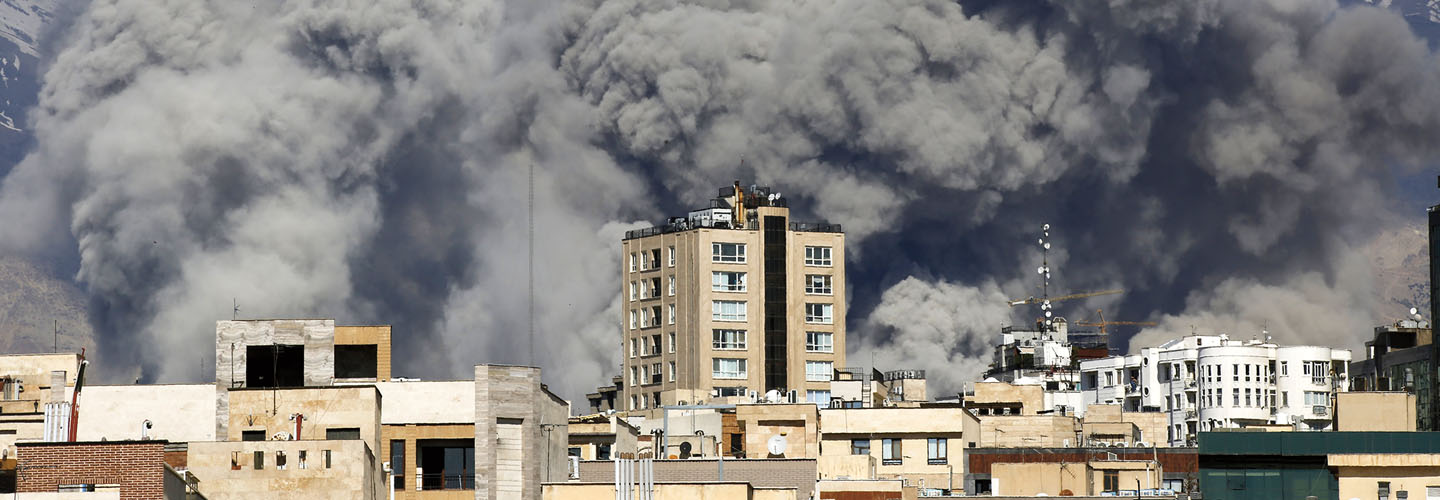

A government building in Tehran targeted in the U.S. and Israeli attack Fatemeh Bahrami/Anadolu via Getty Images

Standards

At War With Iran

In February, the U.S. and Israel attacked Iran and killed its leader. Here’s what you need to know.

Around 9:40 a.m. on February 28, long-range missiles launched as part of a coordinated attack by the United States and Israel struck the Tehran compound of Iran’s Supreme Leader, Ayatollah Ali Khamenei. The strikes killed him and 40 senior Iranian officials. They marked the start of a military conflict that quickly spread from Iran across the Middle East, from Lebanon to the United Arab Emirates.

The attack followed weeks of threats from President Donald Trump that the U.S. would strike Iran unless its leadership agreed to stop developing nuclear weapons and killing its own people, among other demands. The president stated that the U.S. would keep attacking Iran until it no longer posed a threat. “We’re destroying Iran’s missile capability,” Trump said in early March.

The attacks have raised many questions, including how long the U.S. could be involved in the conflict and how it could affect the rest of the region and the world.

Here’s what you need to know to understand the situation.

The United States and Israel launched long-range missiles around 9:40 a.m. on February 28. The coordinated attack struck the Tehran compound of Iran’s Supreme Leader, Ayatollah Ali Khamenei. The strikes killed him and 40 senior Iranian officials. The military conflict quickly spread from Iran across the Middle East, from Lebanon to the United Arab Emirates.

The attack followed weeks of threats from President Donald Trump. He warned that the U.S. would strike Iran unless its leadership agreed to stop developing nuclear weapons and killing its own people, among other demands. The president stated that the U.S. would keep attacking Iran until it no longer posed a threat. “We’re destroying Iran’s missile capability,” Trump said in early March.

The attacks have raised many questions. These include how long the U.S. could be involved in the conflict and how it could affect the rest of the region and the world.

Here’s what you need to know to understand the situation.

Jim McMahon

What are the origins of the war?

The U.S. and Iran have had troubled relations for nearly 50 years. In 1979,
the student-led Iranian Revolution ousted the nation’s U.S.-backed monarch, known as the shah of Iran. After the revolution, Iran’s government became a theocracy led by the Islamist cleric Ayatollah Ruhollah Khomeini. He enforced extremist laws that included execution or torture for participants in political protests and imprisonment for women who refused to wear head scarves concealing their faces. He referred to the U.S. as the “Great Satan.”

In November 1979, not long after the revolution, a group of radicalized college students, encouraged by Khomeini, seized the U.S. embassy
in Tehran and held dozens of American diplomats and civilians hostage for 444 days.

In the aftermath of the hostage crisis, many Americans viewed Iran as a hostile adversary. In 2002, two decades after the hostage crisis, President George W. Bush labeled Iran, along with Iraq and North Korea, as an “axis of evil” that sponsored terrorism.

At the same time, the U.S. was growing alarmed at signs that Iran was enriching uranium with the goal of building nuclear bombs. Iran has long claimed it only has an interest in peaceful nuclear technology. In 2015, President Barack Obama and representatives of several other nations signed an agreement with Iran. It greatly restricted Iran’s ability to enrich uranium for 15 years in exchange for an easing of economic sanctions that were crippling Iran’s economy.

The U.S. and Iran have had troubled relations since 1979. That was when the student-led Iranian Revolution overthrew the nation’s U.S.-backed monarch, known as the shah of Iran. After the revolution, Iran’s government became a theocracy. It was led by the Islamist cleric Ayatollah Ruhollah Khomeini. He enforced extremist laws. Participants in political protests could be executed or tortured. Women could be imprisoned for refusing to wear head scarves concealing their faces. He referred to the U.S. as the “Great Satan.”

In November 1979, not long after the revolution, a group of radicalized college students, encouraged by Khomeini, seized the U.S. embassy in Tehran. They held dozens of American diplomats and civilians hostage for 444 days.

After the hostage crisis, many Americans viewed Iran as a hostile opponent. In 2002, President George W. Bush labeled Iran, along with Iraq and North Korea, as an “axis of evil” that sponsored terrorism.

At the same time, the U.S. was growing alarmed at signs that Iran was enriching uranium to build nuclear bombs. Iran has long claimed it only has an interest in peaceful nuclear technology. In 2015, President Barack Obama and representatives of several other nations signed an agreement with Iran. It greatly restricted Iran’s ability to enrich uranium for 15 years. In exchange, there would be an easing of economic sanctions that were crippling Iran’s economy.

US President Trump Via Truth Social/Anadolu via Getty Images

President Trump announced the airstrikes in a recorded address posted on social media.

But three years later, during his first term, President Trump withdrew the U.S. from the pact, saying it wasn’t tough enough. He imposed new economic punishments that led to Iran’s worst economic crisis in decades.

Another source of lingering hostility is Iran’s longstanding threat against the two main allies of the U.S. in the Middle East: Israel and Saudi Arabia. Last June, the U.S. bombed three Iranian nuclear sites in the midst of the Twelve-Day War between Israel and Iran. Israel targeted Iranian leadership and nuclear facilities, and Iran retaliated by firing missiles at Israel and a U.S. base in Qatar.

Tensions continued to mount at the beginning of this year, following the Iranian government’s deadly crackdown on protests challenging its authoritarian rule. The crackdown killed thousands of Iranians. Trump repeatedly threatened military intervention to protect the protesters.

Ahead of the current conflict, the relationship between the U.S. and Iran was “mired in deep, deep, distrust on both sides,” says Mona Yacoubian, director of the Middle East Program at the Center for Strategic and International Studies.

But three years later, during his first term, President Trump withdrew the U.S. from the pact. He said it wasn’t tough enough. He imposed new economic penalties that led to Iran’s worst economic crisis in decades.

Another source of ongoing tension is Iran’s longstanding threat against two key U.S. allies in the Middle East: Israel and Saudi Arabia. Last June, during the Twelve-Day War between Israel and Iran, the U.S. bombed three Iranian nuclear sites. Israel also targeted Iranian leadership and nuclear facilities. Iran retaliated by firing missiles at Israel and a U.S. base in Qatar.

Earlier this year the Iranian government started a deadly crackdown on protests challenging its authoritarian rule. The crackdown killed thousands of Iranians. Trump repeatedly threatened military intervention to protect the protesters.

Ahead of the current conflict, the relationship between the U.S. and Iran was “mired in deep, deep, distrust on both sides,” says Mona Yacoubian, director of the Middle East Program at the Center for Strategic and International Studies.

Arash Khamooshi/The New York Times (Driving); Vahid Salemi/AP Images (Police Station)

The ruins of a police station in Tehran after U.S. and Israeli strikes; driving through the city in March (left)

Why did the U.S. and Israel attack Iran?

President Trump has listed several objectives for the attacks, including destroying Iran’s missile capabilities, dismantling its navy, preventing the country from obtaining a nuclear weapon, and stopping Iran from funding terrorist groups outside its borders.

For Israeli Prime Minister Benjamin Netanyahu, the strikes on Iran are part of a long-held goal of overthrowing the government in a country he has portrayed as an existential threat to Israel. The Israeli military has also said that it was acting against terror threats to its civilians.

In February, the U.S. and Iran engaged in weeks of negotiations over the future of Iran’s nuclear program, which had already been weakened by U.S. attacks in June. But the talks went nowhere.

In taped remarks announcing the attack, Trump urged Iranians to “take over your government” once the military action concluded. The U.S. and Israel have struck police stations, detention centers, and intelligence offices. Experts say the apparent effort to weaken the country’s security infrastructure, which led the brutal crackdown against tens of thousands of protesters, may be part of a strategy to encourage Iranians to rise up and fight against the state from within.

“This clearly is one of the main objectives of this operation—to dismantle the operative machine of a regime,” says Farzin Nadimi, a defense analyst at the Washington Institute for Near East Policy.

President Trump has listed several objectives for the attacks. These include the destruction of Iran’s missile capabilities, dismantling its navy, and preventing the country from obtaining a nuclear weapon. He also wanted to stop Iran from funding terrorist groups outside its borders.

For Israeli Prime Minister Benjamin Netanyahu, the strikes on Iran are part of a long-held goal of overthrowing its government. He has portrayed the country as an existential threat to Israel. The Israeli military has also said that it was acting against terror threats to its civilians.

In February, the U.S. and Iran engaged in weeks of negotiations over Iran’s nuclear future. The program had already been weakened by U.S. attacks in June. But the talks went nowhere.

In taped remarks announcing the attack, Trump urged Iranians to “take over your government” once the military action concluded. The U.S. and Israel have struck police stations, detention centers, and intelligence offices. Experts think these attacks are meant to weaken the government’s security forces. Those forces led the brutal crackdown against tens of thousands of protesters. Experts say weakening the security forces may be part of a strategy to encourage Iranians to rise up and fight against the state from within.

“This clearly is one of the main objectives of this operation—to dismantle the operative machine of a regime,” says Farzin Nadimi, a defense analyst at the Washington Institute for Near East Policy.

Ohad Zwigenberg/AP Images (Apartment Building); AMR ALFIKY/Reuters (Oil Terminal)

An apartment building in Tel Aviv, Israel, hit by an Iranian missile; an oil terminal in the United Arab Emirates after Iranian strikes (right)

How have Iranians reacted?

In the immediate aftermath of the U.S. and Israeli strikes, Iranians have expressed hope, grief, disbelief, and uncertainty. The day after Khamenei’s killing, large crowds poured into the streets of Tehran and other cities across the country to celebrate his death with fireworks, dancing, and cheering. Hours later, scores of tearful mourners came out to the streets to grieve his death, waving Iranian flags and holding photos of Khamenei.

Payman, 45, is a resident of Tehran who gave only his first name out of fear of government retribution. Everything happening in the country feels “unbelievable and unpredictable,” he says. “I feel like this system can’t sustain itself because people don’t accept it anymore.”

In Los Angeles, home to the largest community of Iranians outside Iran, there was a surge of hope and celebration, as well as fear for loved ones still in Iran. More than a half-million residents of the U.S. have some Iranian ancestry, according to census data.

“This is a global moment,” says Sharon S. Nazarian, a political scientist whose family fled Iran amid death threats when she was 10. “There’s a lot of fear, a lot of mixed emotion, but also a lot of hope.”

After the U.S. and Israeli strikes, Iranians have expressed a range of emotions, including hope, grief, disbelief, and uncertainty. The day after Khamenei’s killing, large crowds poured into the streets of Tehran and other cities across the country. They celebrated his death with fireworks, dancing, and cheering. Hours later, many tearful mourners came out to the streets to grieve his death. They waved Iranian flags and held photos of Khamenei.

Payman, 45, is a resident of Tehran who gave only his first name out of fear of government retribution. Everything happening in the country feels “unbelievable and unpredictable,” he says. “I feel like this system can’t sustain itself because people don’t accept it anymore.”

In Los Angeles, home to the largest community of Iranians outside Iran, there was a surge of hope and celebration. There was also fear for loved ones still in Iran. More than a half-million residents of the U.S. have some Iranian ancestry, according to census data.

“This is a global moment,” says Sharon S. Nazarian, a political scientist whose family fled Iran amid death threats when she was 10. “There’s a lot of fear, a lot of mixed emotion, but also a lot of hope.”

Bettmann Archive/Getty Images

American hostages taken from the U.S. embassy in Tehran, 1979

What’s next for Iran?

It’s unclear whether Khamenei’s death will lead to regime change in Iran. In early March, the country’s religious leaders named Khamenei’s son, Mojtaba Khamenei, as the new supreme leader. President Trump declared the choice “unacceptable” and said the U.S. should have a role in choosing who leads Iran after the war. Trump has said he’d be open to a more “moderate” leader from within the Iranian establishment. But experts warn that there’s no guarantee new leadership would be any more likely to agree to a deal with the U.S.

“There’s a low likelihood that a successor state would be a liberal democracy friendly to the United States—given that it was forged in a war with the United States,” says Rosemary Kelanic of Defense Priorities, a group generally opposed to U.S. foreign interventions.

Iran responded to the attacks by firing missiles at Israel and U.S. military bases in the region. It also moved to expand the war with attacks against other Middle Eastern nations, including Saudi Arabia, Qatar, and Kuwait. Iran’s leaders want to disrupt the flow of oil and increase the costs of the war for the U.S. in terms of casualties, energy costs, and inflation, experts say. They hope to persuade President Trump to declare victory and go home.

As of press time, 13 U.S. service members had died in the conflict. More than 1,300 people had been killed in Iran, according to the country’s ambassador to the United Nations. Hundreds of others had been killed elsewhere in the region.

“The Iranians want to spread the pain as much as they can, regardless of the cost to themselves and burned relations with their neighbors,” says Ali Vaez of the International Crisis Group in Belgium.

It’s unclear whether Khamenei’s death will lead to a change of government in Iran. In early March, the country’s religious leaders named Khamenei’s son, Mojtaba Khamenei, as the new supreme leader. President Trump declared the choice “unacceptable.” He thinks the U.S. should have a role in choosing who leads Iran after the war. Trump has said he’d be open to a more “moderate” leader from within the Iranian establishment. But experts warn that there’s no guarantee new leadership would be any more likely to agree to a deal.

“There’s a low likelihood that a successor state would be a liberal democracy friendly to the United States—given that it was forged in a war with the United States,” says Rosemary Kelanic of Defense Priorities, a group generally opposed to U.S. foreign interventions.

Iran responded to the attacks by firing missiles at Israeli and U.S. military bases in the region. It also moved to expand the war with attacks against other Middle Eastern nations. This included Saudi Arabia, Qatar, and Kuwait. Iran’s leaders want to disrupt the flow of oil. Experts say Iran wants to increase the costs of the war for the U.S. in terms of casualties, energy costs, and inflation. Iran hopes to persuade President Trump to declare victory and go home.

As of press time, 13 U.S. service members had died in the conflict. More than 1,300 people had been killed in Iran, according to the country’s ambassador to the United Nations. Hundreds of others had been killed throughout the region.

“The Iranians want to spread the pain as much as they can, regardless of the cost to themselves and burned relations with their neighbors,” says Ali Vaez of the International Crisis Group in Belgium.

Apu GOMES/AFP via Getty Images (Celebration); Arash Khamooshi/The New York Times (Mourning)

Celebrations in Los Angeles after the attacks on Iran in February

What does the war mean for the rest of the world?

In the U.S., Trump’s unilateral decision to strike Iran has opened a new chapter in the ongoing debate about the separation of powers in American democracy, as it did after he ordered the seizure of Venezuelan President Nicolás Maduro. (See “What’s Next for Venezuela?,” in the February 16, 2026, issue of Upfront.) The War Powers Resolution, passed in 1973, requires the president to end the deployment of armed forces within 60 days unless Congress authorizes it. Congress is currently divided along partisan lines, with Democrats calling for Congressional oversight and Republicans largely backing the operation.

In the U.S., Trump’s unilateral decision to strike Iran has opened a new chapter in the ongoing debate about the separation of powers in American democracy. The discussion started after he ordered the seizure of Venezuelan President Nicolás Maduro. (See “What’s Next for Venezuela?,” in the February 16, 2026, issue of Upfront.) The War Powers Resolution was passed in 1973. It requires the president to end the deployment of armed forces within 60 days unless Congress authorizes it. Congress is currently divided along partisan lines. Democrats are calling for Congressional oversight and Republicans are largely backing the operation.

The balance of power is shifting  in the Middle East.

Some European countries that initially voiced misgivings, including Britain and France, have nevertheless gotten involved in the conflict. Those two nations have contributed their navies and air forces to help defend against Iran’s retaliatory strikes. Greece has sent planes and warships to help defend its neighbor, Cyprus, after an Iranian drone struck a British air base there.

The longer the war lasts, the greater its potential impact on the global economy. About 20 percent of the world’s oil and liquefied natural gas passes through the Strait of Hormuz, a narrow waterway off the southern coast of Iran. A sharp reduction in oil tanker traffic since the start of the war has reduced supply, raising global oil and gas prices.

Whatever the war’s duration, experts say, the conflict is part of a dramatic shift in the balance of power in the Middle East.

“Iran is a critical power in this region,” Yacoubian says. What happens there “is enormously consequential for the future of the Middle East.”

Some European countries, like Britian and France, initially voiced concerns. Nevertheless, they have gotten involved in the conflict. They have contributed their navies and air forces to help defend against Iran’s retaliatory strikes. After an Iranian drone struck a British air base in Cyprus, Greece has sent planes and warships to help defend its neighbor.

The longer the war lasts, the greater its potential impact on the global economy. About 20 percent of the world’s oil and liquefied natural gas passes through the Strait of Hormuz. The narrow waterway is off the southern coast of Iran. Since the start of the war there has been a sharp reduction in oil tanker traffic. This has reduced supply and raised global oil and gas prices.

However long the war lasts, experts say, the conflict is part of a dramatic shift in the balance of power in the Middle East.

“Iran is a critical power in this region,” Yacoubian says. What happens there “is enormously consequential for the future of the Middle East.”

The Iran Hostage Crisis
How events unfolded in the country in the 1970s and early ’80s

With reporting by Erika Solomon, Christina Goldbaum, Shawn Hubler, and Steven Erlanger of The Times.

With reporting by Erika Solomon, Christina Goldbaum, Shawn Hubler, and Steven Erlanger of The Times.

AT A GLANCE

IRAN

Population

88 million | (U.S.: 342 million)

Per Capita GDP

$15,900 | U.S.: $74,600)

Unemployment Rate

8.3% | (U.S.: 4.4%)

Sources: The World Factbook (C.I.A.); World Bank; Bureau of Labor Statistics

Sources: The World Factbook (C.I.A.); World Bank; Bureau of Labor Statistics

videos (1)
Skills Sheets (4)
Skills Sheets (4)
Skills Sheets (4)
Skills Sheets (4)
Lesson Plan (1)
Leveled Articles (1)
Text-to-Speech