

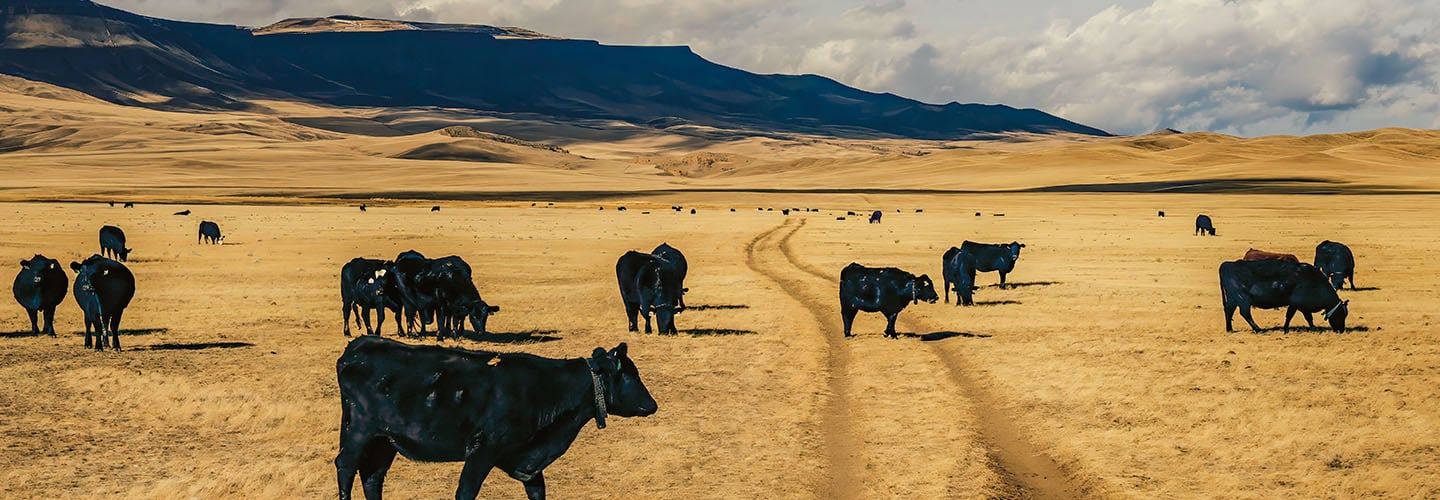

One November morning on Pitchfork Ranch in Wyoming, wranglers coaxed hundreds of cows into a holding pen. The cattle were there for their regular twice-per-year checkups. But this time, they got something more: GPS collars.
The collars would allow ranch manager Ben Anson to take down miles of barbed-wire fences that divide the nearly 100,000-acre operation into separate pastures. More than 620,000 miles of fences slice up the American West. They keep cattle contained, but they can also make it difficult to manage sensitive ecosystems. The GPS collars would instead act as virtual livestock fencing.
Pitchfork Ranch is in the Bighorn Basin, a rugged area of grassy prairie, sagebrush shrubs, and delicate river ecosystems that’s a critical corridor for wildlife such as elk and mule deer. Physical fences can block animal migrations.
Plus, fences are expensive to build and maintain. A mile of new barrier can cost up to $25,000. Some fencing in the West is about a century old and deteriorating. Many ranchers struggle to afford the high cost.
“We want to coexist with wildlife, to make things good for them . . . but still make a living with ranching,” says Dustin Taylor, who manages E Spear Ranch, a 70,000-acre cattle operation not far from Pitchfork Ranch.
Taylor and Anson hope virtual fences can help. The collars relay their cattle’s location to cellphones, and farmers set invisible boundaries using GPS coordinates. As a cow approaches a boundary, the collar beeps. If the cow crosses it, the collar delivers a mild electric shock.
One November morning, wranglers coaxed hundreds of cows into a holding pen at Pitchfork Ranch in Wyoming one November morning. The cattle were there for their regular twice-per-year checkups. But this time, they got something else. They were fitted with GPS collars.
The collars would allow ranch manager Ben Anson to take down miles of barbed-wire fences. The fences divide the nearly 100,000-acre operation into separate pastures. There are more than 620,000 miles of fences in the American West. While they keep cattle contained, fences can make it difficult to manage sensitive ecosystems. The GPS collars would instead act as virtual fences for the livestock.
Pitchfork Ranch is in the Bighorn Basin. The rugged area of grassy prairie, sagebrush shrubs, and delicate river ecosystems is a critical corridor. Wildlife such as elk and mule deer need to migrate through the area. Physical fences can block their path.
Fences are expensive to build and maintain. A mile of new barrier can cost up to $25,000 and some fencing in the West is about 100 years old. It is deteriorating. Many ranchers struggle to afford the high cost.
“We want to coexist with wildlife, to make things good for them . . . but still make a living with ranching,” says Dustin Taylor, who manages E Spear Ranch, a 70,000-acre cattle operation not far from Pitchfork Ranch.
Taylor and Anson hope virtual fences can help. The collars relay their cattle’s location to cellphones. Farmers set invisible boundaries using GPS coordinates. As a cow approaches a boundary, the collar beeps. The collar delivers a mild electric shock if the cow crosses the boundary.