

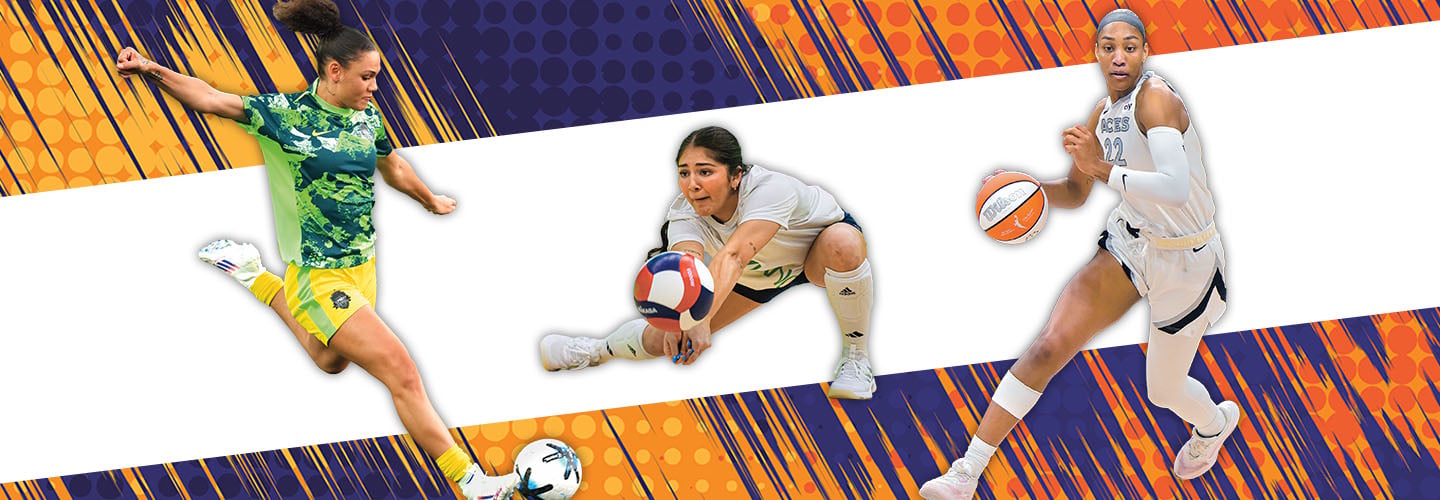

Trinity Rodman, of the Washington Spirit, recently signed a record-breaking contract for women’s soccer, worth $2 million a year (left). Lexi Rodriguez plays for League One Volleyball Nebraska. Fans chose her for the first all-star team, in 2025 (center). A’ja Wilson, of the Las Vegas Aces, was the first Women’s National Basketball Association player to win four MVP awards (right). Jeff Dean/NWSL via Getty Images (Rodman); Christian Petersen/Getty Images (Wilson); Jay Biggerstaff/LOVB/Getty Images (Rodriguez); Shutterstock.com (background)

Standards

The Rise of Women’s Sports

Female pro athletes are taking their sports to the next level, with record attendance, new leagues, and fast-growing fan bases

When the final buzzer sounded, the women’s basketball team from the University of California, Los Angeles (UCLA) rushed onto the court. They had just won the 2026 national championship. Led by star players such as Lauren Betts and Gabriela Jaquez, UCLA had overpowered the University of South Carolina, winning 79-51 in front of a sellout crowd of nearly 16,000 people.

About 10 million viewers tuned in to see who would win, making it one of the most-watched games of this year’s National Collegiate Athletic Association (NCAA) Division I tournaments, better known as March Madness. But a few decades ago, having millions of people watch a women’s basketball game was unheard of. In fact, the women’s tournament wasn’t even allowed to use the term March Madness until 2022. Before then, it had been reserved for the men’s tournament.

Buzz around women’s basketball has been soaring. Recent viewership is among the highest in the sport’s history, and players like Azzi Fudd of the University of Connecticut and Flau’jae Johnson of Louisiana State University are stars in their own right. Johnson, for example, has more than 10 times as many social media followers as many of the top players in the men’s game.

And college basketball isn’t the only women’s sport that’s gaining momentum these days. There are new professional leagues for softball, volleyball, and baseball, and existing pro leagues, such as the Women’s National Basketball Association (WNBA), are seeing attendance and revenue soar. And millions of new fans—many of them teens—are finding inspiration on the court and the field.

“This moment feels like we’ve crossed a threshold where there is no going back,” says Victoria Jackson, a sports historian at Arizona State University.

The women’s basketball team from the University of California, Los Angeles (UCLA) rushed onto the court at the final buzzer. They had just won the 2026 national championship. They were led by star players such as Lauren Betts and Gabriela Jaquez. UCLA had won 79-51 over the University of South Carolina, in front of a sellout crowd of nearly 16,000 people.

About 10 million viewers tuned in to see who would win the game. That made it one of the most-watched games of this year’s National Collegiate Athletic Association (NCAA) Division I tournaments. The tournaments are known as March Madness. But a few decades ago, having millions of people watch a women’s basketball game was unheard of. In fact, the women’s tournament wasn’t even allowed to use the term March Madness until 2022. Before then, the term referred only to the men’s tournament.

The popularity of women’s basketball has been soaring. Recent viewership is among the highest in the history of the sport. Players like Azzi Fudd of the University of Connecticut and Flau’jae Johnson of Louisiana State University are stars in their own right. Johnson has more than 10 times as many social media followers as many of the top players in the men’s game.

College basketball isn’t the only women’s sport that is becoming popular these days. There are new professional leagues for softball, volleyball, and baseball. Attendance and revenue are soaring for existing pro leagues, such as the Women’s National Basketball Association (WNBA). And millions of new fans, many of them teens, are finding inspiration on the court and the field.

“This moment feels like we’ve crossed a threshold where there is no going back,” says Victoria Jackson, a sports historian at Arizona State University.

Action Images via Reuters

World Cup win: The U.S. women’s soccer team celebrates after the 1999 championship.

An Uphill Climb

Four sports leagues have dominated American pop culture for decades: the National Football League (NFL), Major League Baseball (MLB), the National Basketball Association (NBA), and the National Hockey League (NHL). Those men’s pro sports consistently pull in the most money, get the best TV airtime, and attract the most fans.

Women have had to play catch-up to try to compete with the men for America’s attention. For much of the 20th century, girls and women had relatively few opportunities to play team sports. In the 1971-72 school year, for instance, girls made up roughly 8 percent of all high school athletes, according to the National Federation of State High School Associations.

The passage of Title IX in 1972 started to change that. This federal law requires schools receiving government funding to provide boys and girls with equal access to educational programs and activities, including athletics. Schools began creating and funding programs for girls’ soccer, softball, and other sports, and female students started signing up. Today roughly 43 percent of high school athletes are girls.

Professional soccer also helped pave the way for female athletes. In 1991, the U.S. women’s soccer team, created only six years earlier, won the FIFA Women’s World Cup. The team took the title again eight years later, this time in front of more than 90,000 fans. The athletes, including Mia Hamm and Brandi Chastain, became overnight sensations.

The team’s continued success had an impact on future generations, says Alice Merryweather, who was born in 1996 and grew up to become a U.S. Olympic alpine skier.

“They normalized the idea that women could be . . . athletes,” she told reporters. “They were my idols.”

Four sports leagues have dominated American pop culture for decades: the National Football League (NFL), Major League Baseball (MLB), the National Basketball Association (NBA), and the National Hockey League (NHL). Those men’s pro sports consistently pull in the most money. They get the best TV airtime, and they attract the most fans.

Women have had to compete with the men for America’s attention. For much of the 20th century, girls and women had few chances to play team sports. In the 1971-72 school year, girls made up roughly 8 percent of all high school athletes, according to the National Federation of State High School Associations.

The passage of Title IX in 1972 started to change that. This federal law requires schools receiving government funding to provide boys and girls with equal access to educational programs and activities. This includes athletics. Schools began creating and funding programs for girls’ soccer, softball, and other sports. Female students started signing up. Today roughly 43 percent of high school athletes are girls.

Professional soccer helped pave the way for female athletes. The U.S. women’s team was formed in 1985. The team won the FIFA Women’s World Cup in 1991. The team took the title again eight years later. This time it was in front of more than 90,000 fans. The athletes, including Mia Hamm and Brandi Chastain, became popular overnight.

The team’s continued success had an impact on future generations, says Alice Merryweather. She was born in 1996 and grew up to become a U.S. Olympic alpine skier.

“They normalized the idea that women could be . . . athletes,” she told reporters. “They were my idols.”

Luke Hales/Getty Images

Basketball star Caitlin Clark (center) with fans in 2024, before a WNBA game

The Caitlin Clark Effect

Female athletes began getting more opportunities to play in pro leagues such as the WNBA, which launched in 1997. Still, women’s sports remained largely sidelined. Television networks didn’t air them regularly and rarely put them in prime-time slots, when they tend to be seen by the most people.

That made businesses less willing to invest in female leagues, according to sports broadcaster Kim Adams.

“The lack of games on television,” she says, “is what was always kind of holding back the growth that we’re seeing now.”

Then NCAA basketball player Caitlin Clark claimed the spotlight in 2023. The University of Iowa guard wowed fans by sinking three-pointers from near mid-court, something previously done only by NBA players like Steph Curry. Her record-breaking scoring drew unprecedented numbers of fans to her team’s games. Television network executives took notice and gave women’s college basketball a bigger platform. The NCAA championship aired on the ABC network for the first time in 2023, giving it more reach than ever before. And in 2024, a record 24 million viewers watched all or part of the women’s title game—topping the men’s championship for the first time.

That boost in viewers helped persuade broadcasters to show more women’s sports on major networks and at times when more people would watch. And the leagues’ continued progress has made those deals even better. The WNBA recently signed a $2.2 billion deal giving networks the right to broadcast its games over 11 years. That price is six times higher than the WNBA’s previous contracts.

Many players and fans have argued that female athletes don’t benefit enough from these deals, however. In the WNBA, for example, the average salary was about $120,000 in the 2025 season. The NBA’s average salary is roughly $10 million—about 80 times higher. The NBA, which is a majority owner of the WNBA, has argued that the difference in pay is justified by the men’s league’s much higher revenue. The NBA’s recent TV deal, also for 11 years, is valued at $76 billion.

But the basketball salary gap began to shrink in March. After a year of tumultuous negotiations, the WNBA and its players agreed on a deal that will pay the athletes more. Starting next season, players will earn an average salary of $600,000, and pay will be tied to league revenue, so as the WNBA grows more profitable, players will earn more. WNBA players were inspired to advocate for themselves by the U.S. women’s soccer team, which had recently fought for the same pay as the U.S. men’s soccer team. The women are now paid the same rate for game appearances, prize money, and bonuses as their male counterparts.

Many female athletes are marketing themselves directly to fans on social media. National Women’s Soccer League (NWSL) stars Rose Lavelle and Trinity Rodman, for example, engage hundreds of thousands of followers with content chronicling their lives on and off the field.

Female athletes began getting more opportunities to play in pro leagues such as the WNBA, which launched in 1997. Still, women’s sports remained largely sidelined. Television networks didn’t air them regularly. Their games were rarely put in prime-time slots, which have the most viewers.

That made businesses less willing to invest in female leagues, according to sports broadcaster Kim Adams.

“The lack of games on television,” she says, “is what was always kind of holding back the growth that we’re seeing now.”

Then NCAA basketball player Caitlin Clark claimed the spotlight in 2023. The University of Iowa guard wowed fans by sinking three-pointers from near mid-court. This was something previously done only by NBA players like Steph Curry. Her record-breaking scoring drew an extraordinary number of fans to her team’s games. Television network executives took notice. They gave women’s college basketball a bigger platform. The NCAA championship aired on the ABC network for the first time in 2023. That gave the championship more reach than ever before. And in 2024, a record 24 million viewers watched all or part of the women’s title game. Viewership topped the men’s championship for the first time.

That boost in viewers helped persuade broadcasters to show more women’s sports on major networks. More games were in prime time, when more people could watch. The leagues’ continued progress has made those deals even better. The WNBA recently signed a $2.2 billion deal that gives networks the right to broadcast its games over 11 years. That price on the contract was six times higher than the WNBA’s previous ones.

However, many players and fans have argued that female athletes don’t benefit enough from these deals. The average salary in the WNBA was about $120,000 in the 2025 season. The NBA’s average salary is about 80 times higher, at roughly $10 million. The NBA, which is a majority owner of the WNBA, has argued that the difference in pay is justified because the men’s league brings in much more money. The NBA also signed a recent TV deal, for 11 years, and it is valued at $76 billion.

The basketball salary gap began to shrink in March. After a year of difficult negotiations, the WNBA and its players agreed on a deal that will pay the athletes more. Starting next season, players will earn an average salary of $600,000. The pay will be tied to league revenue. That means players will earn more as the WNBA grows more profitable. WNBA players were inspired by the U.S. women’s soccer team. The team had recently fought for the same pay as the U.S. men’s soccer team. The women are now paid the same rate for game appearances, prize money, and bonuses as their male counterparts.

Many female athletes are marketing themselves directly to fans on social media. National Women’s Soccer League (NWSL) stars Rose Lavelle and Trinity Rodman, for example, engage hundreds of thousands of followers with content showing their lives on and off the field.

Women for the Win
A look back at the evolution of women in sports

Sponsorships & Big Salaries

Those views translate into sponsorship deals, which can supplement athletes’ regular salaries and boost their overall earnings. Rodman—who in January signed a $2 million annual contract, making her one of the highest-paid women’s soccer players in the world—has major sponsorships with Ford Motor Company, Home Depot, and Google Pixel, among others. She also has a custom line of Adidas gear, including a pair of cleats she helped design.

As the leagues grow in popularity, female athletes are drawing in a new generation of fans. Riley Caron, 17, of Pembroke, New Hampshire, plays basketball, field hockey, and tennis, and says watching women’s games inspires her.

“I think [the leagues] are really, really important,” she says. “Especially as a female who plays sports in high school, it’s encouraging to see.”

The athletes “are so talented, and they deserve the amount of attention that the men get,” adds her teammate Anne Phillips, 17, of Epsom, New Hampshire.

In fact, for some professional athletes, inspiring young people is even better than scoring on the court.

“It’s the reason why I do what I do and why I love what I do,” top WNBA player A’ja Wilson told TIME. “If a young girl can look at the WNBA or me and say, ‘I just want to do that’ . . . that’s the real trophy.”

Those views translate into sponsorship deals, which can supplement athletes’ regular salaries and boost their overall earnings. Rodman signed a $2 million annual contract in January. It made her one of the highest-paid women’s soccer players in the world. She also has major sponsorships with Ford Motor Company, Home Depot, and Google Pixel, among others. Her custom line of Adidas gear includes a pair of cleats she helped design.

Female athletes are drawing in a new generation of fans. Riley Caron, 17, of Pembroke, New Hampshire, plays basketball, field hockey, and tennis. She says that watching women’s games inspires her.

“I think [the leagues] are really, really important,” she says. “Especially as a female who plays sports in high school, it’s encouraging to see.”

The athletes “are so talented, and they deserve the amount of attention that the men get,” adds her teammate Anne Phillips, 17, of Epsom, New Hampshire.

For some professional athletes, inspiring young people is even better than scoring on the court.

“It’s the reason why I do what I do and why I love what I do,” top WNBA player A’ja Wilson told TIME. “If a young girl can look at the WNBA or me and say, ‘I just want to do that’ . . . that’s the real trophy.”

With reporting by Chrisanne Grisé.

With reporting by Chrisanne Grisé.

24 million

NUMBER of viewers who watched some or all of the 2024 NCAA Women’s Basketball Championship. It was the most-watched basketball game since 2019, including in the NBA.

Source: NPR

NUMBER of viewers who watched some or all of the 2024 NCAA Women’s Basketball Championship. It was the most-watched basketball game since 2019, including in the NBA.

Source: NPR

Leagues on the Move

Women’s National Basketball Association

FIRST SEASON: 1997

SIGN OF GROWTH: The 2025 season was its most-watched ever, with an average of 1.3 million viewers per game.

FIRST SEASON: 1997

SIGN OF GROWTH: The 2025 season was its most-watched ever, with an average of 1.3 million viewers per game.

National Women’s Soccer League

FIRST SEASON: 2013

SIGN OF GROWTH: A record 1.2 million people tuned in for last year’s championship, 22 percent more than in 2024.

FIRST SEASON: 2013

SIGN OF GROWTH: A record 1.2 million people tuned in for last year’s championship, 22 percent more than in 2024.

Emilee Chinn/LOVB/Getty Images

League One Volleyball

FIRST SEASON: 2025

SIGN OF GROWTH: In 2027, the league will add three new teams to its original six.

FIRST SEASON: 2025

SIGN OF GROWTH: In 2027, the league will add three new teams to its original six.

Matt McClain/The Washington Post via Getty Images

Professional Women’s Hockey League

FIRST SEASON: 2024

SIGN OF GROWTH: Merchandise sales doubled and attendance increased by 27 percent in the 2024-25 season.

FIRST SEASON: 2024

SIGN OF GROWTH: Merchandise sales doubled and attendance increased by 27 percent in the 2024-25 season.

Athletes Unlimited Softball League

FIRST SEASON: 2025

SIGN OF GROWTH: The league will go from four teams to six in its second season.

FIRST SEASON: 2025

SIGN OF GROWTH: The league will go from four teams to six in its second season.

Women’s Pro Baseball League

FIRST SEASON: 2026

SIGN OF GROWTH: Sign of growth: The first season doesn’t start until August, but the WPBL is already set to expand in 2027.

FIRST SEASON: 2026

SIGN OF GROWTH: Sign of growth: The first season doesn’t start until August, but the WPBL is already set to expand in 2027.

Shutterstock.com (sports icons)

Shutterstock.com (sports icons)

videos (1)
Skills Sheets (6)
Skills Sheets (6)
Skills Sheets (6)
Skills Sheets (6)
Skills Sheets (6)
Skills Sheets (6)
Lesson Plan (1)
Leveled Articles (1)
Text-to-Speech