


iStockPhoto/Getty Images (phone); PonyWang/Getty Images (class)

Standards

The Teen Sleep Crisis

American teens aren’t sleeping enough. That’s hurting their health, experts say.

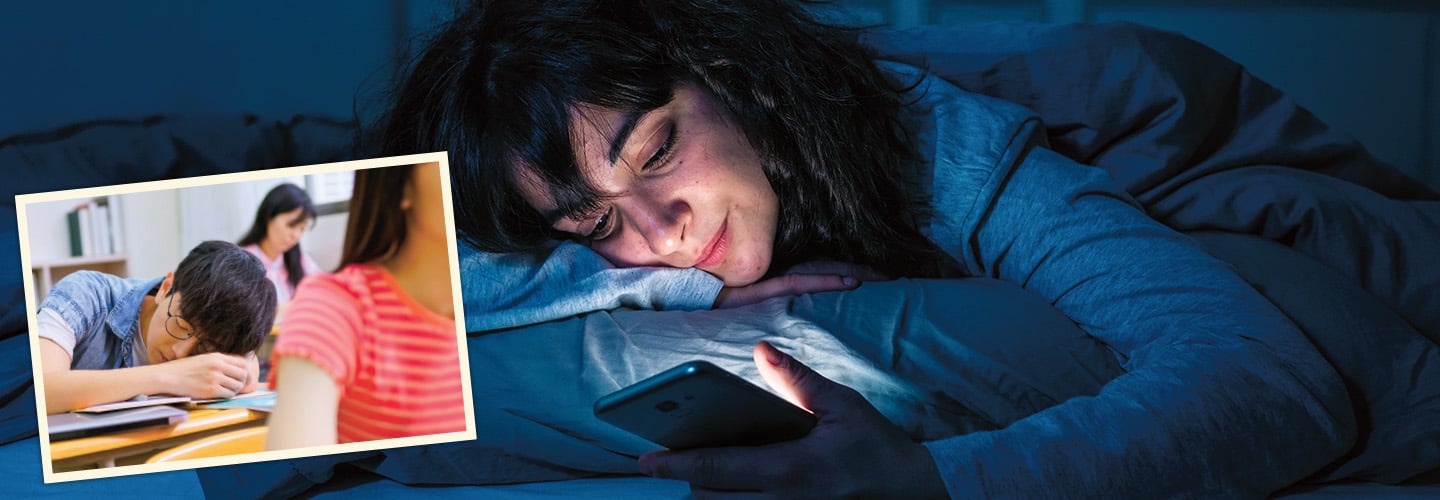
During a typical school week, Rhea Pallerla gets six to seven hours of sleep a night. But if it’s finals period or she has an especially large workload, the 16-year-old says, she’ll sleep as little as five hours. At school, it’s often difficult for her to focus. Sometimes she dozes off in her AP chemistry class.

“My sleep, frankly, has suffered since I started high school,” says Rhea. A sophomore at Heritage High School in Brentwood, California, she juggles academics and extracurriculars, including speech and debate club and writing for a student newspaper. But Rhea hardly stands out among her peers in getting too little sleep. It “is sort of a badge of honor,” she notes, “like the less sleep you get, the more disciplined you are.”

In fact, nearly 80 percent of American teens are sleep-deprived, according to the Centers for Disease Control and Prevention (C.D.C.). That means they’re regularly getting less than the 8 to 10 hours of sleep the C.D.C. recommends for people ages 13 to 18. Teens’ sleep has been on the decline over roughly the past two decades; today the average U.S. teen gets between six and seven hours per night.

“Teenagers will sometimes be surprised that they feel like they need more sleep when they’re, say, 16 than when they were 11,” says Heather Turgeon,
a psychotherapist and co-author of the book Generation Sleepless. “The brain and the body are changing so much . . . and much of that work happens at night when you’re sleeping.”

Sleep is critical for many important processes in our bodies, including maintaining a healthy metabolism, flushing toxins out of the brain, and helping the immune system fight off illness. During sleep, the brain releases growth hormones and develops connections that regulate decision-making, information processing, and self-reflection. These functions make sleep especially critical for teens, whose brains are still developing and whose bodies are experiencing growth spurts.

Rhea Pallerla is a 16-year-old student. During a regular school week, she gets six to seven hours of sleep a night. But if it’s finals period or if she has an especially large workload, she will get as little as five hours of sleep. She often has a hard time focusing at school. Sometimes she falls asleep in her AP chemistry class.

“My sleep, frankly, has suffered since I started high school,” says Rhea. She is a sophomore at Heritage High School in Brentwood, California. She is active in academics and extracurriculars, including speech and debate club. Rhea also writes for a student newspaper. She is not alone in getting too little sleep. It “is sort of a badge of honor,” she notes, “like the less sleep you get, the more disciplined you are.”

In fact, nearly 80 percent of American teens are sleep-deprived, according to the Centers for Disease Control and Prevention (C.D.C.). Teens are getting less than the 8 to 10 hours of sleep the CDC recommends for people ages 13 to 18. For the past 20 years, teens’ sleep has been declining. Today the average U.S. teen gets between six and seven hours per night.

“Teenagers will sometimes be surprised that they feel like they need more sleep when they’re, say, 16 than when they were 11,” says Heather Turgeon, a psychotherapist and co-author of the book Generation Sleepless. “The brain and the body are changing so much . . . and much of that work happens at night when you’re sleeping.”

Sleep is critical for many important processes in our bodies. It helps maintain a healthy metabolism, flushes toxins out of the brain, and helps the immune system fight off illness. During sleep, the brain releases growth hormones. It also develops connections that regulate decision-making, information processing, and self-reflection. These functions make sleep especially critical for teens. Their brains are still developing, and their bodies are still experiencing growth spurts.

Courtesy of family

“[Lack of sleep] has definitely affected my social life as well as my academic life.”

—Rhea Pallerla, 16

Hormonal changes during puberty shift teens’ internal clocks, delaying when they feel tired to around 11 p.m. and their natural wake time to around 8 a.m. These biological changes can make waking up early for school especially difficult. Add to that the demands of homework, extracurriculars, and after-school jobs, plus the temptations of smartphones and the internet, which experts say all contribute to a major sleep crisis among teens.

Over the past 20 years, teen mental health has worsened drastically in the U.S. In 2021, the U.S. Surgeon General warned of a “devastating” mental health crisis among teenagers. In 2023, 40 percent of high schoolers reported having persistent feelings of sadness and hopelessness, according to the C.D.C. Many health experts say that the teen sleep crisis and mental health crisis are intertwined.

“Mental health is extremely sensitive to sleep,” says Andrew Fuligni, the director of the Adolescent Development Lab at the University of California, Los Angeles (UCLA). “Disrupted sleep or irregular sleep can lead to feelings of anxiety or depression. . . . Those in turn could also lead to more difficult sleep at night.”

When people don’t get enough sleep, the systems within the brain that help regulate emotions don’t function as well, Fuligni adds. Sleep disruption can also cause inflammation, which researchers have linked to depression.

Hormonal changes during puberty shift teens’ internal clocks. They begin to feel tired around 11 p.m. and their natural wake time shifts to around 8 a.m. These changes can make waking up early for school especially difficult. Homework, extracurriculars, and after-school jobs, plus time on smartphones and the internet, all add up to a major sleep crisis among teens.

At the same time, teen mental health in the U.S. has worsened over the past 20 years. In 2021, the U.S. Surgeon General warned of a “devastating” mental health crisis among teenagers. The C.D.C. reported in 2023 that 40 percent of high schoolers reported feeling sad and hopeless. Many health experts say that the teen sleep crisis and mental health crisis are connected.

“Mental health is extremely sensitive to sleep,” says Andrew Fuligni, the director of the Adolescent Development Lab at the University of California, Los Angeles (UCLA). “Disrupted sleep or irregular sleep can lead to feelings of anxiety or depression. . . . Those in turn could also lead to more difficult sleep at night.”

When people don’t get enough sleep, the brain systems that help regulate emotions don’t function as well, Fuligni adds. Interrupted sleep can also cause inflammation, which researchers have linked to depression.

Searching for Solutions

Many health experts point to early school start times as a major contributor to the teen sleep crisis. While roughly 40 percent of U.S. high schools start at 8 a.m. or earlier, the American Academy of Pediatrics recommends a start time of no earlier than 8:30 a.m., to better align with teenagers’ circadian rhythms, or internal body clocks. Studies have shown that later school start times help boost students’ academic performance, reduce youth crime, and even improve driving records, as teens are less likely to doze off at the wheel.

Rhea says that on the days she’s the most sleep-deprived, she notices she’s less social at school.

“I tend to be closed off completely and isolate myself from my friends,” she says. Lack of sleep “has definitely affected my social life as well as my academic life.”

Some schools have responded to the sleep crisis by changing their schedules. In 2022, California became the first state in the nation to require that all public high schools start no earlier than 8:30 a.m. Lawmakers in New Jersey, New York, and Connecticut have introduced similar bills.

Many health experts say early school start times contribute to the teen sleep crisis. While roughly 40 percent of U.S. high schools start at 8 a.m. or earlier, the American Academy of Pediatrics recommends a start time of no earlier than 8:30 a.m. Starting school later would better align with teenagers’ circadian rhythms, or internal body clocks. Studies have shown that later school start times help boost students’ academic performance and reduce youth crime. There is even an improvement in driving records because teens are less likely to fall asleep at the wheel.

Rhea says that on the days that she sleeps less, she has noticed she’s less social at school.

“I tend to be closed off completely and isolate myself from my friends,” she says. Lack of sleep “has definitely affected my social life as well as my academic life.”

Some schools have changed their schedules in response to the sleep crisis. In 2022, California became the first state in the nation to require that all public high schools start no earlier than 8:30 a.m. Similar bills have been introduced in New Jersey, New York, and Connecticut.

“Sleeping in even an extra 20 minutes ... makes a big difference.”

—Spencer Sherr, 18

“Our teens would be better off if school started later,” Connecticut State Senator Derek Slap told CT Insider. “People don’t dispute the science.”

Those in favor of letting teens sleep in point to districts such as Seattle Public Schools, which shifted high school start times from 7:50 a.m. to 8:45 a.m. in 2016. Research found the change gave students 34 more minutes of sleep on average and improved academic performance.

Spencer Sherr, 18, successfully lobbied his Birmingham, Michigan, school last year to delay the opening bell from 7:30 to 7:50 a.m., with the support of the advocacy group Start School Later. Before the change, he says, he constantly felt tired, and it was difficult to perform at his best in class.

“Sleeping in even an extra 20 minutes . . . makes a big difference,” he says. At school, he adds, “there’s definitely been an improvement in mood.”

Opponents of later school start times say that they create logistical challenges for school districts, such as having to reconfigure bus routes and after-school programs. And they pose problems for parents with inflexible work schedules. In California, responses to the later start time have so far been mixed among parents and students.

“Our teens would be better off if school started later,” Connecticut State Senator Derek Slap told CT Insider. “People don’t dispute the science.”

Those in favor of letting teens sleep in point to districts such as Seattle Public Schools. High school start times were changed from 7:50 a.m. to 8:45 a.m. in 2016. Research found the change gave students 34 more minutes of sleep on average and improved academic performance.

Spencer Sherr, 18, successfully lobbied his Birmingham, Michigan, school last year to delay the opening bell from 7:30 to 7:50 a.m., with the support of the advocacy group Start School Later. Before the change, he says, he constantly felt tired, and it was difficult to perform at his best in class.

“Sleeping in even an extra 20 minutes . . . makes a big difference,” he says. At school, he adds, “there’s definitely been an improvement in mood.”

People who disagree with later school start times say that they create logistical challenges for school districts, such as having to reconfigure bus routes and after-school programs. They also think it creates problems for parents with inflexible work schedules. In California, responses to the later start time have so far been mixed among parents and students.

Why Are Teens So Sleepy?
Young people’s body clocks naturally prompt them to stay up late and wake up late.

“Because they are able to wake up later, teens go to sleep later and in the end get the same amount of sleep,” parent and teacher Adriana Aguilar told the San Diego Union-Tribune.

There are plenty of habits that teens can adopt to improve their sleep hygiene, including sticking to a regular sleep schedule and creating a screen-free wind-down routine at bedtime (see “Sleep Tips for Teens,” below). Structural changes, such as putting more restrictions on social media and reducing homework loads, are also critical to helping teens get the sleep they need, health experts say.

Rhea, the California student, says she’d like to see a shift in the way her classmates talk about sleep and hopes that teachers and administrators can more openly discuss the negative consequences of sleep deprivation.

At school, sleep “is just not seen as important,” she says. “I think we could have more discussions about sleep health.”

“Because they are able to wake up later, teens go to sleep later and in the end get the same amount of sleep,” parent and teacher Adriana Aguilar told the San Diego Union-Tribune.

There are plenty of habits that teens can adopt to improve their sleep quality. These include sticking to a regular sleep schedule and creating a screen-free wind-down routine at bedtime (see “Sleep Tips for Teens,” below). Health experts also suggest structural changes, such as putting more restrictions on social media and reducing homework loads.

Rhea, the California student, says she’d like to see a shift in the way her classmates talk about sleep. She hopes that teachers and administrators can more openly discuss the negative consequences of sleep deprivation.

At school, sleep “is just not seen as important,” she says. “I think we could have more discussions about sleep health.”

Timeline

Sleep Throughout History

400 B.C.: Ancient Greece

imageBROKER/Sunny Celeste/Getty Images

The Greek physician Hippocrates (left) identifies sleep as critical to human health. Before then, most ancient Greeks simply viewed sleep as a divine state between life and death.

The Greek physician Hippocrates (left) identifies sleep as critical to human health. Before then, most ancient Greeks simply viewed sleep as a divine state between life and death.

Ancient Times–19th Century: Two Sleeps

In pre-industrial Europe, people sleep in two shifts—waking up for a few hours in the middle of the night to eat, pray, or socialize. References to this practice appear in medieval literature such as Geoffrey Chaucer’s The Canterbury Tales.

In pre-industrial Europe, people sleep in two shifts—waking up for a few hours in the middle of the night to eat, pray, or socialize. References to this practice appear in medieval literature such as Geoffrey Chaucer’s The Canterbury Tales.

1729: Internal Clock

The first evidence of circadian rhythms, or internal body clocks, is discovered by French scientist Jean-Jacques d’Ortous de Mairan. He observes that the leaves of certain plants open and close on a 24-hour cycle—even in complete darkness.

The first evidence of circadian rhythms, or internal body clocks, is discovered by French scientist Jean-Jacques d’Ortous de Mairan. He observes that the leaves of certain plants open and close on a 24-hour cycle—even in complete darkness.

1879: The Light Bulb

Science & Society Picture Library/SSPL/Getty Images

Thomas Edison’s invention of the light bulb, combined with the rise of streetlamps in cities, allows people to stay up later, causing them to sleep through the night. This schedule is also encouraged by the rise of factory work, which demands more rigid wake-up times.

Thomas Edison’s invention of the light bulb, combined with the rise of streetlamps in cities, allows people to stay up later, causing them to sleep through the night. This schedule is also encouraged by the rise of factory work, which demands more rigid wake-up times.

1953: REM

Researchers at the University of Chicago discover that sleep has distinct stages, including rapid eye movement (REM) sleep. That’s when most dreaming takes place, and it’s critical for brain functioning.

Researchers at the University of Chicago discover that sleep has distinct stages, including rapid eye movement (REM) sleep. That’s when most dreaming takes place, and it’s critical for brain functioning.

Today: Sleep Deprivation

Shutterstock.com

Americans are sleeping less than ever. Nearly a quarter of teens report getting less than five hours of sleep per night, according to research published by the American Medical Association. Only 26 percent of U.S. adults get 8 hours of sleep each night, per Gallup.

Americans are sleeping less than ever. Nearly a quarter of teens report getting less than five hours of sleep per night, according to research published by the American Medical Association. Only 26 percent of U.S. adults get 8 hours of sleep each night, per Gallup.

Sleep in the Animal Kingdom

Virtually all animals need sleep. But the amount they sleep varies widely, depending on their energy needs, diet, and place on the food chain. Which of these animals’ sleep habits do you find the most surprising? Why?

Virtually all animals need sleep. But the amount they sleep varies widely, depending on their energy needs, diet, and place on the food chain. Which of these animals’ sleep habits do you find the most surprising? Why?

KOALA

Shutterstock.com

Sleep per Day: Up to 22 hours

Did You Know? Koalas need to conserve energy because the eucalyptus leaves they eat are very difficult to digest.

Sleep per Day: Up to 22 hours

Did You Know? Koalas need to conserve energy because the eucalyptus leaves they eat are very difficult to digest.

PYTHON

Shutterstock.com

Sleep per Day: 18 hours

Did You Know? Pythons don’t have eyelids, so they sleep with their eyes open.

Sleep per Day: 18 hours

Did You Know? Pythons don’t have eyelids, so they sleep with their eyes open.

ORANGUTAN

Scott Strazzante/San Francisco Chronicle via Getty Images

Sleep per Day: 13 hours

Did You Know? Orangutans build new elaborate treetop beds to sleep in each night.

Sleep per Day: 13 hours

Did You Know? Orangutans build new elaborate treetop beds to sleep in each night.

CHINSTRAP PENGUIN

Shutterstock.com

Sleep per Day: 11 hours

Did You Know? These Antarctic penguins take more than 10,000 micronaps per day. Each nap lasts a few seconds.

Sleep per Day: 11 hours

Did You Know? These Antarctic penguins take more than 10,000 micronaps per day. Each nap lasts a few seconds.

DOLPHIN

Jeff Rotman/Alamy Stock Photo

Sleep per Day: 8 hours

Did You Know? During sleep, dolphins shut down one half of their brain at a time, for about two hours, so they can stay alert for predators.

Sleep per Day: 8 hours

Did You Know? During sleep, dolphins shut down one half of their brain at a time, for about two hours, so they can stay alert for predators.

REINDEER

Shutterstock.com

Sleep per Day: 6 hours

Did You Know? Reindeer multitask and eat while they’re in non-REM sleep.

Sleep per Day: 6 hours

Did You Know? Reindeer multitask and eat while they’re in non-REM sleep.

AFRICAN ELEPHANT

Design Pics/Offset

Sleep per Day: 2 hours

Did You Know? Elephants usually sleep standing up and lie down every three to four days.

Sleep per Day: 2 hours

Did You Know? Elephants usually sleep standing up and lie down every three to four days.

GREAT FRIGATEBIRD

Shutterstock.com

Sleep per Day: 45 minutes to 12 hours

Did You Know? During weeks-long flights over the ocean looking for food, these maritime birds sleep in the air for about 45 minutes a day. Back on land, they sleep for up to 12 hours at a time.

Sleep per Day: 45 minutes to 12 hours

Did You Know? During weeks-long flights over the ocean looking for food, these maritime birds sleep in the air for about 45 minutes a day. Back on land, they sleep for up to 12 hours at a time.

SOURCES: BBC; National Audubon Society; National Geographic

SOURCES: BBC; National Audubon Society; National Geographic

Sleep Tips for Teens

How to consistently get a good night’s rest

Go to bed and wake up at consistent times.

Even on the weekends, try to go to bed and wake up within an hour of when you do on a weekday. Having a vastly different sleep schedule on the weekend can make you feel more tired, creating what experts call “social jet lag.”

Go to bed and wake up at consistent times.

Even on the weekends, try to go to bed and wake up within an hour of when you do on a weekday. Having a vastly different sleep schedule on the weekend can make you feel more tired, creating what experts call “social jet lag.”

Develop a bedtime routine.

About an hour before bed, do relaxing things to help your body wind down, such as taking a shower or reading a book. Put away your screens—the blue light they release suppresses melatonin, the hormone that signals it’s time to sleep.

Develop a bedtime routine.

About an hour before bed, do relaxing things to help your body wind down, such as taking a shower or reading a book. Put away your screens—the blue light they release suppresses melatonin, the hormone that signals it’s time to sleep.

Charge your phone outside of your room.

Keeping your phone outside the bedroom at night reduces possible sleep disruptions and the temptation to stay up late and scroll.

Charge your phone outside of your room.

Keeping your phone outside the bedroom at night reduces possible sleep disruptions and the temptation to stay up late and scroll.

Avoid caffeine.

Caffeinated drinks, especially if consumed in the late afternoon or evening, can keep you up at night and cause a cycle of dependence.

Avoid caffeine.

Caffeinated drinks, especially if consumed in the late afternoon or evening, can keep you up at night and cause a cycle of dependence.

Get morning sun.

Your body’s internal clock relies on sunlight to stay in sync. Getting 10-30 minutes of outdoor sunlight in the morning helps signal to your brain that it’s time to be alert and to stop producing melatonin.

Get morning sun.

Your body’s internal clock relies on sunlight to stay in sync. Getting 10-30 minutes of outdoor sunlight in the morning helps signal to your brain that it’s time to be alert and to stop producing melatonin.

SOURCE: National Sleep Foundation | Shutterstock.com (images)

SOURCE: National Sleep Foundation | Shutterstock.com (images)

videos (1)
Skills Sheets (4)
Skills Sheets (4)
Skills Sheets (4)
Skills Sheets (4)
Lesson Plan (1)
Leveled Articles (1)
Text-to-Speech