

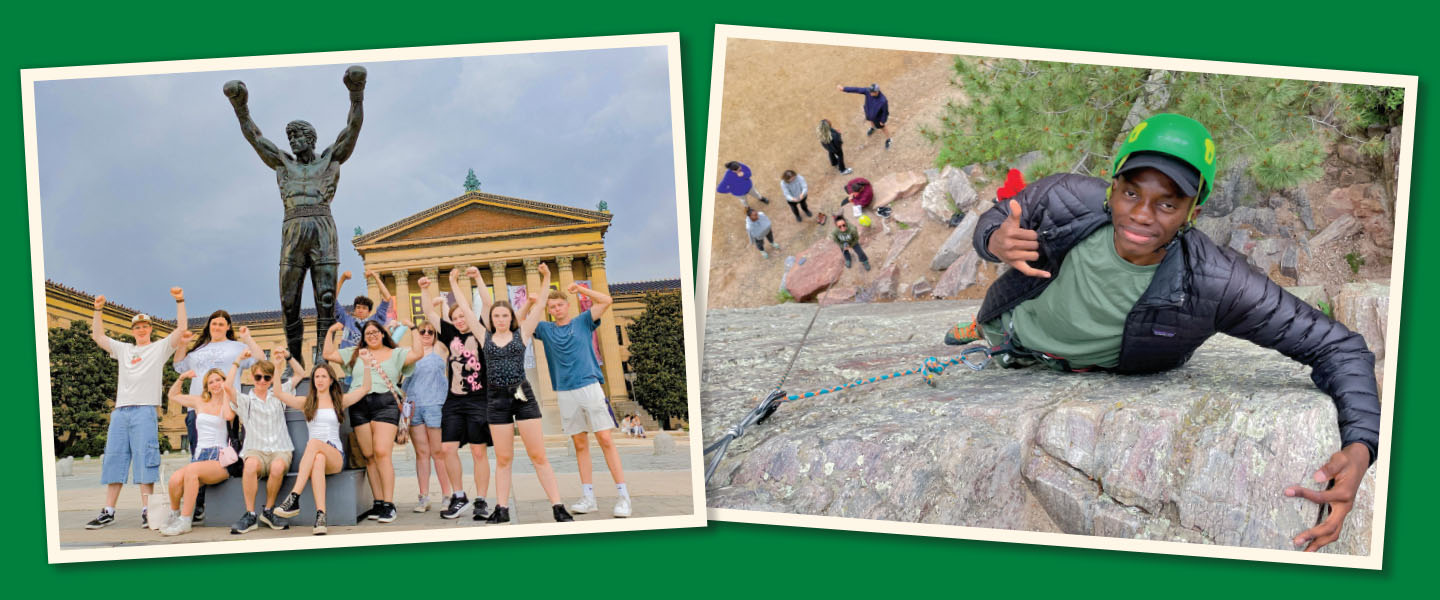

A.E.P. participants pose like Rocky in Philadelphia and rock climb in Colorado. Courtesy of American Exchange Project

Standards

The American Exchange Project

Meet the teens who are being sent on trips across the nation in an effort to reduce political polarization

One Friday afternoon in March, nine students—all seniors at The Morgan School in Clinton, Connecticut—sat onstage in the auditorium with a United States map projected behind them. In their hands, they each clutched a manilla envelope. They knew that in the summer they’d each be taking an all-expenses-paid trip to another state. There was one catch: When they signed up, they didn’t know where they’d be going. They were about to find out.

“You’re going to be traveling to a place unknown,” said Eric Bergman, the English teacher who had recruited the students for the program, “and you’re going to meet with people who you do not know, and you’re going to have to make the best of it.”

One Friday afternoon in March, nine seniors at The Morgan School in Clinton, Connecticut, sat onstage in the auditorium. There was a United States map projected behind them. They each held a manilla envelope. They knew that in the summer they’d each be taking an all-expenses-paid trip to another state. There was one catch: When they signed up, they didn’t know where they’d be going. They were about to find out.

“You’re going to be traveling to a place unknown,” said Eric Bergman, the English teacher who had recruited the students for the program, “and you’re going to meet with people who you do not know, and you’re going to have to make the best of it.”

‘We have inaccurate ideas about people who are different from us.’

Courtesy of American Exchange Project

One by one, the students opened their envelopes and announced where they’d be going, to much applause and laughter. The states included Alaska, Arkansas, Nebraska, and Texas.

“Oh my god, I got Colorado!” one student shrieked.

The students were all participating in a program run by the American Exchange Project (A.E.P.), a non-partisan organization that sends recent high school graduates on week-long trips across America in an attempt to reduce political polarization in an increasingly divided nation. The goal is for students to meet people with different views, experience another part of the country, and, ideally, learn to treat other Americans with more civility.

One by one, the students opened their envelopes. They announced where they’d be going, to much applause and laughter. The states included Alaska, Arkansas, Nebraska, and Texas.

“Oh my god, I got Colorado!” one student shrieked.

The students were all participating in a program run by the American Exchange Project (A.E.P.). The non-partisan organization sends recent high school graduates on weeklong trips. The goal of the A.E.P. is to reduce political polarization in an increasingly divided nation. The students meet people with different views and experience another part of the country. Ideally, they learn to treat other Americans with more civility too.

Courtesy of American Exchange Project

Students from Clinton, Connecticut, learn where they’ll be traveling with A.E.P.

About 40 percent of Americans have never met a farmer, almost three-quarters of White Americans don’t have a friend who’s not White, and roughly two-thirds of Americans have never met a Native American, notes David McCullough III, CEO and co-founder of A.E.P. “We have inaccurate ideas about people who are different from us . . . because we don’t know each other,” he says. “And so perhaps, if we got to know each other—especially at an early age, when you don’t have as many misperceptions to correct—then people are going to have greater empathy for people who they might otherwise be polarized against.”

About 40 percent of Americans have never met a farmer. Almost three-quarters of White Americans don’t have a friend who’s not White. Roughly two-thirds of Americans have never met a Native American. “We have inaccurate ideas about people who are different from us . . . because we don’t know each other,” says David McCullough III, CEO and co-founder of A.E.P. “And so perhaps, if we got to know each other—especially at an early age, when you don’t have as many misperceptions to correct—then people are going to have greater empathy for people who they might otherwise be polarized against.”

Courtesy of American Exchange Project

Relaxing at a host family home in New Hampshire

‘We’re Just So Far Apart’

A.E.P. was inspired in part by a road trip that McCullough—the grandson of the late Pulitzer Prize-winning historian of the same name—took in 2016, while he was a student at Yale University, in New Haven, Connecticut. As a self-proclaimed “kid of enormous privilege,” McCullough says that driving 7,100 miles across the U.S. and visiting communities such as Cotulla, Texas, and Pine Ridge, South Dakota, had a profound impact on him. One thing stuck out in particular: the sharp political divides that were springing up between Americans in the run-up to that year’s presidential election between Democrat Hillary Clinton and Republican Donald Trump.

“I found myself on the other side of America in that summer of the Trump and Clinton campaigns,” McCullough says. “We were realizing we’re just so far apart from one another. We’re so polarized.”

He thought that maybe, if young people could step out of their comfort zones and get to know people far from home, it could help break down some of that polarization. And so A.E.P. was born.

A.E.P. was inspired in part by a road trip that McCullough—the grandson of the late Pulitzer Prize-winning historian of the same name—took in 2016. At the time, he was a student at Yale University, in New Haven, Connecticut. As a self-proclaimed “kid of enormous privilege,” McCullough says that driving 7,100 miles across the U.S. and visiting communities such as Cotulla, Texas, and Pine Ridge, South Dakota, had a profound impact on him.  One thing stuck out to McCullough: Sharp political divides were springing up between Americans in the run-up to that year’s presidential election between Democrat Hillary Clinton and Republican Donald Trump.

“I found myself on the other side of America in that summer of the Trump and Clinton campaigns,” McCullough says. “We were realizing we’re just so far apart from one another. We’re so polarized.”

He thought that maybe, if young people could step out of their comfort zones and get to know people far from home, it could help break down some of that polarization. And so A.E.P. was born.

Courtesy of American Exchange Project

Students take a break from driving in Colorado.

Since the program began in 2019, about 1,500 students have taken part in an exchange. Participants must attend a school that’s registered with the A.E.P. Schools not only send some of their students out to other places, but also host a handful of students from around the country for a week each summer. All students fill out a survey about their interests, goals, availability, and more, and then they’re matched to a host family elsewhere in the U.S.

On their trips, students do all kinds of sightseeing and adventuring together, from hiking and camping to visiting museums to indulging in local foods. (All costs, including airfare, are covered by A.E.P., which is funded by donors.) And when it’s their school’s turn to host an exchange, the students get an additional chance to connect with teens from other areas.

Since the program began in 2019, about 1,500 students have taken part in an exchange. Participants must attend a school that’s registered with the A.E.P. That means each school not only sends some of its students out to other places, but it also hosts a handful of students from around the country for a week each summer. All students fill out a survey about their interests, goals, availability, and more. Then they’re matched to a host family elsewhere in the U.S.

On their trips, students do all kinds of sightseeing and adventuring together. They do everything from hiking and camping to visiting museums to indulging in local foods. (All costs, including airfare, are covered by A.E.P., which is funded by donors.) And when it’s their school’s turn to host an exchange, the students get an additional chance to connect with teens from other areas.

Courtesy of American Exchange Project

Learning beekeeping in Illinois

Preconceived Notions

Despite A.E.P.’s ultimate goals to prevent polarization, the trips are more focused on making sure the students have fun together, rather than forcing them to talk about politics or other controversial matters.

“If you go to an exchange project trip, all of the big, weighty things . . . are not readily apparent,” McCullough says. “What is readily apparent is a bunch of kids . . . having a blast.”

Anyla Tobias, 19, of New Orleans, wasn’t sure what to think when she first found out she’d be traveling to Maine with A.E.P. in 2024.

“I don’t even think I’d heard of Portland, Maine,” she says. “I looked it up on TikTok and was like ‘Look at this!’ There was a lot of seafood and a lot of water.”

Despite A.E.P.’s ultimate goals to prevent polarization, the trips are more focused on making sure the students have fun together, rather than forcing them to talk about politics or other controversial matters.

“If you go to an exchange project trip, all of the big, weighty things . . . are not readily apparent,” McCullough says. “What is readily apparent is a bunch of kids . . . having a blast.”

Anyla Tobias, 19, of New Orleans, participated in the program in 2024. She wasn’t sure what to think when she first found out she’d be traveling to Maine.

“I don’t even think I’d heard of Portland, Maine,” she says. “I looked it up on TikTok and was like ‘Look at this!’ There was a lot of seafood and a lot of water.”

About 1,500 students have taken part in an A.E.P. exchange.

Once she got to Portland, though, Tobias was immediately impressed by how different it was from her hometown.

“It just felt so peaceful,” she says. “It felt like a breath of fresh air.”

She quickly bonded with her host family, who went out of their way to make her feel welcome. Together they played games, watched movies, and talked about their different cultures. Tobias even cooked some of her favorite Southern food—including smoked chicken with gravy and rice—to share with everyone.

“I felt like [my host family] really wanted to connect and make me feel like I was at home,” she says.

Karley Hardman, 19, of Lake Charles, Louisiana, was similarly full of trepidation when she realized she’d be headed to Anchorage, Alaska, last summer.

“My first thought was, ‘Oh my goodness, I don’t know what’s up there,’” she says. “‘I’m gonna be in the wilderness. I’m gonna be in the woods all day.’”

Once she got to Portland, though, Tobias was immediately impressed by how different it was from her hometown.

“It just felt so peaceful,” she says. “It felt like a breath of fresh air.”

She quickly bonded with her host family. They went out of their way to make her feel welcome. Together they played games, watched movies, and talked about their different cultures. Tobias even cooked some of her favorite Southern food—including smoked chicken with gravy and rice—to share with everyone.

“I felt like [my host family] really wanted to connect and make me feel like I was at home,” she says.

Karley Hardman, 19, of Lake Charles, Louisiana, was similarly full of anxiety when she realized she’d be headed to Anchorage, Alaska, last summer.

“My first thought was, ‘Oh my goodness, I don’t know what’s up there,’” she says. “‘I’m gonna be in the wilderness. I’m gonna be in the woods all day.’”

Courtesy of American Exchange Project

Visiting New York City

Her host family and fellow exchange members probably had preconceived notions about her too, she admits, noting that sometimes her accent “slips out” during conversation.

“It probably seemed like I was some country bumpkin or something,” she adds.

Those misconceptions were quickly put to rest on the trip, however. Hardman and her group did spend a day or two camping in the wilderness and hiking a glacier, but they also visited urban areas, learned about Alaska’s Indigenous people, and formed tight bonds with each other.

“I learned from my trip that looking into other people’s perspectives, stepping into their shoes—it helps you see the world better,” Hardman says.

Her host family and fellow exchange members probably had preconceived notions about her too. She admits that sometimes her accent “slips out” during conversation.

“It probably seemed like I was some country bumpkin or something,” she adds.

Those misconceptions were quickly put to rest on the trip, however. Hardman and her group did spend a day or two camping in the wilderness and hiking a glacier. They also visited urban areas, learned about Alaska’s Indigenous people, and formed tight bonds with each other.

“I learned from my trip that looking into other people’s perspectives, stepping into their shoes—it helps you see the world better,” Hardman says.

Courtesy of American Exchange Project

Hiking in the mountains of Utah

Talking to Strangers

Although A.E.P. exchanges are focused on fun, politics inevitably comes up during many of them.

In July, four months after that March assembly, the Morgan School hosted 10 students who came from states such as Georgia, Oklahoma, and Utah. On the last full day of the exchange, the students sat around a picnic table outside Meigs Point Nature Center in Madison, Connecticut, reflecting on a week of activities and how the trip had made them think differently about the rest of the country.

“This trip really changed my idea of what an American is. [The East Coast] doesn’t feel like America to me,” said Gage Burdine, 18, of Lincoln, Nebraska. “Whenever I heard the question ‘What is America to you?,’ I had an answer, but now I don’t know.”

Although A.E.P. exchanges are focused on fun, politics inevitably comes up during many of them.

In July, four months after that March assembly, the Morgan School hosted 10 students who came from states such as Georgia, Oklahoma, and Utah. On the last full day of the exchange, the students sat around a picnic table outside Meigs Point Nature Center in Madison, Connecticut. They reflected on a week of activities and how the trip had made them think differently about the rest of the country.

“This trip really changed my idea of what an American is. [The East Coast] doesn’t feel like America to me,” said Gage Burdine, 18, of Lincoln, Nebraska. “Whenever I heard the question ‘What is America to you?,’ I had an answer, but now I don’t know.”

‘We need to know how to disagree in a productive way.’

Burdine—who said he’s “very conservative” compared with many he’d met on the East Coast—was initially hesitant to talk about his beliefs in front of the group, worried that he might be ostracized. But he found that as the week went on, he was able to speak up more.

“You have to be able to have those real conversations,” added Kelly Arnold, 18, of Tulsa, Oklahoma. “It’s hard to trust strangers . . . and say, ‘Hey, this is what I truly believe.’ That’s opening your heart up, and that makes it really easy for me to stick a knife in there. But also, the more open you are, the easier it is for other people to open up [too].”

Part of America’s problem today, some students agreed, is that people aren’t willing to hear each other out.

“It’s impossible to make everybody talk to each other and reach a compromise in such a big place,” Burdine said.

“We always have this idea that America needs to be unified, and I think that we need to stop hanging on to this,” said Simon Williams, 18, of Lawrence, Kansas. “We need to know how to disagree in a productive way. . . . We’re never gonna have unity. We’re too big.”

On that note, the political discussion ended, and the students scooped up their bags and made their way to the beach across the street. They grabbed burgers and fries from the food stand and sat together at another picnic table, this time laughing and chatting about TV shows, inside jokes, and the evening’s dinner plans. Then they headed down toward the water, ready to spend their last afternoon together.

Burdine—who said he’s “very conservative” compared with many he’d met on the East Coast—was initially hesitant to talk about his beliefs in front of the group. He was worried that he might be excluded. But he found that as the week went on, he was able to speak up more.

“You have to be able to have those real conversations,” added Kelly Arnold, 18, of Tulsa, Oklahoma. “It’s hard to trust strangers . . . and say, ‘Hey, this is what I truly believe.’ That’s opening your heart up, and that makes it really easy for me to stick a knife in there. But also, the more open you are, the easier it is for other people to open up [too].”

Some students agreed that part of America’s problem today is that people aren’t willing to hear each other out.

“It’s impossible to make everybody talk to each other and reach a compromise in such a big place,” Burdine said.

“We always have this idea that America needs to be unified, and I think that we need to stop hanging on to this,” said Simon Williams, 18, of Lawrence, Kansas. “We need to know how to disagree in a productive way. . . . We’re never gonna have unity. We’re too big.”

On that note, the political discussion ended. The students picked up their bags and made their way to the beach across the street. They grabbed burgers and fries from the food stand and sat together at another picnic table, this time laughing and chatting about TV shows, inside jokes, and the evening’s dinner plans. Then they headed down toward the water, ready to spend their last afternoon together.

A Pair of Teens Talk About Their Trips
Two teens talk about what it was like to stay with families in other states and learn about different lifestyles and ideas.

Fed Up With Polarization

Many Americans are frustrated by the current state of politics. Here's what recent polls have shown.

Dissatisfied with the system:
Only 4 percent of U.S. adults say the political system is working extremely or very well. More than 60 percent express not much or no confidence
in the future of the political system.

A lack of trust:
16 percent say they trust the federal government always or most of the time, the lowest share ever.

No love for parties:
28 percent of Americans have an unfavorable opinion of both the Republican and Democratic parties, compared with 6 percent in 1994.

Not enough cooperation:
84 percent of U.S. adults think that Americans of different political views should come together and work out their differences.

Sources: Pew Research Center; YouGov; The Economist

Dissatisfied with the system:
Only 4 percent of U.S. adults say the political system is working extremely or very well. More than 60 percent express not much or no confidence
in the future of the political system.

A lack of trust:
16 percent say they trust the federal government always or most of the time, the lowest share ever.

No love for parties:
28 percent of Americans have an unfavorable opinion of both the Republican and Democratic parties, compared with 6 percent in 1994.

Not enough cooperation:
84 percent of U.S. adults think that Americans of different political views should come together and work out their differences.

Sources: Pew Research Center; YouGov; The Economist

videos (1)
Skills Sheets (5)
Skills Sheets (5)
Skills Sheets (5)
Skills Sheets (5)
Skills Sheets (5)
Lesson Plan (1)
Leveled Articles (1)
Text-to-Speech