

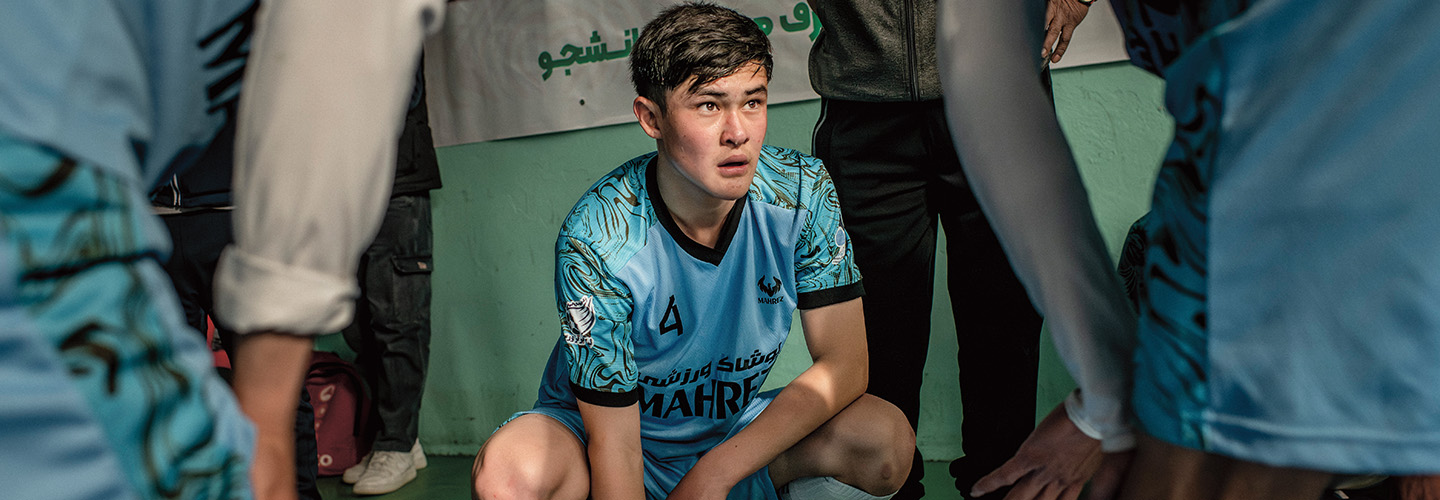

A young soccer player in a number 4 jersey crouches among teammates on a sideline bench

Alireza Ahmadi during a futsal match in Kabul, 2025. Tomás Munita/The New York Times

Standards

Afghanistan’s Unlikely Star

Teen athlete Alireza Ahmadi is from an ethnic group long marginalized in Afghanistan. He’s also a national hero.

Jim McMahon

After a lukewarm shower in the freezing winter of Afghanistan’s capital, Kabul, Alireza Ahmadi combed his hair, tucked his white shirt into his black pants, and stepped onto the court.

The 17-year-old is his nation’s newest phenom, playing futsal, a fast indoor variant of soccer with five players on each side. Word had spread that he was participating in a local tournament that afternoon, and fans rushed to snap selfies with him as he exited the locker room.

Alireza became a national hero after scoring the winning goal against Afghanistan’s archrival, Iran, at the Asian Youth Games in Bahrain in 2025. It was the country’s first title. The victory spurred an outburst of collective joy that’s become rare under the Taliban’s strict Islamic rule (see timeline, below). When the team returned to Afghanistan, fans were so jubilant they ignored prohibitions on playing music in public and posting videos online. The win changed how many Afghans perceive their own country.

“We’re trying from our end to show a different image of Afghanistan,” Alireza says. “There was war here. Now we want to host more games with foreign teams.”

After a lukewarm shower, Alireza Ahmadi combed his hair and tucked his white shirt into his black pants. He stepped onto the court in the freezing winter of Afghanistan’s capital, Kabul.

The 17-year-old is his nation’s newest phenom. He plays futsal, a fast indoor variant of soccer with five players on each side. Word had spread that he was participating in a local tournament that afternoon. Fans rushed to snap selfies with him as he exited the locker room.

Alireza became a national hero after scoring the winning goal against Afghanistan’s archrival, Iran, at the Asian Youth Games in Bahrain in 2025. It was the country’s first title. The victory caused an outburst of joy that’s rare under the Taliban’s strict Islamic rule (see timeline, below). Fans were so excited when the team returned home, they ignored prohibitions on playing music in public and posting videos online. The win changed how many Afghans perceive their own country.

“We’re trying from our end to show a different image of Afghanistan,” Alireza says. “There was war here. Now we want to host more games with foreign teams.”

Tomás Munita/The New York Times

Soccer in Daikundi Province

But Alireza’s fame is extraordinary for another reason. He and nearly all of his teammates are Hazaras, a religious and ethnic minority long marginalized by the Taliban. Hazaras make up from 10 to 20 percent of Afghanistan’s population. They are Shiite Muslims among a Sunni majority and have faced violence and discrimination for the past 150 years. Since the Taliban swept back into power in 2021, they have evicted some Hazara communities from their ancestral lands, excluded them from higher levels of government, and diverted humanitarian aid bound for Hazara-majority provinces, human rights groups say.

Public adoration for the team could amount to defiance of the Taliban. Wherever the team travels, Afghans celebrate together—playing music, taking videos, flouting the rules.

“We brought people pride, and they responded with warmth,” Alireza says.

But Alireza’s fame is extraordinary for another reason. He and nearly all of his teammates are Hazaras, a religious and ethnic minority long marginalized by the Taliban. Hazaras make up from 10 to 20 percent of Afghanistan’s population. They are Shiite Muslims among a Sunni majority. For the past 150 years, they have faced violence and discrimination. Since the Taliban came back into power in 2021, they have evicted some Hazara communities from their ancestral lands. They have also excluded Hazaras from higher levels of government and redirected humanitarian aid bound for Hazara-majority provinces, human rights groups say.

Public adoration for the team could amount to defiance of the Taliban. Wherever the team travels, Afghans celebrate together—playing music, taking videos, flouting the rules.

“We brought people pride, and they responded with warmth,” Alireza says.

Tomás Munita/The New York Times

Futsal in Kabul, last year

Rising Sport

Though cricket remains the most popular sport in Afghanistan, the team’s victory in Bahrain has accelerated the rise of futsal.

“Futsal is more popular than soccer in the cities because there are more indoor futsal courts than proper soccer pitches,” says Alireza’s teammate Hamza Qasimi.

Afghanistan has 1,000 futsal courts across the country, 400 of them in Kabul, according to the Afghan soccer federation. Attendance at games has surged since the youth team’s victory, coaches and court managers say.

In the rugged stretches outside of Kabul, the courts are the most imposing structures around—steel frames and floodlights rising from empty lots. At night, the buildings look like spaceships. In the winter, the covered arenas become gathering places, with dozens of fans watching from the stands overlooking the pristine courts.

Though cricket remains the most popular sport in Afghanistan, the team’s victory in Bahrain has sped up the rise of futsal.

“Futsal is more popular than soccer in the cities because there are more indoor futsal courts than proper soccer pitches,” says Alireza’s teammate Hamza Qasimi.

According to the Afghan soccer federation, there are 1,000 futsal courts across the country, with 400 of them in Kabul. Attendance at games has risen rapidly since the youth team’s victory, coaches and court managers say.

In the rugged stretches outside of Kabul, the courts are the most imposing structures around. The steel frames and floodlights rise from empty lots. At night, the buildings look like spaceships. In the winter, the covered arenas become gathering places. Dozens of fans watch from the stands overlooking the pristine courts.

Alireza has become a celebrity beyond the futsal court.

In Dasht-e-Barchi, the Hazara neighborhood in Kabul where Alireza grew up, the sport has become inescapable.

“You can’t find a family without a kid playing futsal,” says Ghazanfar Arian, who organizes tournaments in the city.

With his neatly trimmed hair and shy smile, Alireza has become a celebrity well beyond the futsal court. He has appeared in an ad for an Afghan soft drink. His match videos and messages draw tens of thousands of views, even as the Taliban have banned the depiction of human beings on television and social media, calling it a form of idolatry.

In Dasht-e-Barchi, the Hazara neighborhood in Kabul where Alireza grew up, the sport has become inescapable.

“You can’t find a family without a kid playing futsal,” says Ghazanfar Arian, who organizes tournaments in the city.

With his neatly trimmed hair and shy smile, Alireza has become a celebrity. He has appeared in an ad for an Afghan soft drink. His match videos and messages draw tens of thousands of views, even as the Taliban have banned the depiction of human beings on television and social media, calling it a form of idolatry.

Tomás Munita/The New York Times

Hamza Qasimi and teammates before a game in Kabul

‘A Day of Joy’

Last November, thousands of people welcomed the team in Herat, a city that’s home to a large Hazara population. Fathers hoisted sons on their shoulders for a glimpse of the players. Fans threw firecrackers and played music, swamping officers from Afghanistan’s feared Ministry for the Prevention of Vice and Promotion of Virtue, the agency in charge of implementing Taliban law. When officers tried to stop photography, hundreds of smartphones lit up the stands in response. As security forces lined up for the evening prayer, crowds rushed to the futsal court and surrounded the players for selfies.

“I request officials from the ministry for promotion of virtue not to harass the youth,” Shah Rasol Ehrari, Herat’s soccer federation head, told the crowds. “Today is a day of joy.”

Last November, thousands of people welcomed the team in Herat, a city that’s home to a large Hazara population. Fathers put sons on their shoulders to be able to see the players. Fans threw firecrackers and played music. They swamped officers from Afghanistan’s feared Ministry for the Prevention of Vice and Promotion of Virtue, the agency in charge of implementing Taliban law. Officers tried to stop photography, but hundreds of smartphones lit up the stands in response. As security forces lined up for the evening prayer, crowds rushed to the futsal court. They surrounded the players for selfies.

“I request officials from the ministry for promotion of virtue not to harass the youth,” Shah Rasol Ehrari, Herat’s soccer federation head, told the crowds. “Today is a day of joy.”

Tomás Munita/The New York Times

A futsal team celebrates a victory in Kabul.

Surprised by the youth team’s popularity, the Taliban have rewarded Alireza and his teammates with cars and motorcycles. During a ceremony in January, a Taliban official noted the favorable attention futsal had been getting recently in the international press. It was less than five years since the Taliban banned women from sports. Since then, members of the Afghanistan women’s national soccer team have lived in exile.

Alireza says he had dreamed of joining Afghanistan’s senior squad or pro clubs in Europe. But he plans instead to honor his parents’ wishes and study medicine.

For now, his focus remains on the court. He’s training for the Youth Olympic Games in Senegal in November, where the Afghan team is scheduled to compete.

“We had that strength in Bahrain, that we found each other easily on the pitch,” he says. “When Afghanistan is united, we can win.”

Surprised by the youth team’s popularity, the Taliban have rewarded Alireza and his teammates with cars and motorcycles. During a ceremony in January, a Taliban official noted the favorable attention futsal had been getting recently in the international press. It was less than five years since the Taliban banned women from sports. Members of the Afghanistan women’s national soccer team still live in exile.

Alireza says he had dreamed of joining Afghanistan’s senior squad or pro clubs in Europe. But he plans instead to honor his parents’ wishes and study medicine.

For now, his focus remains on the court. He’s training for the Youth Olympic Games in Senegal in November, where the Afghan team is scheduled to compete.

“We had that strength in Bahrain, that we found each other easily on the pitch,” he says. “When Afghanistan is united, we can win.”

Elian Peltier is The New York Times’s bureau chief for Pakistan and Afghanistan; Yaqoob Akbary is a reporter for The Times.

Elian Peltier is The New York Times’s bureau chief for Pakistan and Afghanistan; Yaqoob Akbary is a reporter for The Times.

Why So Many Afghans Have Been Forced Out of Iran
Amid economic and military turmoil, Iran has expelled hundreds of thousands of Afghans.

67%

PERCENTAGE of Afghan population that was Hazara before persecution began in the late 19th century.

Source: Britannica

PERCENTAGE of Afghan population that was Hazara before persecution began in the late 19th century.

Source: Britannica

Young Lives Under the Taliban

Many young people can’t go to school or have been displaced from their homes

Jim Huylebroek/The New York Times

Khurshid, 18, lives in a refugee camp.

Since the Taliban reclaimed power in 2021, Afghanistan’s economy has collapsed, largely because of international sanctions and reductions in foreign aid. More than 90 percent of the country’s 45 million people live in poverty. Roughly half are under 18.

Opportunities are scarce for young Afghans. Many boys have dropped out of school to work or have fled the country in search of jobs. Girls can’t attend school beyond the sixth grade, by Taliban decree. Some take courses online, but internet outages—often imposed by the Taliban to quell dissent—cause frequent disruptions.

“We are always at home, so the internet was our only way to tell other people that we are alive,” says Mahsa*, 20.

Many Afghan teens are refugees in their own country. Their families fled to Iran years ago and were driven back by the Iranian government, which increasingly has called the immigrants a threat to national security. Some of these teens spent their whole lives there.

Ali Akbar, 14, now lives in a refugee camp in Afghanistan near the Iran border. In his backpack are his most precious belongings—a deflated soccer ball, a speaker, and headphones to listen to his favorite Iranian hits.

“The only kind of music I understand,” he says.

Khurshid, 18, was born in Iran, where she could wear denim and trendy sneakers, a style she picked up on social media. She’ll have to give up all of that now, she says.

“Afghanistan is like a cage for women,” she says, “and we’re coming back to that cage.”

—Brian S. McGrath

Since the Taliban reclaimed power in 2021, Afghanistan’s economy has collapsed, largely because of international sanctions and reductions in foreign aid. More than 90 percent of the country’s 45 million people live in poverty. Roughly half are under 18.

Opportunities are scarce for young Afghans. Many boys have dropped out of school to work or have fled the country in search of jobs. Girls can’t attend school beyond the sixth grade, by Taliban decree. Some take courses online, but internet outages—often imposed by the Taliban to quell dissent—cause frequent disruptions.

“We are always at home, so the internet was our only way to tell other people that we are alive,” says Mahsa*, 20.

Many Afghan teens are refugees in their own country. Their families fled to Iran years ago and were driven back by the Iranian government, which increasingly has called the immigrants a threat to national security. Some of these teens spent their whole lives there.

Ali Akbar, 14, now lives in a refugee camp in Afghanistan near the Iran border. In his backpack are his most precious belongings—a deflated soccer ball, a speaker, and headphones to listen to his favorite Iranian hits.

“The only kind of music I understand,” he says.

Khurshid, 18, was born in Iran, where she could wear denim and trendy sneakers, a style she picked up on social media. She’ll have to give up all of that now, she says.

“Afghanistan is like a cage for women,” she says, “and we’re coming back to that cage.”

—Brian S. McGrath

*Some teens interviewed for this article asked to be identified only by their first names.

*Some teens interviewed for this article asked to be identified only by their first names.

videos (1)
Skills Sheets (5)
Skills Sheets (5)
Skills Sheets (5)
Skills Sheets (5)
Skills Sheets (5)
Lesson Plan (1)
Leveled Articles (1)
Text-to-Speech