

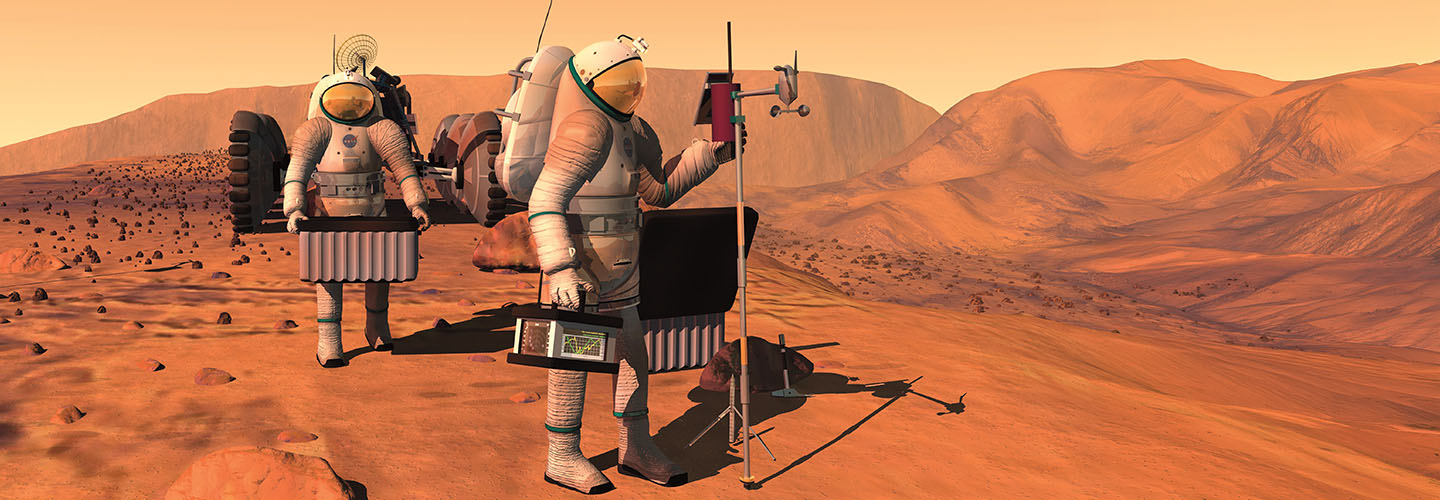

Two astronauts in spacesuits set up scientific equipment on the surface of Mars near a rover

Astronauts set up equipment for monitoring the weather on Mars, in an artist’s rendering for NASA. NASA

Standards

Should Humans Go to Mars?

With the U.S. space agency NASA planning a return to the moon’s surface as early as 2028, some believe a visit to Mars is the next logical next step for the space program.


Thanks to recent technological advancements, reaching—and surviving- on—Mars now seems possible within your lifetime. NASA and several private space companies are already developing the rocket technology that would make the 140-million-mile-long trip to Mars possible.


Yet while most experts agree that we’ll one day be able to send people to Mars, not all of them think doing so is a good idea.


So should humans go to Mars? Two aerospace scientists weigh in.

For decades the idea of humans living on Mars has fascinated scientists—and everyone else. And with recent developments in technology, we can live there. Human settlement on Mars would be an achievement in itself. But it would also bring us closer to answering questions we’ve long been asking: Does life exist on Mars today? What can the planet tell us about Earth’s past, present, and future?

While robots have been extremely helpful in studying Mars—they helped scientists discover ice below the planet’s surface, for example—human explorers would be better. They can make quicker decisions, without having to rely on commands from scientists on Earth, like robots do. What takes a rover days or weeks to analyze takes a person just hours. Humans will also get around much faster. The Curiosity rover, which is currently on Mars, can only travel about the length of a football field in one day.

Humans will one day live and work safely on Mars.

Human settlement will demonstrate our capacity for ingenuity. People living on Mars will be able to grow much of their food in specialized greenhouses. Inedible stems will be used in bioreactors to produce oxygen and fuel. We’ve also made huge strides in recycling water and generating oxygen from Mars’s atmosphere. To assist our human settlers, we can program robots to perform some dangerous tasks.

A key concern has been how to protect astronauts from radiation. Mars lacks a thick atmosphere like Earth’s, which serves as a barrier against galactic cosmic rays (energy from faraway exploding stars). But by using newly developed techniques in gene editing, we may be able to repair DNA that’s been damaged by radiation, or even enhance astronauts’ immune systems before the mission to prevent cancer.

With these advances, we can be confident that humans will one day live and work on Mars.

JAMES L. GREEN
Adviser, Space 11 aerospace company, former NASA chief scientist

Mars is certainly an interesting place for scientists to study. But sending people there for long periods of time would be extremely unsafe and unnecessary.

Space is a very hazardous place for humans, in particular because of cosmic radiation, which can cause cancer and even brain damage. The longer astronauts are in space, traveling to Mars or living on its surface, the more they’ll be exposed to radiation. NASA’s rovers—basically robotic scientists—have been on Mars for years. There’s still lots of important science robots can carry out before assuming the dangers of a human mission.

The rovers have found evidence that Mars could once have sustained indigenous life—one of our biggest reasons for studying the planet. Humans could ruin that work by bringing microbes from Earth and contaminating the Martian samples. Was Martian life like ours? Did it evolve in the same way, or is it entirely different? We’d never answer these questions with ruined samples. Then factor in the cost of human settlement—hundreds of billions of dollars, far more than the cost of sending rovers. Considering the harm we’ve done to our own planet, why would we risk harming another?

Space is a very hazardous place for humans.

Luckily, there’s a safer destination for humans in our solar system: Saturn’s moon Titan. Located 745 million miles from Earth, it has a thick atmosphere that provides protection from dangerous radiation. Titan has other qualities that could help us learn more about our home planet: lakes and seas, as well as wind, weather, and seasons similar to Earth’s. If we’re determined to invest in human settlement, we should do it there.

Human exploration of any planet or moon beyond ours is likely to be far in the future. It will be an enormous challenge to get humans safely to these places. We should take that giant scientific leap only when we’re ready, and we shouldn’t subject our brave astronauts—and the success of the missions—to undue risk.

AMANDA HENDRIX
Senior Scientist & Director, Planetary Science Institute

By the Numbers

6

MINIMUM NUMBER of months it would take to travel the 140 million miles to Mars. It could take up to 9 months depending on Earth’s position in relation to Mars.

-85˚F

AVERAGE TEMPERATURE on Mars, where it ranges from -225˚F to the mid-70s.


Source: NASA

What does your class think?

Should humans go to Mars?

Please enter a valid number of votes for one class to proceed.

Should humans go to Mars?

Please select an answer to vote.

Should humans go to Mars?

0%
0votes
{{result.answer}}
Total Votes: 0
Thank you for voting!
Sorry, an error occurred and your vote could not be processed. Please try again later.
Skills Sheets (1)
Lesson Plan (1)
Text-to-Speech