

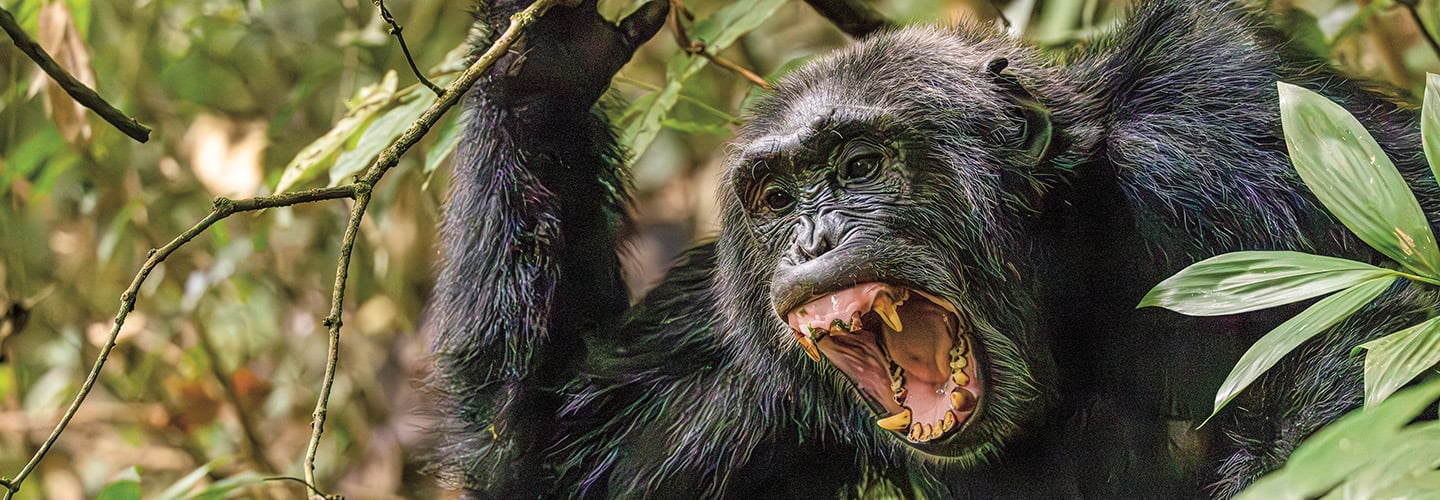

A chimpanzee opens its mouth wide to bare its teeth while gripping a branch overhead in the forest

A chimpanzee in the Ugandan rainforest. Beata Whitehead/Getty Images

Standards

A Chimp Civil War

Primates in Uganda are locked in a violent conflict. What can they teach us about the origins of human warfare?

One day in June 2015, scientists studying chimpanzees in the forests of Uganda witnessed something strange. Researcher John Mitani was following a group of chimps when they suddenly ran down a slope, catching up with a second band of chimps. The apes screamed and fought. The second group ultimately fled, with Mitani’s chimps in pursuit.

“All hell broke loose,” recalls Mitani, one of the founders of the Ngogo Chimpanzee Project.

At first, the researchers thought that confrontation was a fluke. But over the next few years, Mitani and his colleagues observed an unusual amount of violence between the two groups of chimpanzees.

Now researchers are reporting that the Ugandan chimps are locked in a primate version of civil war. Scientists have never seen such widespread, long-running bloodshed among chimpanzees.

“All of a sudden, yesterday’s friend becomes today’s foe,” Mitani says.

Something strange happened in the forests of Uganda in June 2015. John Mitani, a scientist studying chimpanzees, witnessed a group of chimps running down a slope. They caught up with a second group of chimps. The apes screamed and fought. The second group ultimately fled, with the other chimps in pursuit.

“All hell broke loose,” recalls Mitani, one of the founders of the Ngogo Chimpanzee Project.

At first, the researchers thought that confrontation was a one-time occurrence. But over the next few years, Mitani and his colleagues saw an unusual amount of violence between the two groups of chimpanzees.

Now researchers are reporting that the Ugandan chimps are locked in a primate version of civil war. Scientists have never seen such widespread, long-running bloodshed among chimpanzees.

“All of a sudden, yesterday’s friend becomes today’s foe,” Mitani says.

Clusters & Conflicts

For more than 30 years, scientists have tracked the Ngogo group, a community of chimps named for a hill in Kibale National Park where they live.

When they started following the Ngogo chimpanzees, they were struck by the sheer number of apes: more than 100 across a territory of about 10 square miles. The group grew over the years, ultimately swelling to 200 apes that wandered the forest in small bands in search of food. If two bands met up, they’d have a pleasant reunion.

“They start grooming each other, they start socializing, they start acting as one,” says Mitani.

A chimpanzee might leave a band and join another several times a day. But each chimpanzee had its closest ties to one of the three communities—known as the Western, Central, and Eastern clusters.

For more than 30 years, scientists have tracked the Ngogo group. The community of chimps is named for a hill in Kibale National Park where they live.

When they started following the Ngogo chimpanzees, the large community consisted of 100 apes across a territory of about 10 square miles. The group grew over the  years to 200 apes. They wandered the forest in small bands in search of food. If two bands met up, they’d have a pleasant reunion.

“They start grooming each other, they start socializing, they start acting as one,” says Mitani.

A chimpanzee might leave a band and join another several times a day. But each chimpanzee had its closest ties to one of the three communities—known as the Western, Central, and Eastern clusters.

Scientists have never seen such violence among chimps.

Originally, these groups were unified. Males and females from different clusters mated. The males all formed border patrols and hunting parties. They even fought together against a neighboring group of chimpanzees, driving them away and expanding the Ngogo range.

But then came the confrontation in 2015, which was between Western and Central chimps. By 2018, the conflicts were turning deadly.

Only once before had primatologists observed a group of chimpanzees so violently split. British primatologist Jane Goodall and her colleagues documented confrontations among about two dozen chimpanzees in the mid-1970s in Tanzania. But in the years that followed, no one saw other such conflicts. Researchers wondered if the battles among Goodall’s chimpanzees were unnatural. Some noted that she had provided bananas to the animals for years. Perhaps they had fought over the food in a way they wouldn’t have if they had been left alone.

The Ngogo conflict, however, showed that Goodall hadn’t witnessed a fluke. It also showed that chimpanzees could fight on a far bigger scale.

Originally, these groups were unified. Males and females from different groups mated. The males all formed border patrols and hunting parties. They even fought together against a neighboring group of chimpanzees. They drove them away and expanded the Ngogo territory.

But then came the confrontation in 2015. The Western and Central chimps began to fight. By 2018, the conflicts were turning deadly.

Only once before had primatologists observed a group of chimpanzees so violently split. British primatologist Jane Goodall and her colleagues documented confrontations among about two dozen chimpanzees in the mid-1970s in Tanzania. But in the years that followed, no one saw other such conflicts. Researchers wondered if the battles among Goodall’s chimpanzees were unnatural. She had provided bananas to the animals for years. Maybe this caused them to fight over the food in a way they wouldn’t have if they had been left alone.

The Ngogo conflict, however, showed that Goodall hadn’t witnessed a fluke. It also showed that chimpanzees could fight on a far bigger scale.

Jean-Marc Bouju/AP Images

Jane Goodall spent three decades studying chimps.

Social Bonds

The researchers found that the earliest hints of tension emerged in 2014. Over the next few years, the chimpanzees in the Western and Central clusters interacted less and less. They mated only within their own clusters. By 2018, the clusters were occupying different parts of the forest.

Then the killing started, and it hasn’t stopped. Mitani says that researchers have observed at least 28 violent deaths among the Ngogo great apes, including those of 19 infants. The numbers far exceed anything seen before. A group of chimps will take a baby from its mother, or hold down an adult or adolescent male, biting, kicking, and battering him.

What makes the conflict even more extraordinary is how lopsided it is. At the beginning, the Central cluster was much bigger than the Western cluster. But chimpanzees from the Western cluster have become far more aggressive, and every victim of the conflict so far has belonged to the Central cluster.

Scientists have no idea when the battles will simmer down. It’s conceivable that the Western cluster may ultimately eliminate the Central cluster of chimpanzees.

And the researchers are still trying to figure out what set off the conflict in the first place. Within any group of chimpanzees, violence will flare from time to time—when apes converge on a tree full of fruit, for example, or when lower-ranked males vie to replace an old male leader. But the friendships that form over the years usually dampen this aggression.

And some chimpanzees are especially social, jumping between many different cliques. They become “important social bridges,” says Aaron Sandel, co-director of the Ngogo Chimpanzee Project.

But in 2014, five adult males died, perhaps because of disease. Sandel speculates that these deaths ripped away some of the bridges that previously held the Ngogo groups together. Low-level conflicts blew up into something akin to civil war.

In 2014 researchers found the earliest hints of tension. Over the next few years, the chimpanzees in the Western and Central clusters interacted less and less. They mated only within their own clusters. By 2018, the clusters were living in different parts of the forest.

Then the killing started. It hasn’t stopped. Mitani says that researchers have seen at least 28 violent deaths among the Ngogo great apes, including 19 infants. They have never seen numbers that high. A group of chimps will take a baby from its mother. They will hold down an adult or adolescent male, biting, kicking, and battering him.

What makes the conflict even more unusual is how one-sided it is. At the beginning, the Central cluster was much bigger than the Western cluster. But chimpanzees from the Western cluster have become far more aggressive. Every victim of the conflict so far has been from the Central cluster.

Scientists have no idea when the battles will slow down. It’s possible that the Western cluster may ultimately eliminate the Central cluster of chimpanzees.

And the researchers are still trying to figure out what set off the conflict in the first place. Violence is possible within any group of chimpanzees from time to time. Fights can break out when apes converge on a tree full of fruit or when lower-ranked males try to replace an old male leader. But the friendships that form over the years usually reduce this aggression.

Usually, there are some chimpanzees who are especially social. They jump between many different cliques. They become “important social bridges,” says Aaron Sandel, co-director of the Ngogo Chimpanzee Project.

But in 2014, five adult males died, perhaps because of disease. Sandel thinks that these deaths ripped away some of the bridges that previously held the Ngogo groups together. Low-level conflicts blew up into something like a civil war.

Dr. Jane Goodall: We Must Take Action
A look at the anthropologist’s work, and Goodall’s warnings about humans’ impact on the environment.

The Ngogo conflict could offer a glimpse at the kind of violence that might have flared up among our ancient ancestors, given that chimpanzees are one of the closest living relatives to humans.

“These findings tell us indeed that these civil war-like types of conflicts were possible in the course of human evolution,” says Sylvain Lemoine, a primatologist at the University of Cambridge in England who was not involved in the study.

The Ngogo chimpanzees show how our ancestors could have gotten dragged into years of lethal fighting without being driven by differences in ideology or culture—let alone the language to talk about them. Instead, shifting social bonds might have been enough to light the fire.

As bleak as that lesson may be, Sandel sees a silver lining: Caring for social bonds can help counter violence.

“If that’s the case,” he says, “then conflict management in our own lives becomes a civic duty to bring about a more peaceful world.”

The Ngogo conflict could offer a glimpse of the kind of violence that might have happened among our ancient ancestors. (Chimpanzees are one of the closest living relatives to humans.)

“These findings tell us indeed that these civil war-like types of conflicts were possible in the course of human evolution,” says Sylvain Lemoine, a primatologist at the University of Cambridge in England who was not involved in the study.

The Ngogo chimpanzees show how our ancestors could have gotten dragged into years of deadly fighting without being driven by differences in ideology or culture—let alone the language to talk about them. Instead, shifting social bonds might have been enough to start conflicts.

Sandel sees a silver lining in this lesson: Caring for social bonds can help counter violence.

“If that’s the case,” he says, “then conflict management in our own lives becomes a civic duty to bring about a more peaceful world.”

Carl Zimmer covers science for The New York Times.

Carl Zimmer covers science for The New York Times.

95%

PERCENTAGE of DNA that chimps and humans share.

Source: Project Chimps

PERCENTAGE of DNA that chimps and humans share.

Source: Project Chimps

videos (1)
Skills Sheets (3)
Skills Sheets (3)
Skills Sheets (3)
Leveled Articles (1)
Text-to-Speech