
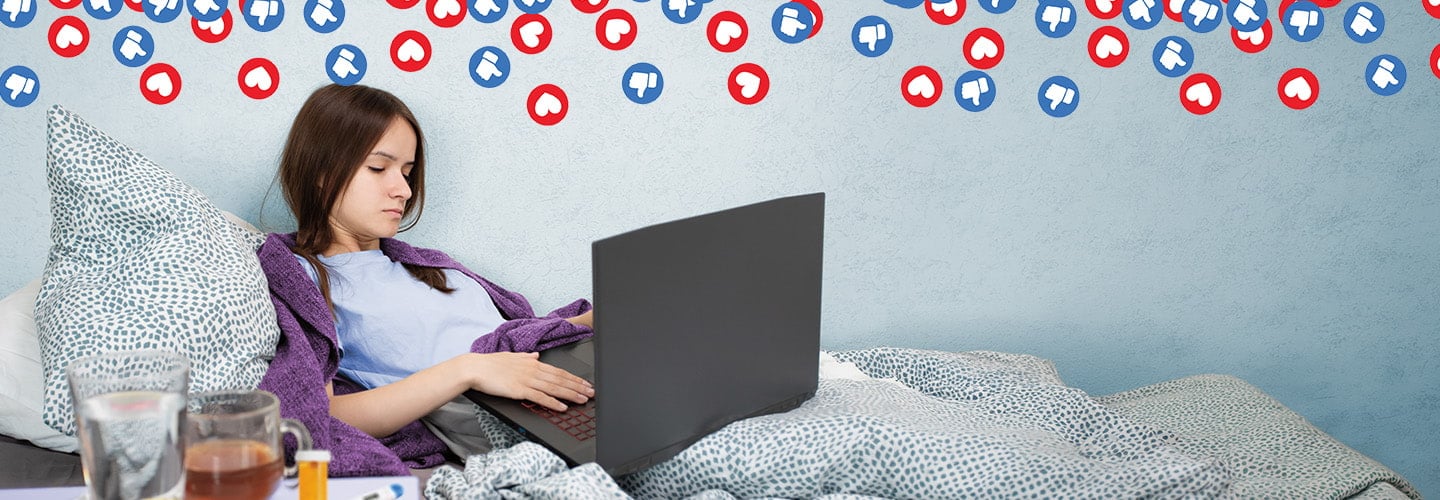

Composite image of a girl lying in bed typing on a laptop as heart & thumbs-down icons fill the wall

Shutterstock.com (all images)

Standards

Should We Trust Social Media for Health Advice?

Looking for a way to cope with stress? To get in shape? To get better sleep? An influencer wants to tell you how.

And people are listening. More and more Americans—including half of people under 25—are getting their health information from social media, according to the Pew Research Center. Many say influencers have helped them better understand how to be healthy.

Some influencers are real doctors who use their medical knowledge to give advice. But the large majority of influencers aren’t medical professionals.

So should we trust social media for health advice? A doctor with more than a million TikTok followers and a health communication expert face off.

Young people are increasingly turning to social media for health information. While that may raise concern, it also presents an opportunity. Social platforms can provide clear and credible health guidance—as long as it’s coming from a qualified professional.

Not all influencers are created equal. Some are licensed physicians, psychologists, or dietitians, who are trained in interpreting research and applying it responsibly, and offer reliable advice. Be sure to check for credentials. These experts can translate complex medical concepts into language people can understand and act on, whether that means using a home remedy or seeking a professional diagnosis and treatment.

Credible influencers ground their advice in science, not popular trends. They won’t claim to have a cure-all. Instead they’re transparent about the limitations of treatment. Why does this matter? Because there are no one-size-fits-all remedies. Anyone who promises an easy remedy is probably spreading misinformation.

Social media is a tool. Its benefits lie in how we use it.

With social media, professional doctors have the potential to improve public health on a scale they’ve long struggled to achieve. Now they can rapidly spread information about mental health and preventive care to people who don’t otherwise have access to trustworthy information. They can reduce the stigma around health issues that often prevent people from seeking treatment. And they can play a critical role in fighting misinformation by addressing health myths directly and providing clear, research-backed alternatives.

Social media is a tool. Its benefits lie in how we use it. When people are taught to evaluate credentials, question sources, and value evidence-based content, social media can become a powerful extension of public health education rather than a risk.

—SASHA HAMDANI
Psychiatrist, Social Media Influencer

Social media influencers may be so entertaining and relatable when they’re offering health advice that it feels like a friend’s talking to you. But that feeling can be deceiving.

Much of the health advice you find on social media is advertising. Influencers are either promoting their own shops and products, or they’re being paid by companies. They promote skin-care products, dietary supplements, even medications, often without telling you it’s an ad. In my survey of young people ages 15 to 25, more than half had bought a product based on an influencer’s recommendation. That’s a lot of trust—and a lot of money changing hands.

What’s worse is that most influencers have no medical training—the years it takes to fully understand how medications work and who can safely benefit from them. Influencers spend just minutes filming themselves applying products they’re paid to promote. Some recommend anti-aging serums to teenagers whose skin doesn’t need them. Others push protein supplements on boys who are already getting enough protein from their diet.

Most of the health advice you find on social media is advertising.

These pitches can be effective because they play on our insecurities. Social media has created the idea that our bodies are never good enough. Influencers use filtered photos, promote extreme diets, and set impossible ideals. For teens already navigating enormous pressure about who they are and how they look, this content isn’t just unhelpful. It can be genuinely harmful.

Some physicians and public health organizations do use social media responsibly. But their posts rarely go viral. Accurate information is not as eye-catching as a bold, inaccurate claim. So before trusting any health tip, ask yourself: “Is someone selling me something? Does this person have real medical credentials?” If you’re unsure, ask your doctor. Your health is too important to leave to an algorithm.

—RAFFAEL HEISS
Health Communication and Policy Expert, Management Center Innsbruck, Austria

By the Numbers

21%

PERCENTAGE of Americans under 30 who get health information from social media extremely often.

17%

PERCENTAGE of health influencers on Instagram, TikTok, or YouTube who have traditional medical backgrounds, such as doctors or nurses.

Source: Pew research center, 2026

What does your class think?

Should we trust social media for health advice?

Please enter a valid number of votes for one class to proceed.

Should we trust social media for health advice?

Please select an answer to vote.

Should we trust social media for health advice?

0%
0votes
{{result.answer}}
Total Votes: 0
Thank you for voting!
Sorry, an error occurred and your vote could not be processed. Please try again later.
Skills Sheets (1)
Lesson Plan (1)
Text-to-Speech