

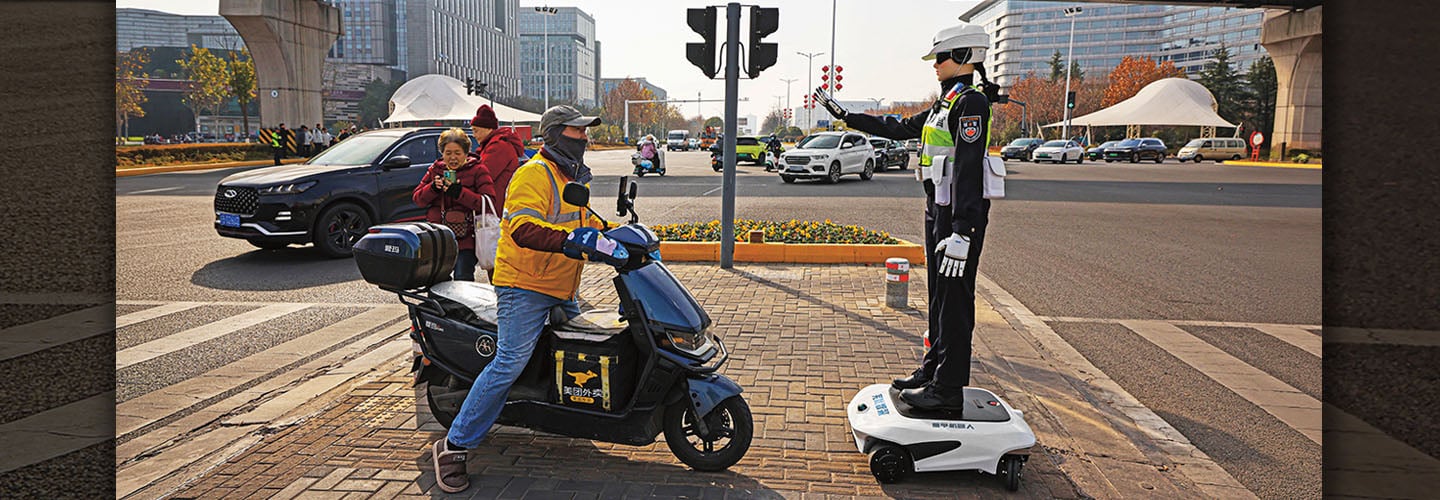

A traffic officer robot stands on a wheeled base and directs traffic at a busy urban intersection

Directing traffic: A police robot halts a motorcycle in Wuhu, China. Wang Yushi/VCG via Getty Images

Standards

In China, the Future Has Arrived

China is adopting technology faster than any other nation—in part, so it can monitor and control nearly every aspect of people’s lives

Jim McMahon

Americans visiting China these days might feel like they’ve entered the future. Robot delivery trucks and self-driving taxis roam city streets. Lunch orders arrive by drone. At a tech expo in Hangzhou in September 2025—which featured a humanoid robot boxing match—a salesman hawked bots for cleaning washrooms in railway stations and other public places.

“Nobody likes cleaning toilets,” he said, so what’s wrong with letting machines do the dirty work?

That view echoes the feeling among many in China, a country that has embraced the newest technologies as a way of making everyday life more efficient for its population of 1.4 billion. China’s confidence about how technology—especially artificial intelligence—can shape a society separates it from much of the West.

The Communist government is driving this rush into the future. It has poured money into tech companies with the aim of making China an A.I. superpower—the same strategy it used to dominate the world’s electric vehicle and solar power industries. In 2025, officials laid out a plan for integrating A.I. into almost every aspect of life by 2030, including governance, infrastructure, and people’s daily routines. This will “promote a revolutionary leap in productive ability,” the plan says, and “create higher-quality, beautiful lives.”

President Xi Jinping believes that technological innovation will be the deciding factor in the competition with the United States. But for all the ways tech can benefit people in China, experts see a downside. A.I. also gives the authoritarian government new ways to monitor and control citizens, tracking them with cameras and police robots and through their internet activity. While authorities could use A.I.-powered surveillance to prevent crime or the spread of disease, for example, it could also use it to silence dissent.

So far, the Chinese people appear to have accepted the increasing presence of technology in their lives as a reminder that anything authorities consider misbehavior won’t be tolerated. During a recent trip to China, Megan Stack, a New York Times journalist, was repeatedly able to leave her bags untended when she ducked into a public restroom. Her tour guides told her: “There’s no crime. There are so many cameras!”

These days, China might feel like the future to visiting Americans. There are robot delivery trucks and self-driving taxis. Lunch orders arrive by drone. At a tech expo in Hangzhou in September 2025, a salesman demonstrated bots for cleaning washrooms in railway stations and other public places.

“Nobody likes cleaning toilets,” he said, so what’s wrong with letting machines do the dirty work?

Many of the 1.4 billion people in China have embraced new technologies as a way of making everyday life more efficient. China’s belief in how technology—especially artificial intelligence—can shape a society separates it from much of the West.

The Communist government is driving this rush into the future. It has poured money into tech companies with the aim of making China an A.I. superpower. The government used the same strategy to dominate the world’s electric vehicle and solar power industries. In 2025, officials laid out a plan for integrating A.I. into almost every aspect of life by 2030. The plan included A.I. use in governance, infrastructure, and people’s daily routines. This will “promote a revolutionary leap in productive ability,” the plan says, and “create higher-quality, beautiful lives.”

President Xi Jinping believes that technological innovation will be the deciding factor in the competition with the United States. But for all of technology’s benefits for people in China, experts see a downside. It gives the authoritarian government new ways to monitor and control citizens. Cameras and police robots track people around cities and through their internet activity. And while authorities could use A.I.-powered surveillance to prevent crime or the spread of disease, they could also use it to silence dissent.

So far, the Chinese people appear to have accepted the increasing presence of technology in their lives. It serves as a reminder that anything authorities consider misbehavior won’t be tolerated. During a recent trip to China, Megan Stack, a New York Times journalist, was repeatedly able to leave her bags untended when she ducked into a public restroom. Her tour guides told her: “There’s no crime. There are so many cameras!”

Sun Shijie/VCG via Getty Images

Flying taxis could fill China’s skies as early as this year.

Surveillance State

Over the past 50 years, China has transformed itself from a mainly rural and impoverished nation into an urbanized economic giant. Technology is now the engine of that growth. As of 2025, China had more than 2 million robots working in factories—more than the rest of the world combined. The factories have become more efficient, eliminating some workers and altering the roles of others.

Technological change can outpace a society’s ability to adapt, leading to unrest. China has sought to maintain social stability through authoritarian control, using technology as its key instrument.

The government is constantly gathering information about its citizens. Cameras watch from poles as cars pass through intersections. They linger on faces as people shop or withdraw cash at ATMs, and even as they board trains. Authorities say this surveillance allows them to improve security and nudges people toward “positive behaviors.” Yet they’re also using it to silence protests. People who screen as potential political agitators, for example, can be prevented from stepping onto trains bound for demonstrations in Beijing.

Smartphones have also become tracking devices. The government heavily promotes the use of WeChat, an app people can use to do their banking, sign up for healthcare, and shop, among other things. It’s so convenient that people in China can’t imagine not using it. Like other companies, WeChat is required to share users’ data with the government.

The pervasiveness of surveillance technology maintains order, says Alison Sile Chen-Zhao, a researcher at the University of California, San Diego. As long as people believe they’re being watched, they’ll think twice about doing anything the government might disapprove of.

“The surveillance actually doesn’t need to achieve a very high accuracy or effectiveness to have the desired effect,” she says.

China has transformed itself over the past 50 years. A mainly rural and impoverished nation has become an urbanized economic giant. Technology is the engine of that growth. As of 2025, China had more than 2 million robots working in factories. That’s more than the rest of the world combined. The factories have become more efficient, eliminating some workers and changing the roles of others.

Technological change can outpace a society’s ability to adapt, leading to unrest. China has used technology as a tool for maintaining social stability through authoritarian control.

The government is constantly gathering information about its citizens. Cameras watch from poles as cars pass through intersections. They focus on faces as people shop or withdraw cash at ATMs, and even as they board trains. Authorities say this surveillance allows them to improve security. It pushes people toward “positive behaviors.” Yet authorities are also using surveillance to silence protests. For example, people who have been identified as potential political agitators can be prevented from getting on trains headed to demonstrations in Beijing.

Smartphones have also become tracking devices. The government heavily promotes the use of WeChat. People use the app to do their banking, sign up for health care, and shop, among other things. It’s so convenient that people in China can’t imagine not using it. Like other companies, WeChat is required to share users’ data with the government.

The pervasiveness of surveillance technology maintains order, says Alison Sile Chen-Zhao, a researcher at the University of California, San Diego. People will think twice about doing things the government disapproves of if they think they are being watched.

“The surveillance actually doesn’t need to achieve a very high accuracy or effectiveness to have the desired effect,” she says.

Thomas Peter/Reuters

A video demonstrates how Chinese police use A.I. glasses with facial recognition. The right portion of the screen shows what he sees.

A.I. On the Rise

The prevalence of technology in Chinese society has eased the way for A.I. to filter into people’s daily lives. Schools in Beijing teach students as young as 6 how to use chatbots. And in contrast to the U.S., where some parents are starting to question the role of A.I. in their children’s education, many parents in China are getting on board. Li Linyun, who lives in Hunan Province, uses the popular A.I. chatbot Doubao to help her 10-year-old daughter, Weixiao, with homework. The bot has a camera function, which parents call its “eyes.” Li isn’t worried about feeding so much footage of Weixiao to the chatbot. In the social media age, she says, “we don’t have a lot of privacy anyway.”

China is counting on A.I. to boost its economy. Businesses in every industry are integrating the technology into their products and operations. The government wants to fast-track innovation, but it’s also setting rules on how businesses can use A.I., in an effort to control its effects on society.

Those effects are already proving tricky to manage. With a very high youth unemployment rate stemming in part from a record number of college graduates seeking jobs, many young people in China are rejecting traditional social values and turning to A.I. virtual companions to share their anxieties about the future. This has prompted the government to warn tech companies not to have “design goals to replace social interaction.”

But for young people, A.I. chatbots help to fill a void in an increasingly ordered and restrictive society.

“I feel that for our generation, people think being alone is good,” says Phoebe Zhang, a psychology student in southern China. That’s why, instead of socializing with people, the 21-year-old spends hours each day talking to two chatbots she considers boyfriends.

Even when it comes to A.I. chatbots, however, the government may be watching. Chats can be abruptly interrupted with notifications that say, “Your message has been blocked.”

The widespread use of technology in Chinese society has eased the way for A.I. to filter into people’s daily lives. Schools in Beijing teach students as young as 6 how to use chatbots. Unlike the U.S., where some parents question the role of A.I. in their children’s education, many parents in China are getting on board. Li Linyun lives in Hunan Province. She uses the popular A.I. chatbot Doubao to help her 10-year-old daughter, Weixiao, with homework. The bot has a camera function, which parents call its “eyes.” Li isn’t worried about feeding so much footage of Weixiao to the chatbot. In the social media age, she says, “we don’t have a lot of privacy anyway.”

China is counting on A.I. to boost its economy. Businesses in every industry are integrating the technology into their products and operations. The government wants to fast-track innovation. But in an effort to control the effects of A.I. on society, it is also setting rules on how businesses can use it.

Those effects are already proving tricky to manage. The youth unemployment rate is high, in part because of the record number of college graduates seeking jobs. Many young people in China are rejecting traditional social values. They are turning to A.I. virtual companions to share their anxieties about the future. This has prompted the government to warn tech companies not to have “design goals to replace social interaction.”

But for young people, A.I. chatbots help to fill a void in an increasingly ordered and restrictive society.

“I feel that for our generation, people think being alone is good,” says Phoebe Zhang, a psychology student in southern China. That’s why, instead of socializing with people, the 21-year-old spends hours each day talking to two chatbots she considers boyfriends.

Even when it comes to A.I. chatbots, however, the government may be watching. Chats can be abruptly interrupted with notifications that say, “Your message has been blocked.”

With reporting by Andrew Higgins, Alexandra Stevenson, Megan Stack, Vivian Wang, and Murphy Zhao for The New York Times.

With reporting by Andrew Higgins, Alexandra Stevenson, Megan Stack, Vivian Wang, and Murphy Zhao for The New York Times.

600 million

ESTIMATED NUMBER of surveillance cameras in China, three cameras for every seven people.

Source: Australian Strategic Policy Institute, 2025

ESTIMATED NUMBER of surveillance cameras in China, three cameras for every seven people.

Source: Australian Strategic Policy Institute, 2025

Skills Sheets (4)
Skills Sheets (4)
Skills Sheets (4)
Skills Sheets (4)
Lesson Plan (1)
Leveled Articles (1)
Text-to-Speech