

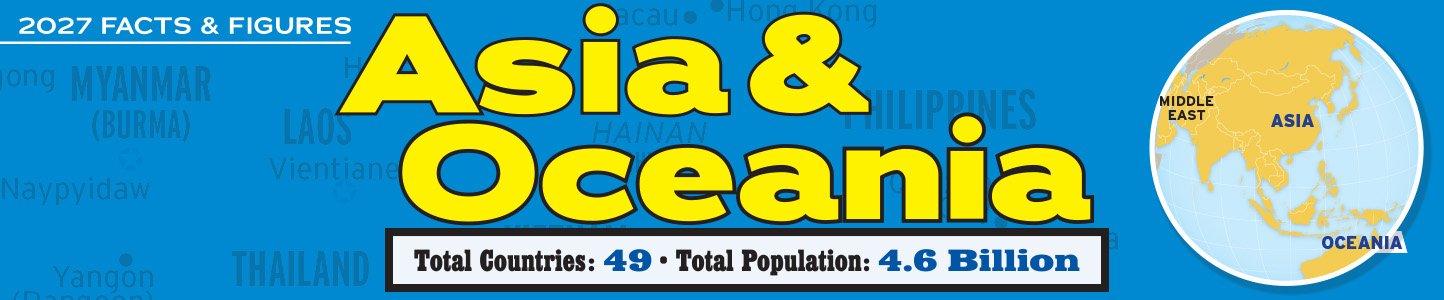

A map shows Asia and Oceania with 49 total countries and a population of 4.6 billion

ASIA & OCEANIA: TOTAL COUNTRIES: 49 | TOTAL POPULATION: 4.6 billion Jim McMahon (map)

Standards

2027 Facts & Figures: ASIA & OCEANIA

JIJI PRESS/AFP via Getty Images

A FIRST FOR JAPAN

In 2025, Sanae Takaichi (above) shattered a political barrier, becoming the first woman to lead JAPAN as prime minister. At 65, Takaichi appealed to younger voters by quoting manga, praising her favorite Japanese rock band, B’z, and speaking candidly about everyday pressures, from rising prices to the stress of being in the public eye.

SOURCE: THE NEW YORK TIMES

Nicky Loh/Bloomberg via Getty Images

INSECTS ON THE MENU

SINGAPORE has approved 16 species of insects for human consumption, including several types of crickets (above), mealworms, moths, and honeybees. While insect consumption is widespread across much of Southeast Asia, Singapore previously had no formal framework for permitting the sale of insects for food. The move is part of a broader effort to reduce Singapore’s reliance on imports, which now account for more than 90 percent of its food.

SOURCE: SMITHSONIAN

NAMGYAL SHERPA/AFP via Getty Images

Mount Everest is littered with trash left behind by mountain climbers.

MOUNTAIN OF GARBAGE

NEPAL is scrapping its failed plan to clean up Mount Everest. The 11-year-old program aimed to tackle an estimated 55 tons of trash on the world’s highest peak. Climbers had to pay a $4,000 deposit, refunded only if they brought down 18 pounds of waste on their descent. However, climbers typically brought back garbage from lower camps—not from the higher elevations, where the problem is worse. With climbers each producing up to 26 pounds of waste during their expeditions and trash still piling up, officials say the program “failed to show tangible results.”

SOURCE: BBC

Adhi Agus Oktaviana/Cover Images via AP Images

Handprints on a cave wall in Indonesia

OLDEST CAVE ART

Archaeologists in INDONESIA recently discovered the world’s oldest-known cave art—handprints stenciled on limestone about 68,000 years ago. Artists made the prints by pressing hands on cave walls and blowing pigment over them. Researchers found the prints hidden beneath more recent cave wall paintings on Indonesia’s Muna Island.

SOURCE: AL JAZEERA

videos (2)
videos (2)
Skills Sheets (5)
Skills Sheets (5)
Skills Sheets (5)
Skills Sheets (5)
Skills Sheets (5)
Lesson Plan (1)
Text-to-Speech