

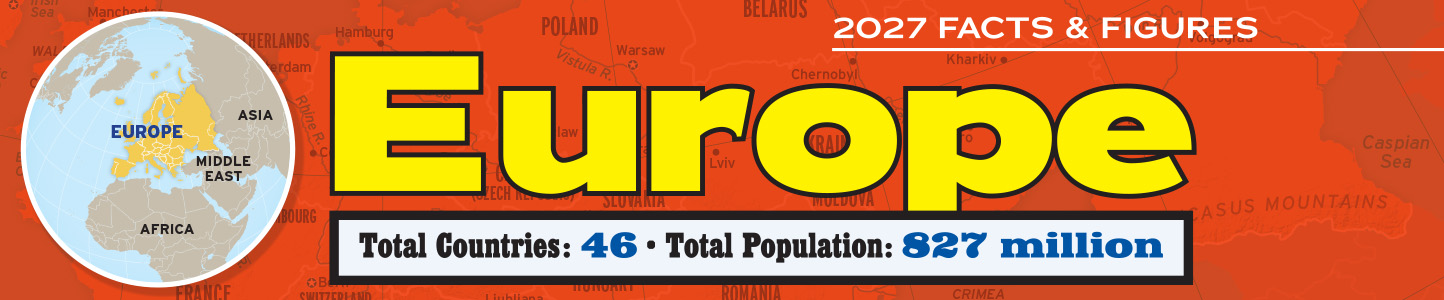

A banner shows Europe 2027 Facts and Figures, with 46 countries and a population of 827 million

EUROPE: TOTAL COUNTRIES: 46 | TOTAL POPULATION: 827 million  Jim McMahon (map)

Standards

2027 Facts & Figures: Europe

Shutterstock.com

A 12th-century castle in the town of Balzers, Liechtenstein

NO OCEAN? NO PROBLEM.

LIECHTENSTEIN is one of only two countries in the world (along with Uzbekistan) that is “doubly landlocked.” That means people there must cross the borders of at least two other nations before reaching the sea. Liechtenstein also has no airport. For many countries, being landlocked has often meant economic struggle, yet Liechtenstein is one of the world’s wealthiest nations—thanks largely to a low business tax rate that attracts investment, robust manufacturing and financial sectors, and a long history of political stability.

Source: Britannica

Christophe Michel/Abaca/Sipa USA via AP Images

A climate protester in Paris calls out plastic usage.

FOREVER FREE

FRANCE has enacted one of the strictest bans on PFAS, a group of synthetic chemicals often called “forever chemicals” because they resist breaking down in the environment and the human body. Found in hundreds of everyday products like cosmetics, waterproof clothing, and plastic food packaging, PFAS have been detected globally in soil, groundwater, and human blood and tissue. The French ban prohibits the production, importing, or sale of products containing PFAS when safer alternatives are available.

Source: EURONEWS

© Xinhua via ZUMA Wire

Voters in Estonia cast their ballots online using their eID cards.

DIGITAL NATION

ESTONIA is often called the world’s most digital country. Nearly 99 percent of Estonians use a state-issued digital ID, known as eID, to pay bills, sign contracts, access health records, and even vote online from anywhere in the world. Estonia’s largely paperless bureaucracy, officials say, is the result of decades of investment in tech infrastructure—and a national push to reinvent itself as a leader of the digital age. 

Source: Unesco Courier

Prasit photo/Getty Images

SPAIN’S GIANT

SPAIN boasts the world’s tallest church, Sagrada Familia (above) in Barcelona. The unfinished basilica—under construction since 1882—now stands 566 feet tall, surpassing Germany’s Ulm Minster, which held the record for more than a century. Although construction continues, much of the interior is already open to visitors, and Mass is held there every Sunday. The entire building is estimated to be completed in 2034. 

Source: BBC

videos (2)
videos (2)
Skills Sheets (4)
Skills Sheets (4)
Skills Sheets (4)
Skills Sheets (4)
Lesson Plan (1)
Text-to-Speech