

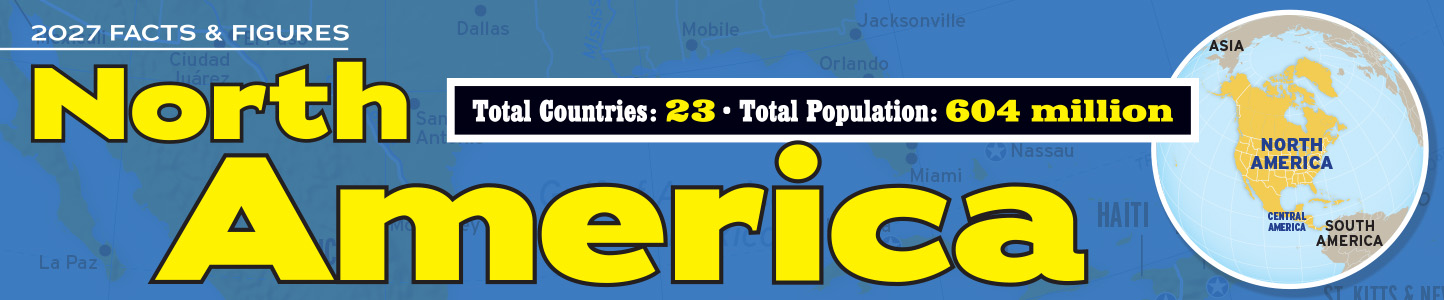

A banner shows 2027 Facts and Figures for North America, with 23 countries and a population of 604 million

NORTH AMERICA: TOTAL COUNTRIES: 23 | TOTAL POPULATION: 604 million Jim McMahon (map)

Standards

2027 Facts & Figures: NORTH AMERICA

florin1961 (Florin Cnejevici)/Alamy Stock Photo

Shops in Santo Domingo, Dominican Republic, with signs in Spanish

TALK TO ME

Hispaniola is the only island in the Western Hemisphere shared by two nations with different primary languages. In HAITI, on the western part of the island, people speak French and Haitian Creole. The Spanish-speaking DOMINICAN REPUBLIC lies to the east. The differences reflect history: Spain colonized Hispaniola beginning in the 15th century but later ceded the western portion of the island to France.

SOURCE: BRITANNICA

©Erich Schlegel/ZUMA Press Wire

Monarch butterflies in Mexico

BUTTERFLY JOURNEY

Each year, millions of monarch butterflies make a multigenerational journey of up to 3,000 miles, traveling from CANADA and the UNITED STATES to escape the cold winter. The eastern population winters in the high mountains of central MEXICO, clustering on fir trees, whose branches, along with the moist climate, help the butterflies survive the cold. The western population migrates to coastal California. In spring, successive generations head north, feeding on milkweed along the way, to start the process all over again.

SOURCE: NATIONAL GEOGRAPHIC

LUIS ACOSTA/AFP via Getty Images

ANCIENT BALLGAME

In BELIZE, descendants of the ancient Maya are reviving pok-ta-pok (above)—one of the world’s oldest-known team sports, dating back thousands of years. In a game that bears similarities to soccer and basketball, players strike a rubber ball with hips, elbows, or knees—no hands or feet allowed. Pok-ta-pok was nearly lost during Spanish colonization of Belize in the 16th century, but now a growing movement is pushing to make it Belize’s national sport. For Maya descendants, the revival is about reclaiming a piece of their cultural identity.

SOURCE: SMITHSONIAN

iStockPhoto/Getty Images

Volcán Fuego in Guatemala is one of Central America’s most active volcanoes.

VOLCANO NATION

GUATEMALA sits atop one of the most active stretches of the Pacific “Ring of Fire.” It’s a horseshoe-shaped zone where many of the world’s earthquakes and volcanic eruptions occur. More than 30 volcanoes dot Guatemala’s landscape, three of which are considered active. Santiaguito is experiencing one of the longest ongoing eruptions on Earth, dating back to 1922. The area is geologically active because of its position at the convergence of several tectonic plates in Earth’s crust that continually shift and collide.

SOURCE: NATIONAL GEOGRAPHIC

videos (2)
videos (2)
Skills Sheets (4)
Skills Sheets (4)
Skills Sheets (4)
Skills Sheets (4)
Lesson Plan (1)
Text-to-Speech