

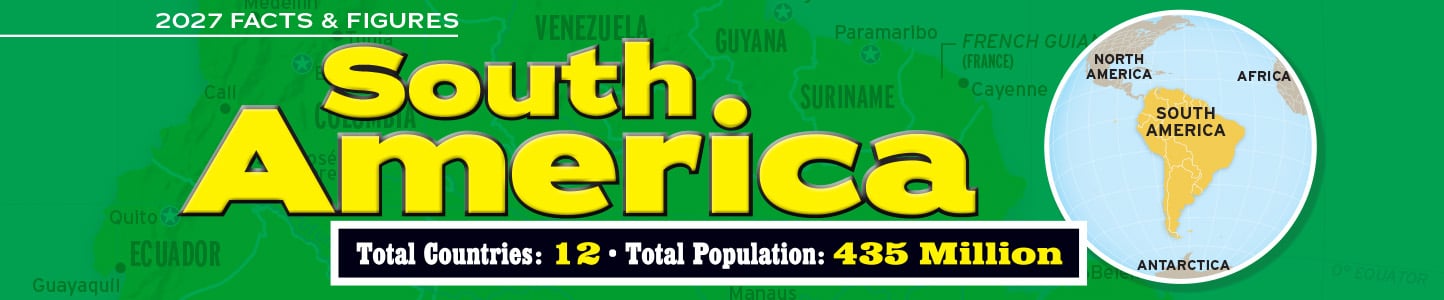

A map shows South America with 12 countries and a total population of 435 million

SOUTH AMERICA: TOTAL COUNTRIES: 12 | TOTAL POPULATION: 435 million Jim McMahon (map)

Standards

2027 Facts & Figures: SOUTH AMERICA

An Indigenous family in the Amazon rainforest

PROTECTING THE AMAZON

COLOMBIA has banned all new oil drilling and large-scale mining projects in its portion of the Amazon rainforest. The policy designates the Amazon, which covers 42 percent of Colombia, as a reserve for renewable natural resources. Home to roughly 10 percent of all species on Earth, the Amazon plays a critical role in regulating the global climate. As acting Environment Minister Irene Vélez Torres put it: “This declaration is an ethical and scientific commitment—to prevent forest degradation, river contamination, and biodiversity loss that threatens the continent’s climate balance.”

SOURCE: MONGABAY

ERNESTO BENAVIDES/AFP via Getty Images

A marine iguana at Santa Cruz Island, part of the Galápagos archipelago

DARWIN’S LABORATORY

The Galápagos Islands, a province of ECUADOR, provided the inspiration for Charles Darwin’s theory of evolution. On the islands, the British naturalist saw animals found nowhere else on Earth, including types of finches, giant tortoises, and marine iguanas. Noticing how species varied from island to island, he had a bold idea: Species aren’t fixed but change over time through a process called natural selection. His discoveries led to the groundbreaking 1859 book On the Origin of Species, which changed how we understand life on Earth.

SOURCE: SMITHSONIAN

Shutterstock.com

Machu Picchu has been designated a UNESCO World Heritage site.

A MIGHTY INCA CITY

Built around 1450 in the Andes Mountains of PERU, Machu Picchu is a testament to the engineering prowess of the Inca Empire. The citadel, which covers around 25 acres, features more than 3,000 stone steps and has walls built without mortar—yet they’re designed to withstand earthquakes. Historians believe Machu Picchu served as a royal estate or sacred site for Inca leaders before Spanish invaders conquered the civilization in the 16th century. For hundreds of years, the abandoned citadel was a secret known only to local peasants—until its rediscovery by the outside world in 1911.

SOURCE: HISTORY.COM

Gabriel Lio

DINOSAUR DISCOVERY

In 2026, paleontologists in ARGENTINA identified a new herbivore dinosaur species named Yeneen houssayi (above). Measuring up to 39 feet long—about the length of a bus—the Yeneen lived around 83 million years ago. The long-necked dinosaur is classified as a sauropod, making it a distant relative of more well-known species like the Brontosaurus.

SOURCE: SCI NEWS

videos (2)
videos (2)
Skills Sheets (4)
Skills Sheets (4)
Skills Sheets (4)
Skills Sheets (4)
Lesson Plan (1)
Text-to-Speech